Sanctuary for The Soul

An extension of a new home for the Trinity Methodist Church Petaling Jaya
Text by the architects
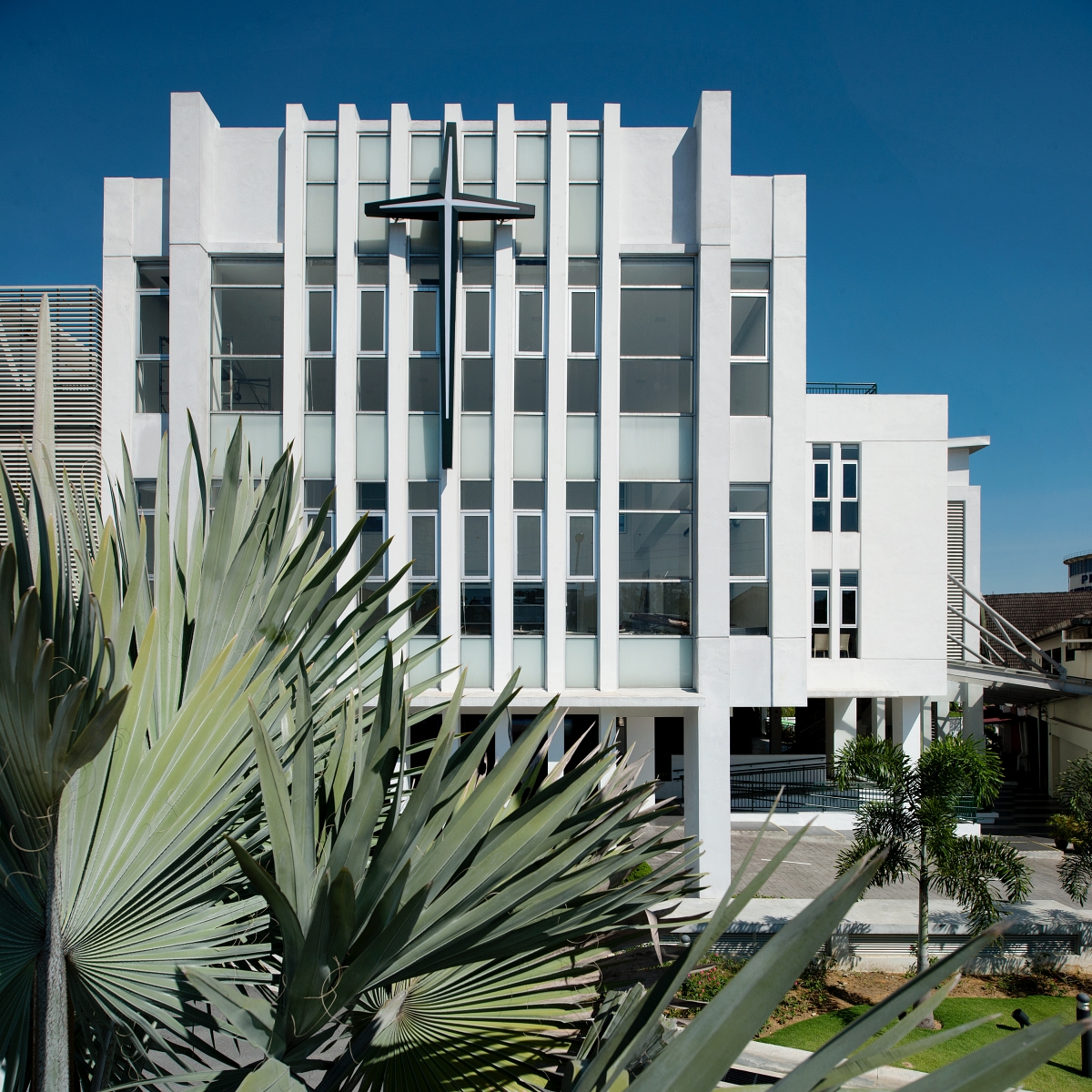
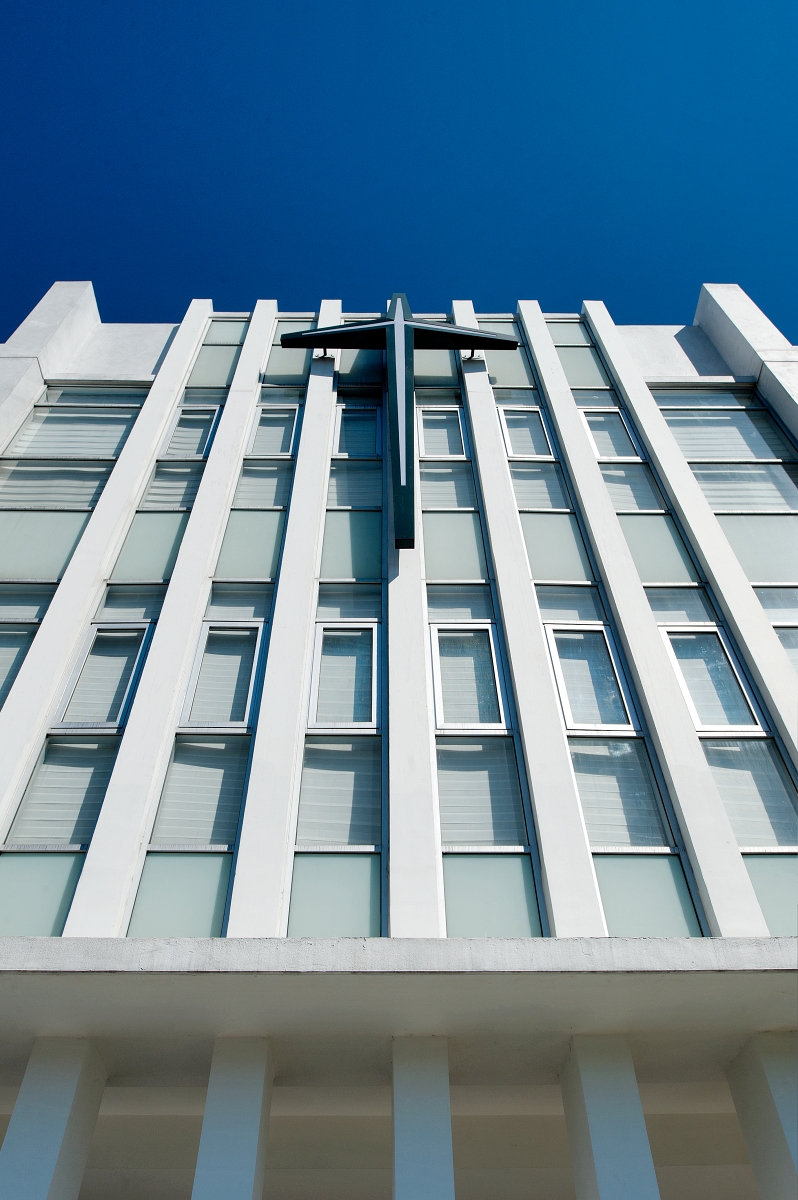
7 vertical fins at fore front symbolize completeness
The brief called for a building to house a new Sanctuary with 900-seating capacity, a 10-classroom kindergarten of 200 students, 8 meeting rooms, an indoor car park and related facilities for Trinity Methodist Church Petaling Jaya owned by The Secretary of Trustee of The Methodist Church in Malaysia.
The land size is approximately 4,400sqm with 40m wide by 110m long boundary on part of Lot No. 89 which covers an area of 2.09 acres in Section 5, Petaling Jaya fronting Jalan 5/37.Existing single-storey kindergarten classrooms and 3-storey classroom blocks built in 1979 were demolished to make way for the new development due to an increase in church membership.
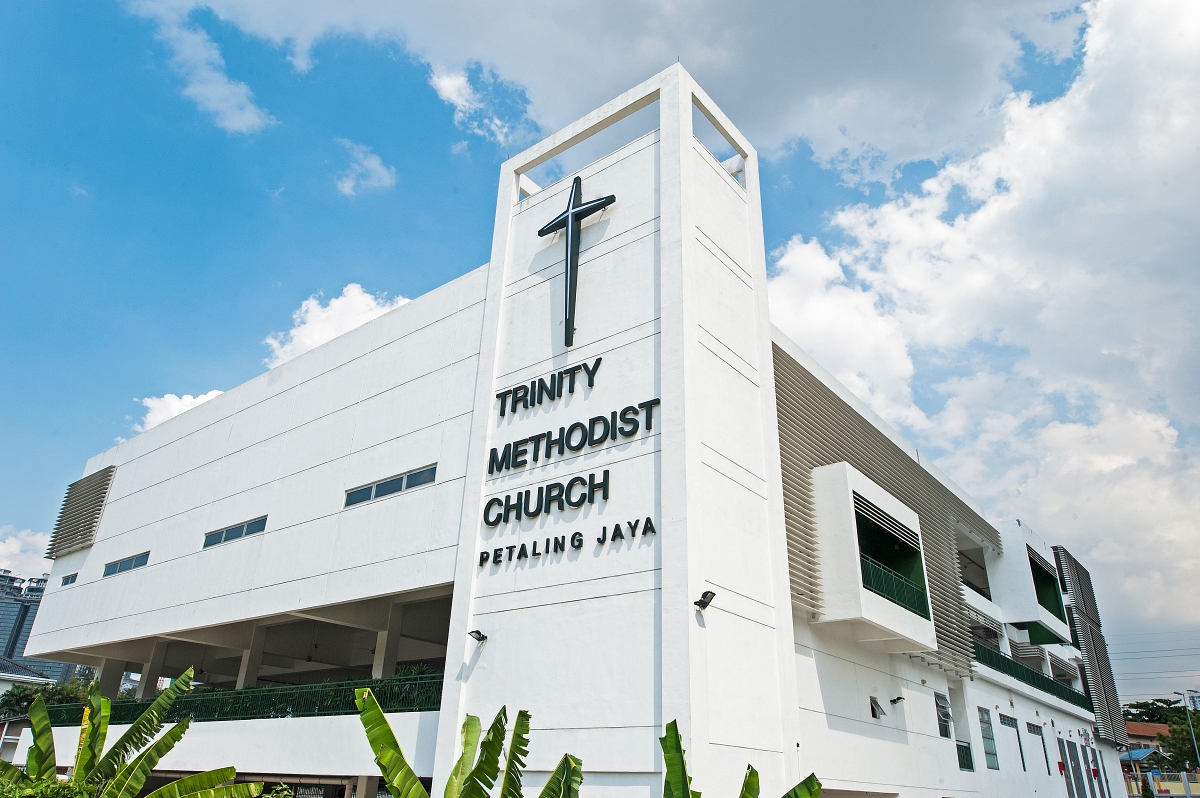
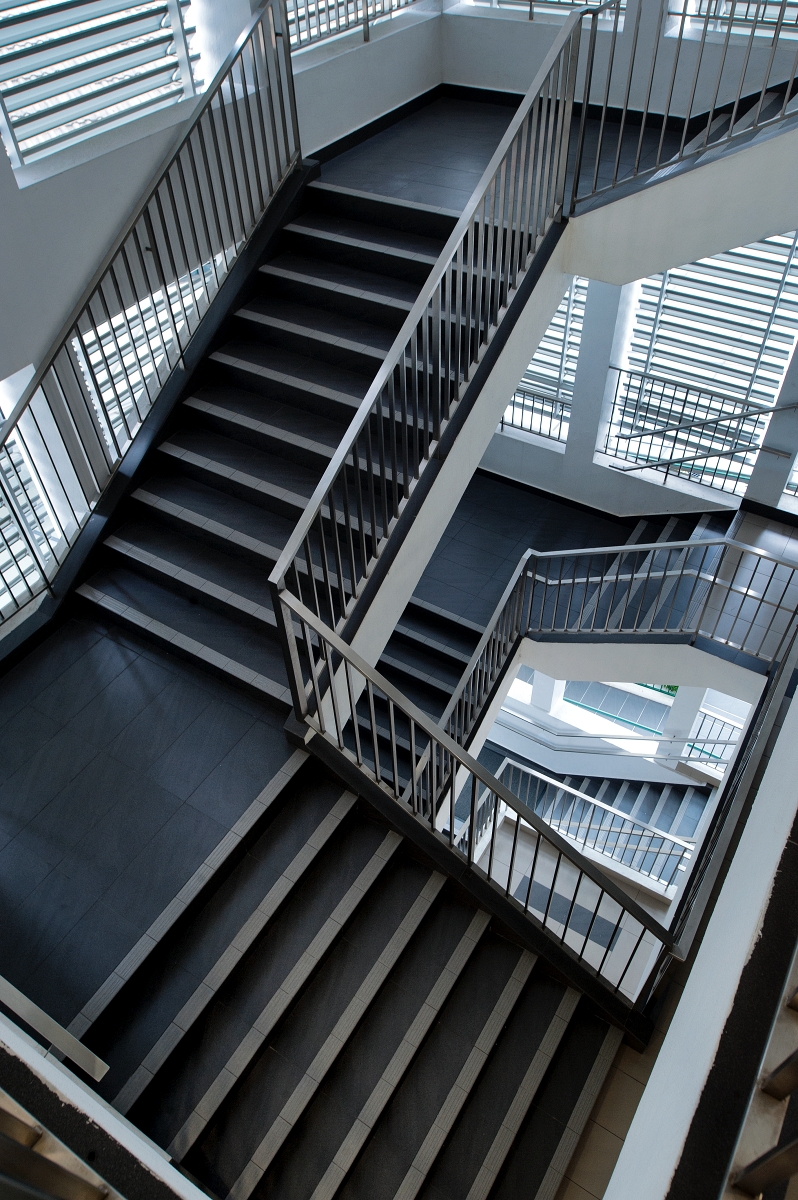
Fire escape staircase act as bell tower with exposed structure frames for future installation of church bell

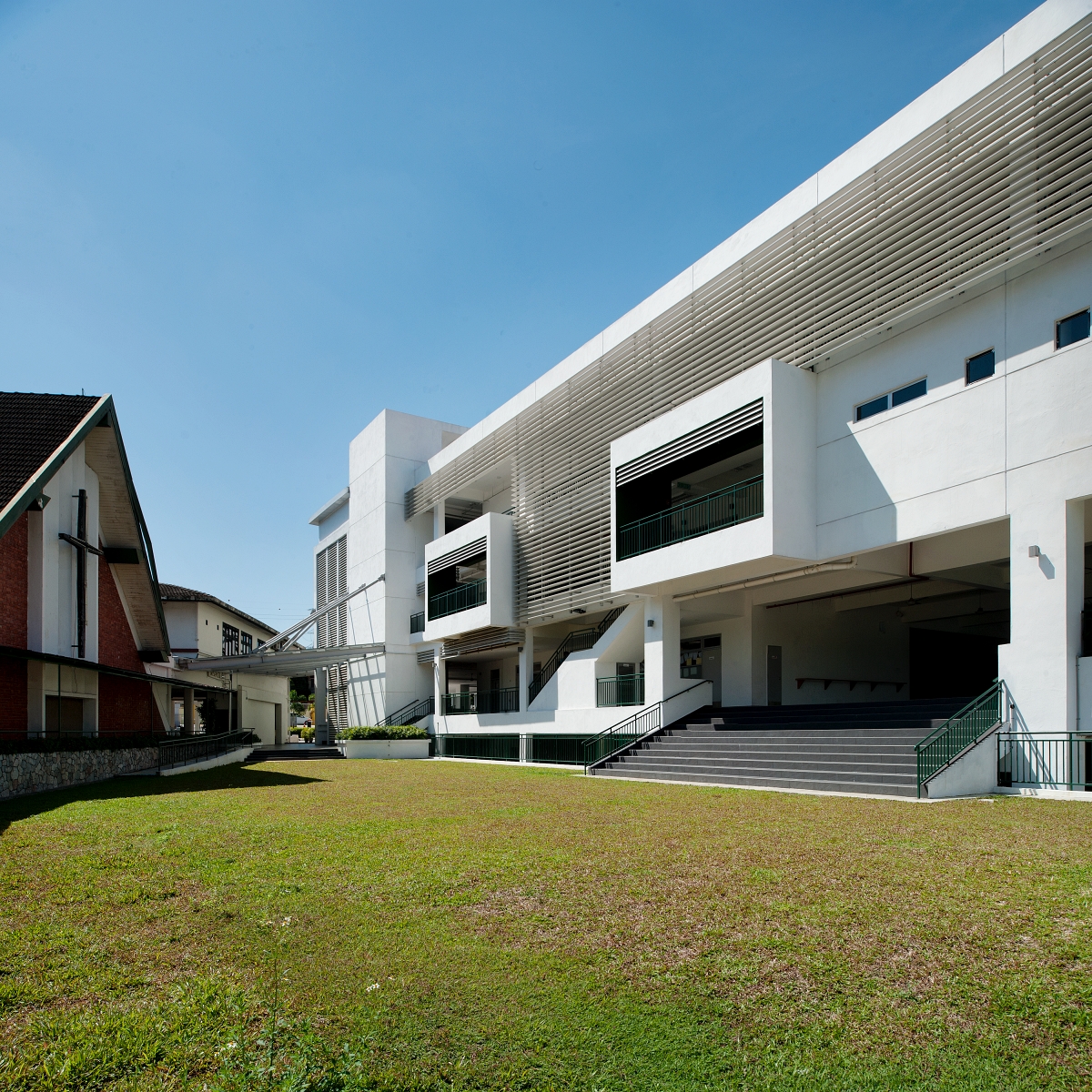
The new building is surrounded by existing buildings on the East side that consist of an A-frame sanctuary building, a 2-storey office building with an open foyer on the Ground Floor, and the remaining three sides are boundary fenced facing Jalan 5/37, EPF office building, and the Federal Highway.

Contour difference of approximately 10’ in North-South direction towards Federal Highway with lower land adjacent to the highway.The heavy traffic of the highway produces noise pollution which has to be dealt with in the design.The local council, MBPJ, also imposed a 3-storey height limit due to its proximity to a residential area.

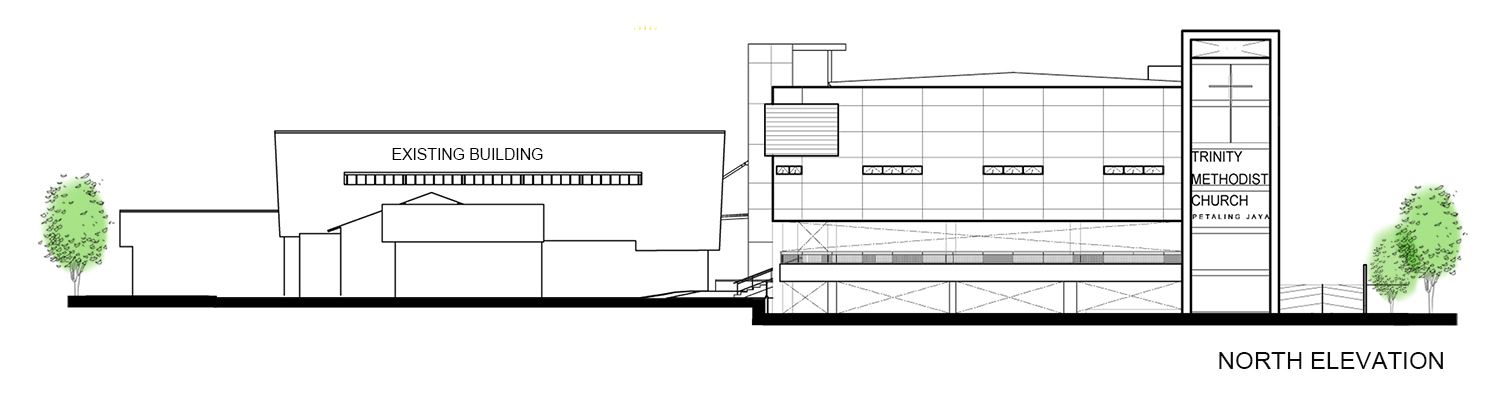
The existing sanctuary built in 1963 was oriented towards the East-West direction, which is approximately 30 degrees to the front boundary.Initially, we tried to align the new building in the same direction and with a similar building form but it was later found impossible to fit all the programs within the given constraints.Hence, the new building is placed parallel to the west boundary line to maximise the footprint.
North elevation

The original proposal was an asymmetrical layout with common facilities placed on the west side so that the building will have more open space towards the existing building to create a dialogue between new and old architecture.However, it was later changed to what it is now to fulfil the client’s wish of a classical symmetrical church layout with a centre axis, similar to the existing sanctuary.

Taking advantage of the contour of the land, the sunken Lower Ground Floor is used as a car park and is designed with openings on three sides and an air shaft on the South side for maximum cross ventilation and daylight.

The building footprint of the First Floor is extended over the porte-cochere on Ground Floor to create a spacious covered area protecting guests from rain and sunlight during dropoff and pick-up.

A podium garden is designed above the car park and below the sanctuary to provide a multi-purpose open space to cater for many different types of activities for kindergarten and church.The podium has a full view of the highway and is directly linked to a field with a 10m wide stairway, which doubles up as seating with a direct view of the field.

Clear spatial planning with M&E services grouped to the west side of the building to free up areas for rooms and open corridor.The open Main Staircase is made visible from the Foyer, and all 5 sets of staircases are expressed on the external to give a clear indication of vertical circulation.

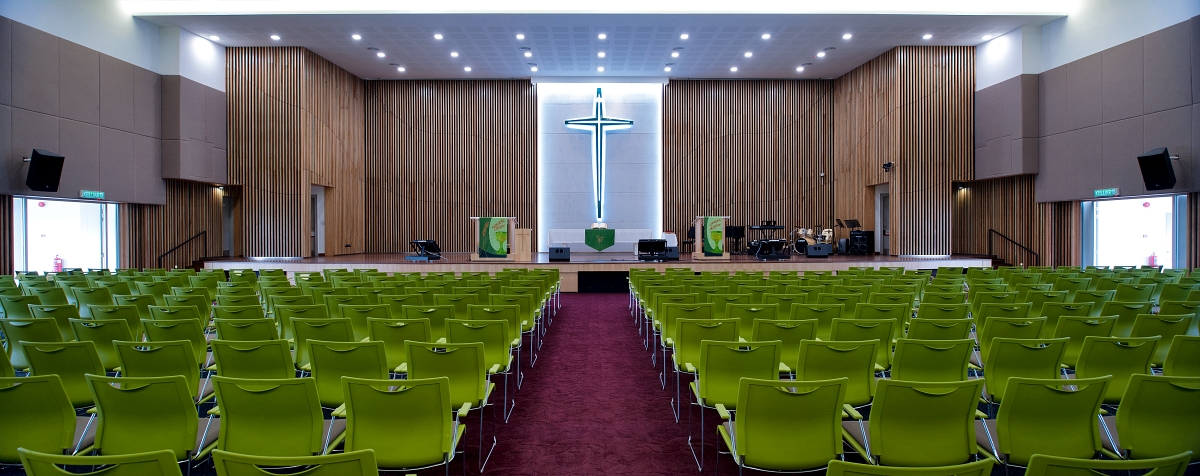
Internal wall cladded with solid semangkok timber strips for acoustic quality

The new and old buildings are connected via an open Plaza covered with a glass canopy to link activities at the new and old Foyers.The green colour of the church logo is used on the metal elements of the new building similar to the old building such as the metal handrails and feature wall of the protruded balconies.

The internal walls of the sanctuary are clad with solid Semangkok timber strips stained with Low-VOC natural wood stain for aesthetic and most importantly for its acoustic quality, similar to the old sanctuary which also uses timber for the wall treatment.

Keeping simplicity as an overriding characteristic using clean lines and distinct geometry.
The building is a contemporary approach to an institutional building with a tropical architecture design.Biblical numerology is used in the architectural design for its symbolic value in biblical texts, such as:

• 7 vertical fins at the forefront of the building set on the centre axis symbolising completeness.
• 12 vertical slots of windows on the left and right of the front façade represent the 12 disciples of Jesus. Similarly, the 12 columns along four walls of the Sanctuary.
• 3 vertical light slots at the Main Entrance door portal of the Sanctuary Hall represent the Trinity: Father, the Son and the Holy Spirit.
• 10 rows of ceiling cove-lights represent the 10 Commandments from God

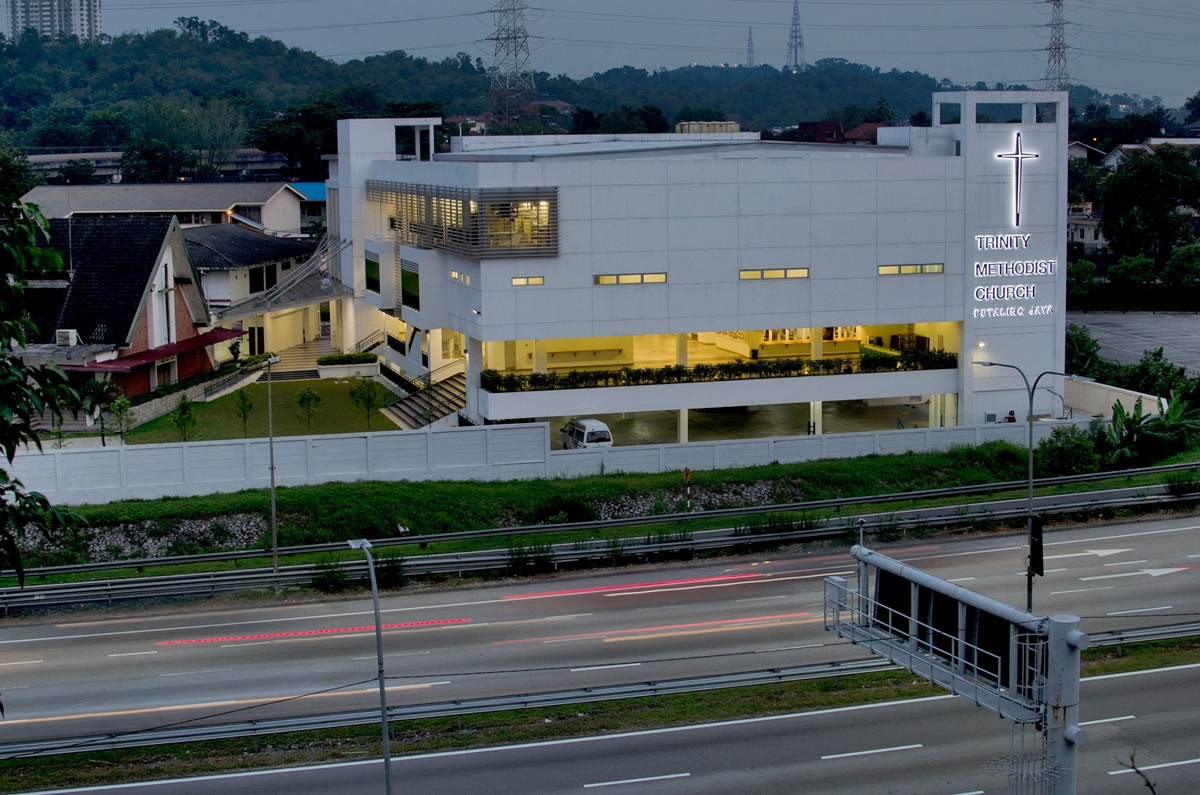
The bell tower facing the highway was designed with proportion based on Golden Ratio in Geometry, which is found throughout nature as The Divine Proportion.

Podium garden above carpark act as multipurpose open space

The biggest and main component of the building, the Sanctuary, is expressed on the building façade by being placed on the First Floor and floating over the Podium when viewed from the highway.The exposed supporting columns below the sanctuary are recessed from the external wall for the sanctuary to cast a deeper shadow.The open space Podium below the sanctuary has a 4m high ceiling for multi-purpose usage.

The structural design is a conventional Post & Beam system and the sanctuary’s balcony seating on Second Floor used Post-Tension Structure System to achieve maximum seating area with a “column-less” Sanctuary.

The fire escape staircase located at the northwest corner of the building is purposely protruded outwards from the building to express as a bell tower of the church with exposed structural frames on the rooftop for future installation of a church bell.

Open Main Staircase easy access from Foyer

Window openings are provided not only to provide view and natural lighting but also to express internal spatial arrangement, such as high vertical windows for Library on First Floor expressing the double-storey height ceiling.Minimal narrow horizontal window slots for the Backstage on First Floor minimise noise penetration from the highway.

The linearity of the space is emphasised through the use of horizontal groove lines, window panels, Colorbond louvres, and Colorbond sunscreens.

Horizontal sunscreens made of Colorbond Zincalume in the size of 50×200mm placed at intervals of 100mm are installed on the external walls facing east and west sun to cut radiation, heat gain and glare.The passive design was strategised with cross-ventilation design, maximum daylight and rainwater harvesting system, and both metal and concrete roofs are thermal-insulated.Other small but significant green building implementations include the use of energy-saving light fittings as well as water-saving sanitary fittings.The soft landscape also serve to keep the areas cool.
Close-up of fore front showing vertical fins and clear window panels
Aerial night view showing bell tower facing highway with proportion based on Golden Ratio in Geometry

FEATURES

RELATED ARTICLES