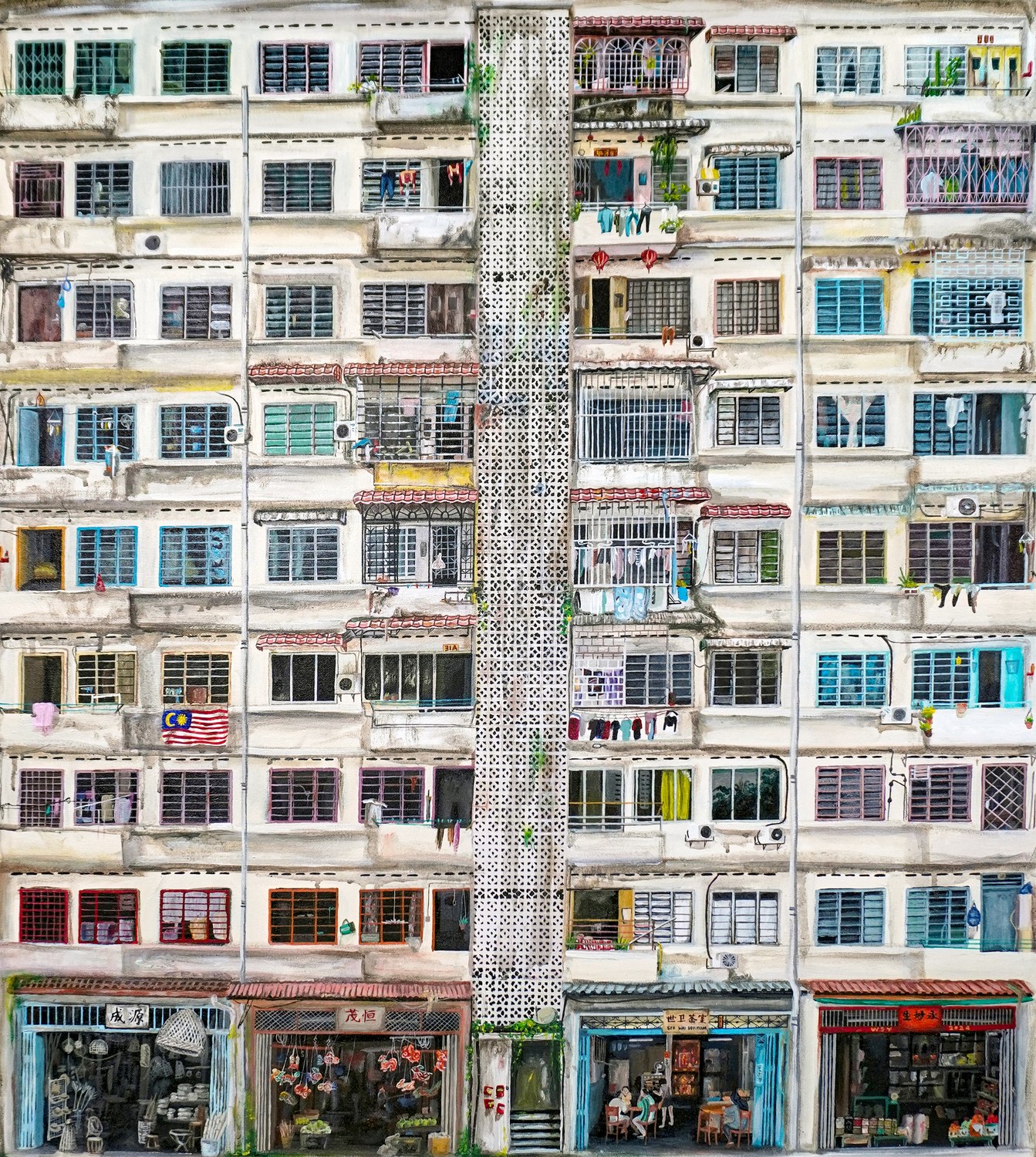
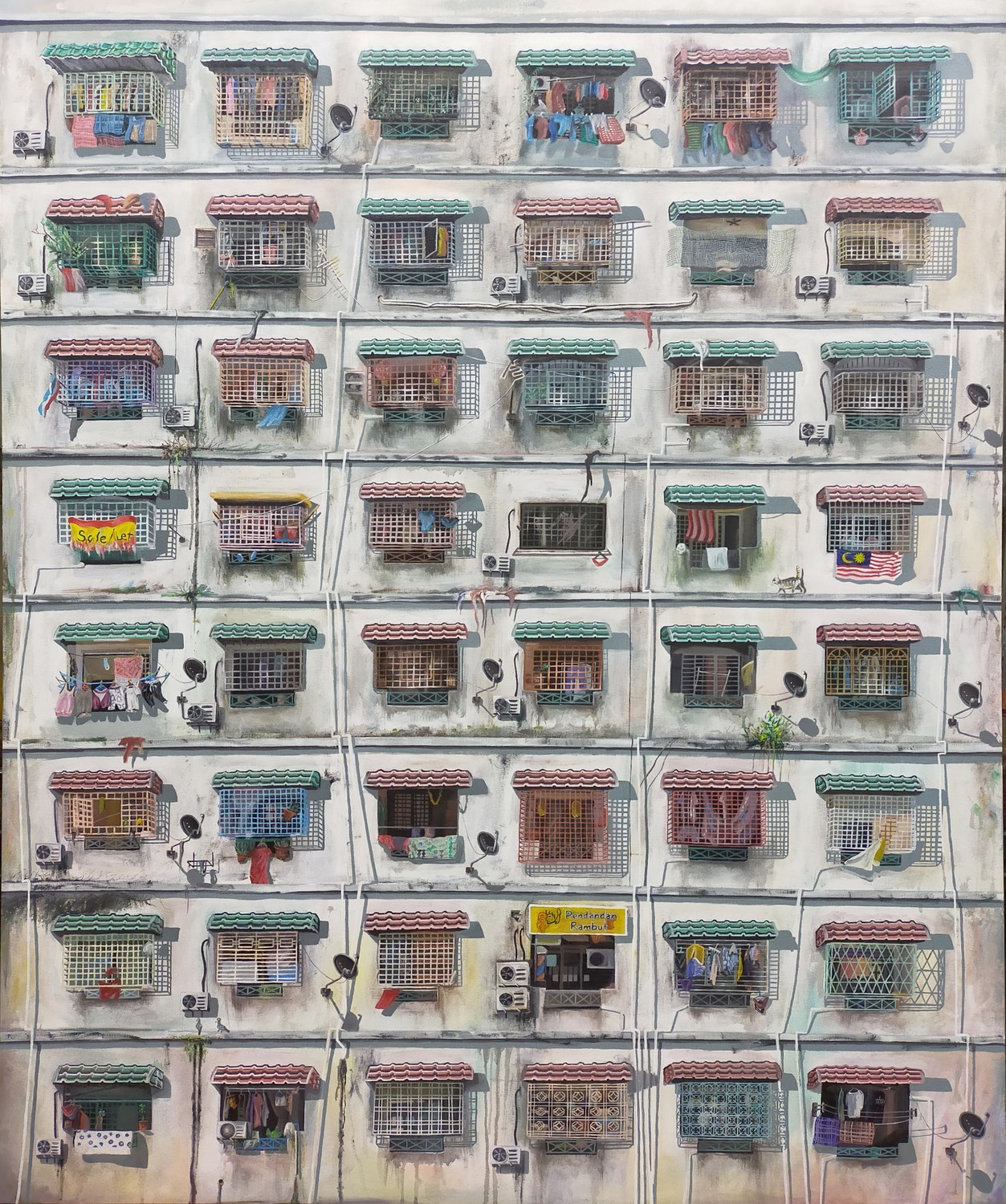
In a visual culture saturated with glossy interior spreads and cutting-edge ecological builds, Malaysian painter Wong Sze Yoong chooses to express the simple architecture of his personal life. Born and raised in Kepong, he grew up in the old flats, where traces of human life formed an everyday sight. During the epidemic lockdown in 2020, he turned to his surroundings for inspiration. What followed was an award-winning journey of painting.
ART IMMITATES ARCHITECTURE
Plato famously declared that ‘art imitates life’. Giorgio Vasari, in his book Lives of the Most Excellent Painters, Sculpts, and Architects, echoed the sentiment, stating that “painting is just the imitation of all the living things of nature with their colours and designs just as they are in nature.” Yet, the most compelling artists don’t merely hold up a mirror to the world. Instead, they reframe reality, revealing a truth that we don’t often examine.
“I had been living in the old flats since I was seven years old, yet I had never truly observed them. During that quiet period, I began to notice the grilles, the textures of the walls, the atmosphere, and the subtle emotions embedded in the space.”
This was the position Wong found himself in during the Movement Control Order (MCO). Being restricted at home allowed him to look at his surroundings differently. He turned to acrylic paint and began creating. He noticed the drain water stains, the dark windows, and the hanging laundry. It took 24 days, but ‘Behind the Grille’, spanning a 150cm x 180 cm canvas, became a snapshot of a young man trying to figure out the world around him. It won the Gold Award in the Emerging Artist Category at the UOB Painting of the Year 2020.
It was evident in the story behind his submitted work: Here, he sees his home. Here, he sees a community staying home in solidarity – to flatten the curve and regain a world free from Covid-19. The greater comfort comes from knowing that he is not a lone soldier but part of an army fighting in solidarity. Wong poured his thoughts onto canvas, asking questions about life’s uncertainty amidst community unity at the time. Architecture to him wasn’t just a place to be held in; it became a source of inspiration and contemplation. Where normal people would see confinement and worn-out spaces, he found a sense of purpose and identity.
FIRST STROKES
Wong’s artistic path began at age 7, when his aunt brought him to her art centre. That small step into the world of creativity carried him to his tertiary education, where he graduated from Universiti Sains Malaysia (USM) in 2019 with a Bachelor of Fine Arts, before pursuing a Master’s Degree in Visual Arts at Universiti Malaya, which he will complete in 2026.
At university, he emphasised how art taught him strong fundamentals, not only in technical skills, but also in theory and critical thinking. It was a process of training maturity. Beyond the curriculum, he also had to be aware of discipline, time management, and social skills, lessons that were equally important to be a successful working artist.
“If you want to become a full-time artist, without seriousness and commitment, it is very difficult to sustain yourself in the art journey.”
PROCESS TO PURPOSE
Since 2020, Wong has created several paintings in the ‘old flats’ series, primarily in acrylic. The fast-drying time allows him to build layers efficiently. A single painting can take anywhere from one week to six months to complete, depending on its complexity, as each work requires painstaking attention to intricate architectural details.
When not behind a canvas, Wong is on the go for inspiration. He will take notes and document locations around Klang Valley, often revisiting sites for sketches and photos, at times referring to Google Maps. While the architecture in his art is based on real locations, he often adds imaginary figures to create a more lively and emotionally resonant environment.
At first glance, Wong’s painted works seem almost a photographic reproduction of a flat facade. It’s a generic vista one would glance at in passing. It’s only when you step closer and look deeper that you begin to notice the delicate brushstrokes hinting at the multitudes of stories. Working layer by layer, Wong constructs his paintings slowly, letting weathered walls, stained windows, and rusty grilles reveal themselves, turning overlooked spaces into familiar, Malaysian scenes.
“When I started painting the flats, something shifted. Through the brushstrokes, the tiny details, and the use of colour, I felt I was uncovering emotions that had been there all along. I realised that these old flats carry a quiet aesthetic and cultural value that we often overlook in our daily lives. That realisation made me certain that this was the subject I wanted to continue exploring.”

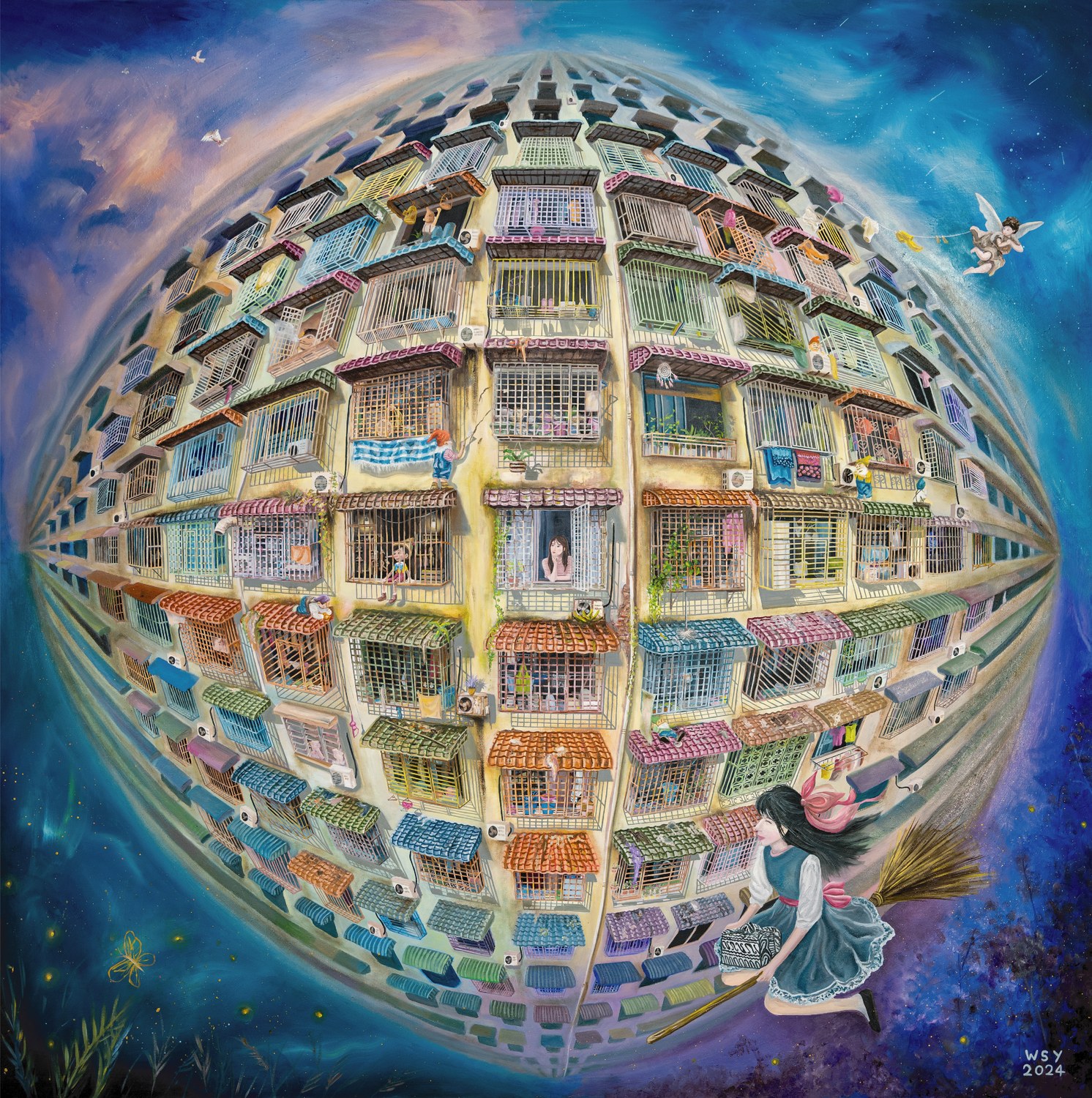
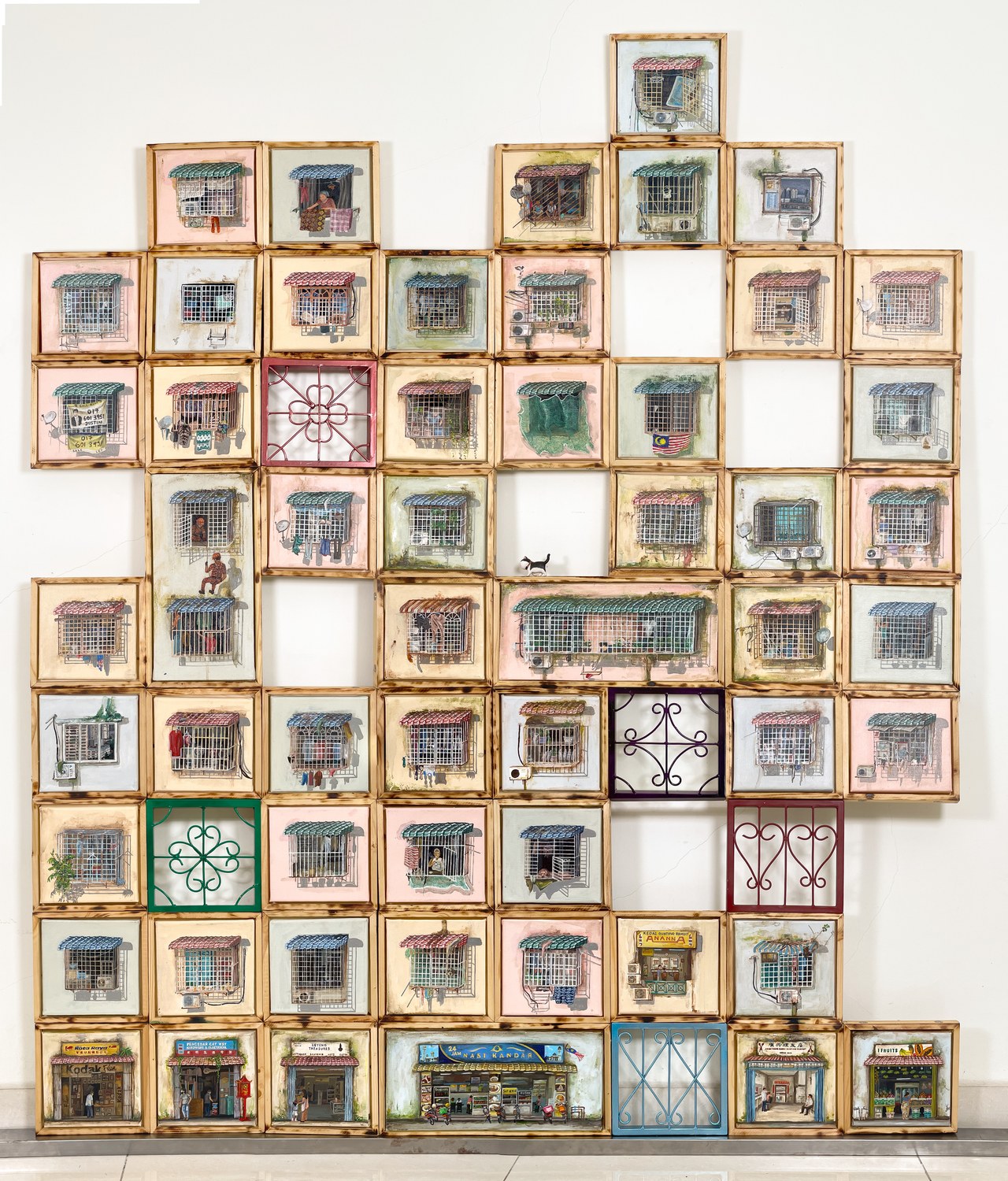
CANVAS OF CHANGE
The old flats are a product of a rapidly expanding urban population during the post-independence era of the 1950s- 70s. The first highrise flats were government-initiated projects, designed with function over form and built with simple materials like concrete. As Kuala Lumpur expanded, Kepong gradually transformed from a rural area into a thriving township. Landed homes, shophouses, and later lowand medium-cost flats were built to accommodate its growing working-class population.
For Wong, the old flats hold much more charm than modern highrises. He prefers lived-in history to the clean appearances of contemporary buildings. New highrise developments offer a more modern and organised environment. Designed with better facilities, security, and infrastructure, they help shape a more structured lifestyle and influence behaviour through planned spaces. While they reflect globalisation and urban living, they sometimes lack a strong sense of local identity. Additionally, he opined that despite living in the same building, people may feel like strangers. In contrast, ageing Malaysian flats carry a distinct visual language and sense of community.
“They may appear messy or chaotic at first glance, but to me, they are full of character and authenticity.”
What draws Wong most is not merely the architecture, but the human traces embedded within it. The hanging objects, the colours, the modifications made by residentsthese details reflect Malaysia’s multicultural and multiracial community living together in one shared space, which to him represents the ‘Malaysian soul’. “The visual diversity becomes a metaphor for harmony. They are more lively, nostalgic, and socially connected.”
One could argue that in the old flats, the lack of enforcement by building management has allowed adjacent neighbours to expand their territory, creating third spaces and personal enclaves. These unsupervised places sprout in shared corridors, stairwells, and balconies, often exposing their daily activities. The unregulated ownership of communal areas becomes an extension of the neighbourhood personality, keeping various neighbours socially connected. Having grown up in these spaces, Wong acknowledges that with the decline and demolition of these old flats, future generations may not have the chance to experience that kind of communal social living as cities continue to modernise.
To be an artist is also, in part, to romanticise. Various studies on low-cost flats and public housing in Malaysia show that they experience higher rates of property crime and vandalism due to high population density, lower security specifications, and maintenance challenges. Wong stated that he has experienced both good and difficult sides of this environment. However, he chooses to highlight instead the quiet resilience, humanity, and dignity that persist despite challenges.
“My paintings are like mirrors; they speak differently to each audience. Some may see childhood memories, others may feel nostalgia, comfort, or even a sense of longing.”
PAINTING HISTORY
For Wong, his practice is both archival and interpretive. While they are created through careful observation and detailed rendering, he intentionally embeds subtle emotional elements and narratives.
“The scenes may look realistic, but they are filtered through my memory, perspective, and personal message. I am not only recording what is physically there; I am inter preting what the space means.”
“It is not just about architecture, but about memory, identity, culture and how we choose to remember our built environment.”