INTRODUCTION
Kota Kemuning, Shah Alam is an impeccably designed primary urban area situated within the Klang district of Selangor. After 23 years since its establishment in 1994, the township lacked a nearby local mosque.
In response to the exigency, Jabatan Agama Islam Selangor has enlisted the services of Jabatan Kerja Raya, Negeri Selangor to develop a 5-acre parcel of land reserved for public use that is strategically located adjacent to the Kota Kemuning Lakeside Park. ATSA Architects Sdn Bhd was entrusted with the task of designing a mosque in Kota Kemuning, in line with the principles of a Green Sustainable City.
CONCEPT AND THEME
The mosque, characterised by its contemporary design, was envisioned to emanate an atmosphere of openness, achieved through ample natural lighting. The rectangular shape of the footprint has been designed to effectively accommodate all essential elements required for prayer. The modern design aimed to free itself from traditional characteristics commonly found in a typical mosque, such as ornate adornments, repetitive arches, intricate minarets and a recognisable yet non-functional dome.
The recurring theme of the mosque centres around the term ‘Kemuning’, which phonetically resembles ‘Kuning’ denoting the colour yellow. Hence, yellow and gold are used exclusively on the roofs and dome, as well as prominently featured in the interior design. The surrounding landscape similarly adheres to this scheme by incorporating trees and plants with yellow leaves and flowers.
FACTS AND FIGURES
The overall floor space of the building amounts to 44,653 sqft. At maximum capacity, the mosque can accommodate up to 3,978 worshippers. The Main Prayer Hall at 5,810 sqft alone can hold 726 individuals, while the overspill area on the ground floor has a capacity of 2,210 and an additional 1,042 are available on the first floor.
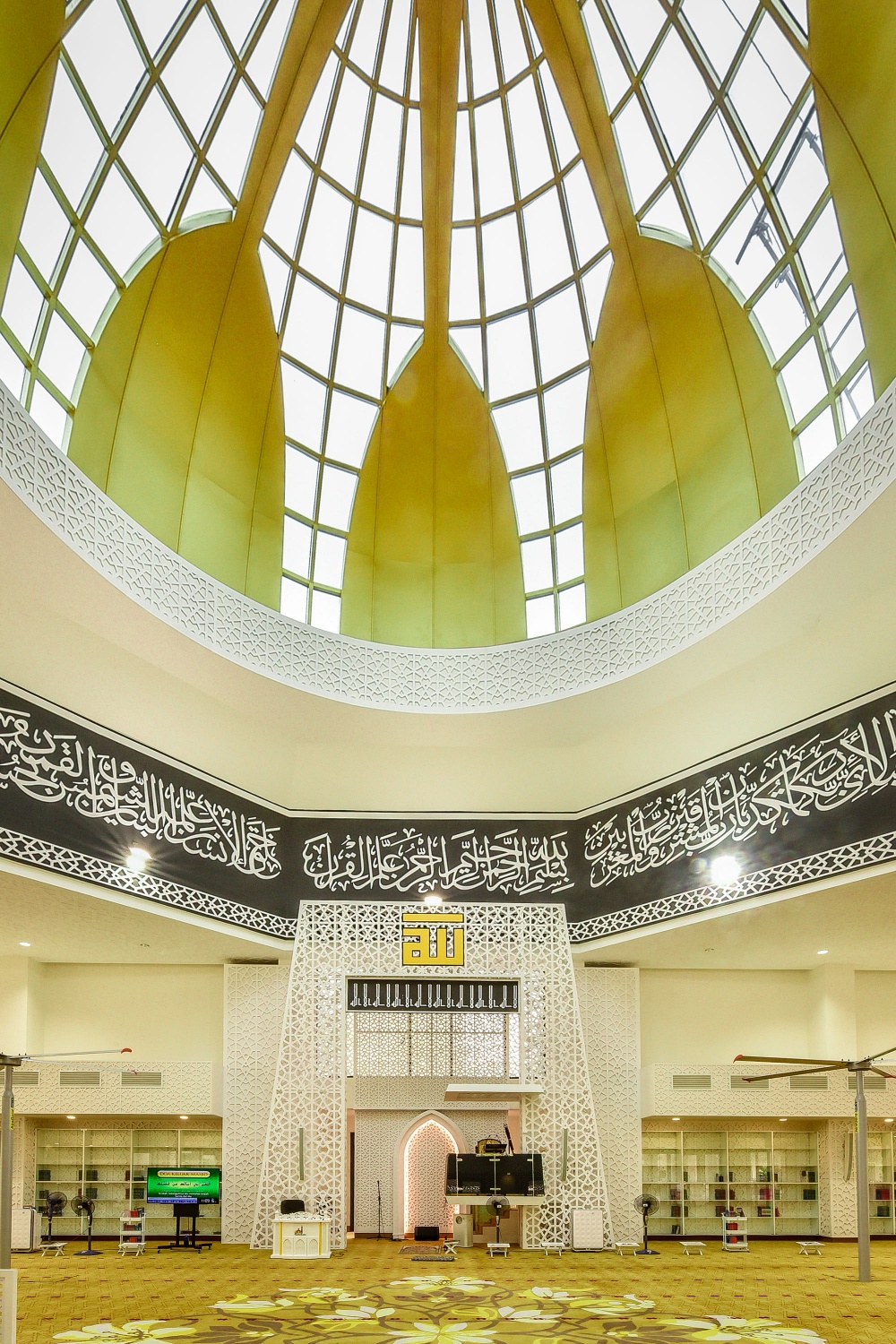
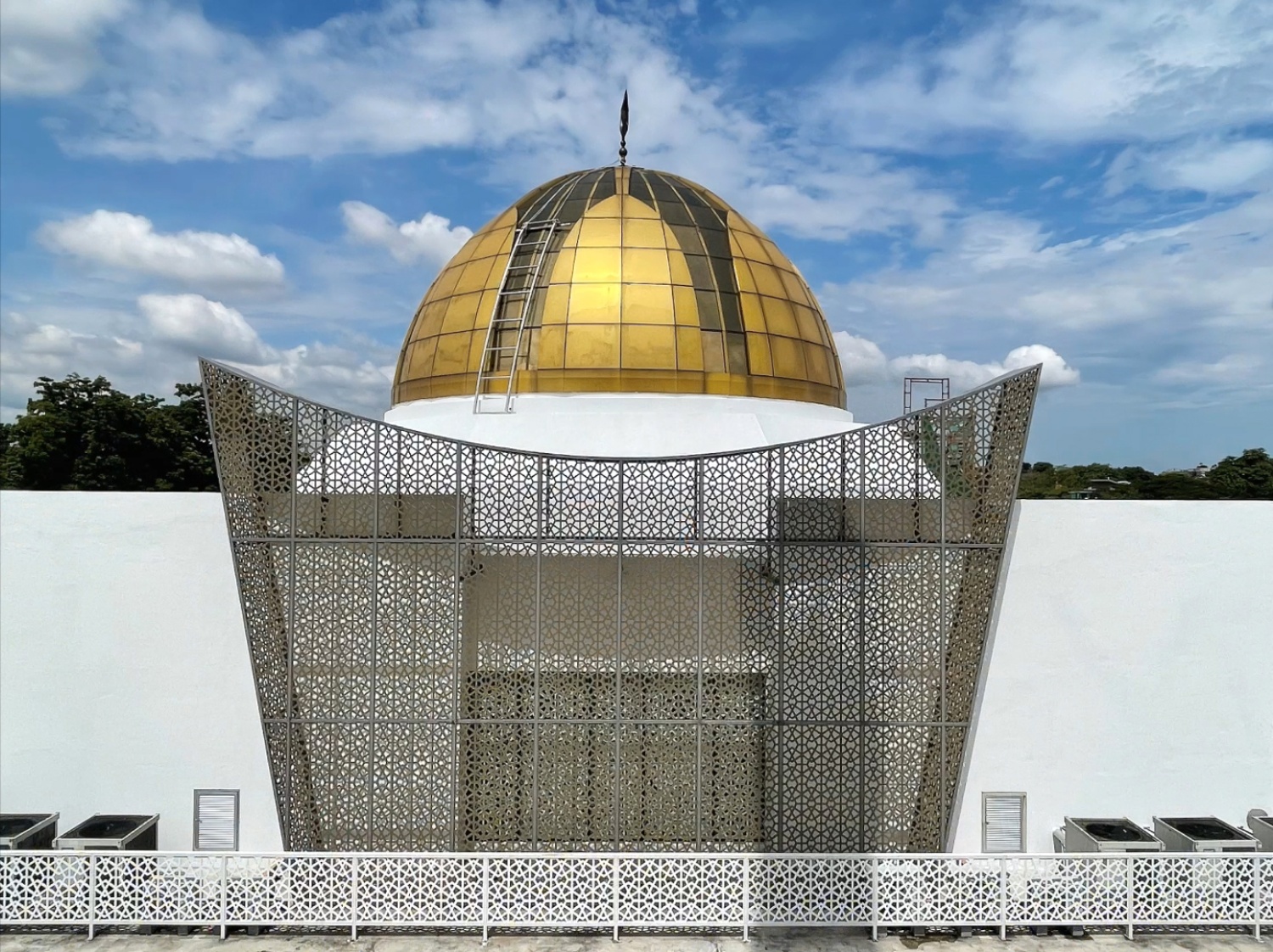
The Main Prayer Hall has a 7.8 metres height glass dome spanning a diameter of 12.7-metre, resting on an octagonal structure without internal pillars. To avoid a monotonous expanse of flat roofing, 49 pyramid-shaped roofs have been constructed in tandem with the glass dome.
There are 4 open ablutions with water features, 2 on each side of the mosque. In addition to the open ablutions, there are separate designated ablutions for both male and female worshipers located within the restrooms at the back of the mosque. 2 disabled ablutions are also provided near the main entrance drop-off.
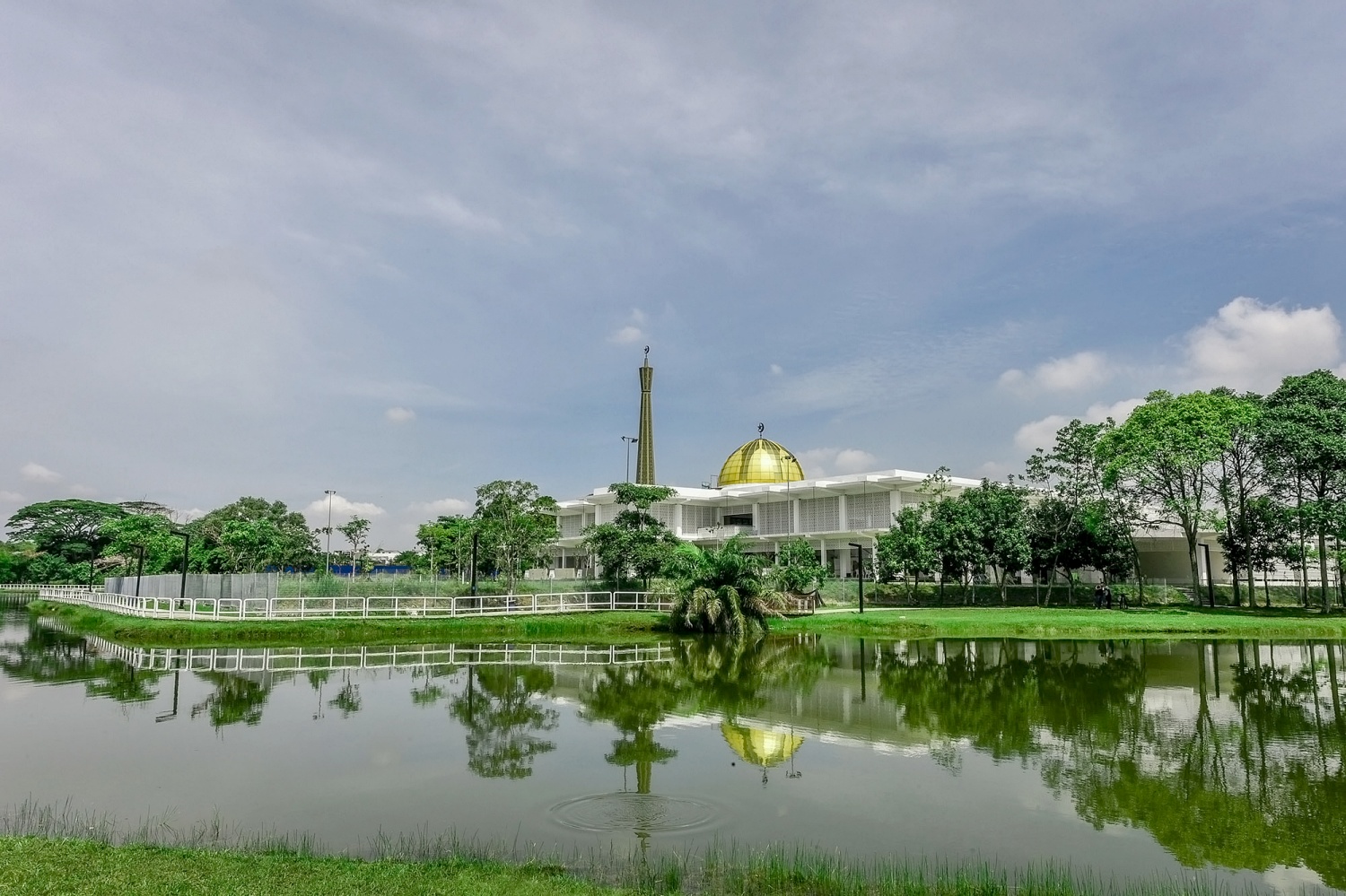
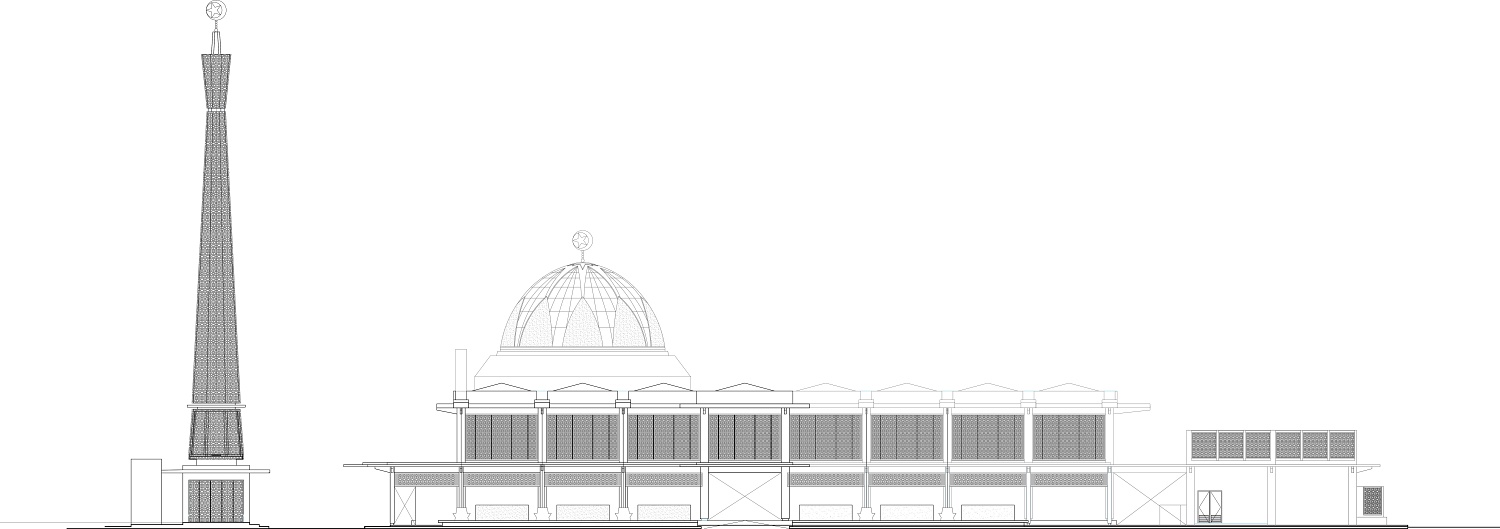
The mosque only has one minaret that reaches a height of 38.7 metres. The tower’s structure is primarily composed of mild steel at 34 metres high with aluminium grille cladding, featuring a geometric pattern in a unique bronze colour. It stands on a 4.7-metre height base structure. A total of 162 car park lots were provided including 2 disabled parking and 8 dedicated lots for the mosque’s personnel and special guests. 52 lots allocated for motorcycle parking.
The modern design aimed to free itself from traditional characteristics commonly found in a typical mosque, such as ornate adornments, repetitive arches, intricate minarets and a recognisable yet non-functional dome.
UNIQUE CHARACTERISTICS
Enhanced with a striking glass dome and a singular minaret, the mosque was unmistakable in its identity. Using a repetitive geometric design on the exterior façade and interior elements effiectively imbued the entire structure with a unique character.
The glass dome is an intricate combination of aluminium cladding panels and Double-Glazed Unit (DGU) gold-reflective laminated tempered glass built on a mild steel structure. The dome presents an enchanting spectacle observed from outside, across the lake or inside the Main Prayer Hall.
In addition to allowing natural lights into the Main Prayer Hall during daylight hours, at night, worshippers may also cast their gaze skyward at nightall to view the stars and the moon. Such an ambience fosters a tranquil atmosphere conducive to reflection and contemplation. The 8 inner side walls of the octagonal dome structure are embellished with verses from Surah Ar-Rahman Ayat 1%17 of the Quran. The verses talk about the teaching of the Qur’an, with Allah Almighty as the Author and the Creator of man who taught Prophet Muhammad (PBUH) the articulation of speech.
The Main Prayer Hall has been designed to provide direct entry for the Imam/Bilal and esteemed guests via the Mihrab section. This ensures that VIPs can occupy the front row of prayer (saf) without having to traverse through the rear line. The passage of way is made clearer since the dedicated car park is also close to the Mihrab zone.
The Mihrab’s design is crafted to create an immersive experience, featuring a main arch adorned with a mesmerising geometric pattern grille constructed from Celuka foam board. The backdrop boasts the same striking motif, with its upper section comprised of glass panels that invite natural light to cascade in and illuminate the space. The juxtaposition of patterned grilles and fenestration results in a captivating interplay of light throughout various times of the day.
Another distinctive feature of the Mihrab is its Floating Mimbar design, which integrates into the Main Arch structure. The Mimbar’s positioning and elevation are meticulously calculated to accommodate the first line of prayer. Composed of tempered glass railings, this component provides worshipers with an unobstructed view during the ‘Khutbah’ (Friday payer sermon). The backdrop stretching on either side of the Mihrab wall has a built-in book cabinet. This provides easy access to the Qur’an and Islamic literature instead of having the wall cluttered with decorative embellishments. The idea is to demonstrate that knowledge occupies a prominent position in Islamic education.
The Main Prayer Hall features a designated area for female worshipers, which is complemented by an adjoining ablution room, thereby enabling the ritual to be performed with ease and convenience. The ablution room is furnished with an ample robe cabinet and changing area, designed to safeguard the sanctity of the female worshipers.
As the Main Prayer Hall has a glass dome above, it necessitates an internal environment equipped with a ventilation system capable of maintaining optimal temperature levels even during full capacity use. In this regard, a mechanical ventilation air conditioning system using a jet diffuser and four strategically positioned helicopter fans ensures maximum efficacy. The jet diffuser allows cold air to be distributed equally into the innermost area of the hall. Surrounding the Main Prayer Hall, the overspill areas look clean and expansive. The unobstructed layout facilitates panoramic vistas from the parking lot to the lake. The open space promotes good cross-ventilation of cool air emanating from the lake. To enhance the ambience, Ablutions are placed right at the sides of the mosque accompanied by water elements. The intention was to allow cold air circulation into the interior of the building.
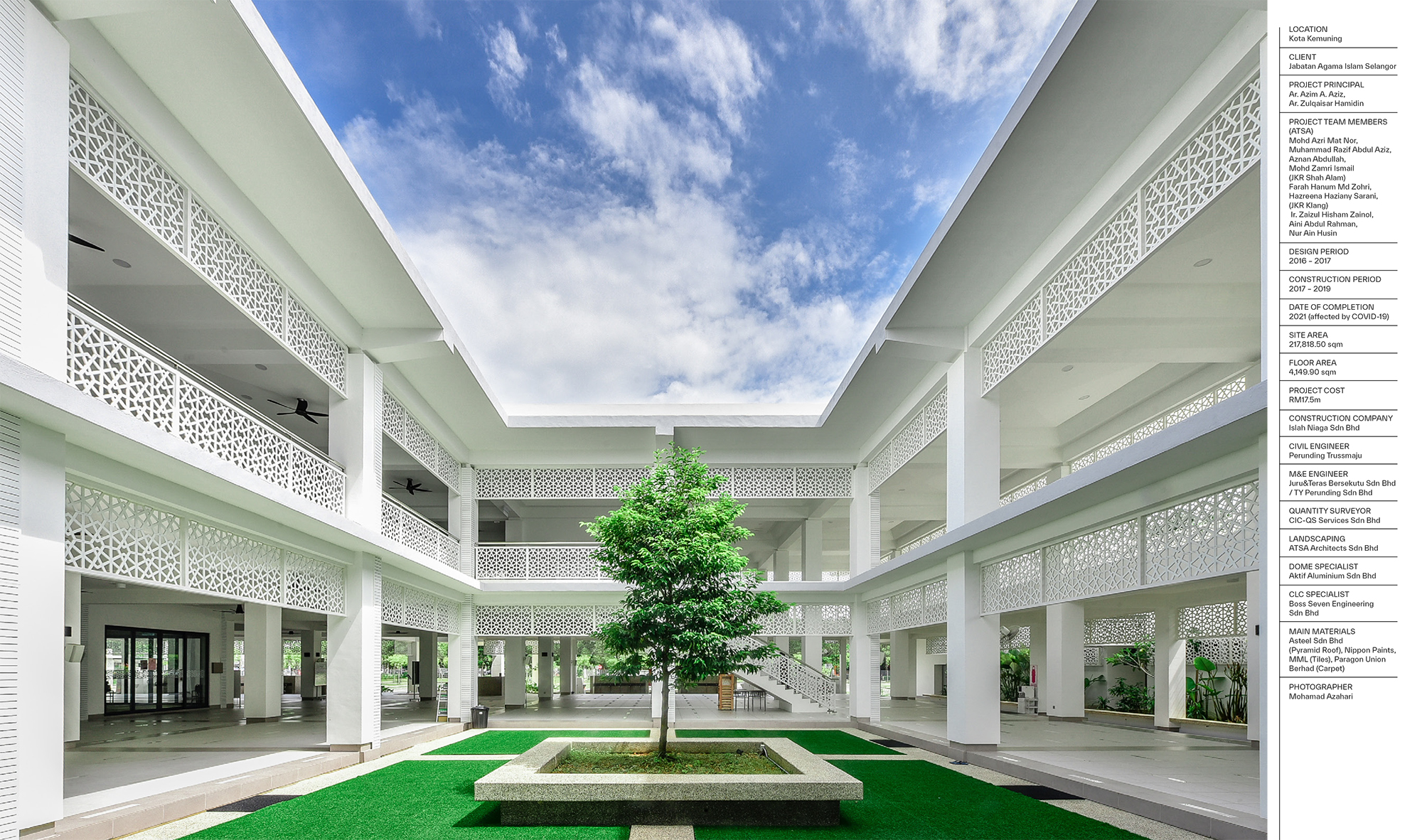
These open ablutions are directly recognisable on approach to the mosque, providing clarity of access and the importance of cleansing oneself before performing prayers. The water feature has seatings all around, allowing worshipers to rest and recuperate before departing. The mosque’s general arrangement is designed with universal accessibility in mind, allowing for easy navigation without the need for excessive directional signage. In addition to the Main Prayer Hall, the Internal Courtyard is a prominent feature that can be seen upon entering. Staircases to the first level are placed on either side of the courtyard.
The courtyard bears a striking resemblance to Masjid Raja Haji Fisabillah in Cyberjaya, thereby imparting a sense of spaciousness that enables worshipers to find comfort within the open area. The ceremonial tree planted is the Mimusop Elengi, commonly known as the Tanjong tree. The artificial grass surrounding the area offers a respite for children to momentarily retreat as their parents engage in prayers.
The Minaret is positioned at the endpoint of the axis which connects the Minaret-Mihrab-Main Prayer HallCourtyard. Its imposing presence renders it easily discernible from the surrounding areas. The Minaret is crafted with distinctive features to complement the Glass Dome and the Mihrab Crown. Instead of a solid structure, the decorative aluminium grilles allow light to permeate through. It features a cat ladder for maintenance access to the loudspeaker system, cleverly concealed out of sight—the base of the Minaret offers ample space that could be transformed into a rest area complete with a water feature.
The basic amenities are placed at the back of the mosque, all within sight and conveniently accessible. Landscaped planters are placed around them to create an oasis for momentary escape. Ample seatings are provided for those who are awaiting their turn or seeking repose before prayer. There is also a designated area for food preparation, with ample space for dining and leisure activities close to the courtyard. The roof of this support facility is utilised to house the cold water and rainwater harvesting tanks, discreetly shielded from view by tall aluminium grille fencing that mirrors the facade. All the utilities are strategically situated with both pedestrian and vehicular access.
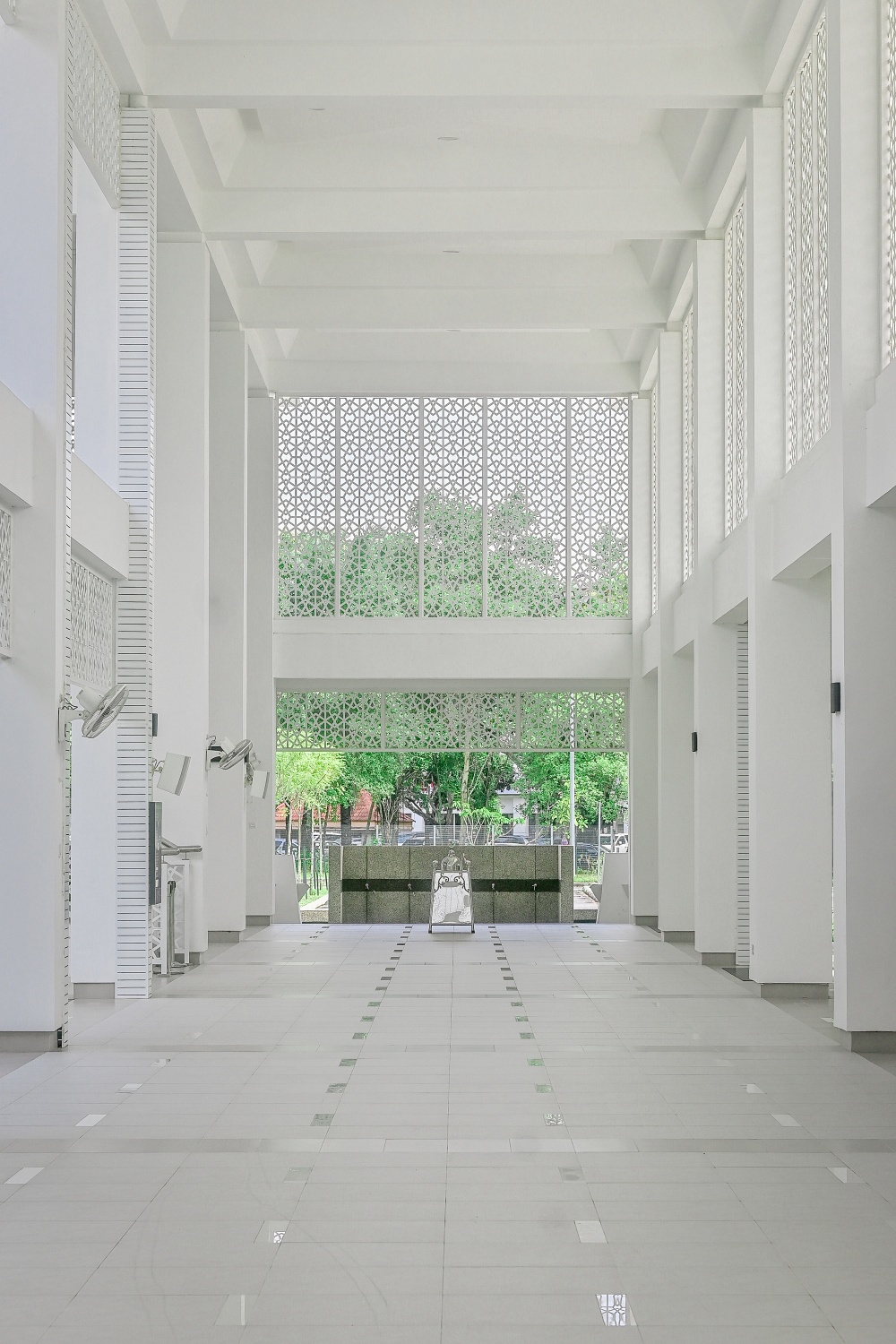
The washrooms with ablutions are designed to open to a landscaped area with a siting bench for resting and waiting. They are enclosed with an aluminium grille to ensure privacy is maintained. The first-floor area can be accessed by 2 staircases on either side of the courtyard. One side, facing the lake serves as an extended indoor overspill area for female worshipers, complete with a dedicated ablution area. On the opposite side, there are 2 classrooms separated by a tall, foldable partition that can be slid open for seminar purposes.
Layout-wise, the mosque’s main areas are flanked with ample parking at the right side and an Open Overspill Area at the left facing the lake. This open overspill area features custom-fabricated concrete pavers resembling prayer mats, serving as an additional prayer space when needed. The area is planted with trees at intervals for shade. At present, this area has been transformed into a temporary multipurpose hall with collapsible tent structures.