TRACING THE EQUATORIAL
Long-time KL-ites with a taste for Tsukiji market-flown sashimi and bonito-flaked sushi may fondly recollect the original Kampachi, a first-generation Japanese eatery that with the Chalet restaurant and others, defined upmarket cuisine from the old Hotel Equatorial Kuala Lumpur. The hotel, a pioneering establishment whose doors first opened in 1973, augured not only the capital’s rise but also helped shape its nascent skyline atop the former Treacher Road that is today Jalan Sultan Ismail. Like many buildings along that famous strip, the all-concrete Equatorial was a quintessential product of the seventies, inevitably capitulating to 21st-century realities with its 2012 demise. What stands in its place in 2019, though dispossessed of erstwhile similarity, nevertheless captures in its fashion, the same pioneering spirit of yesteryear. Bigger, bolder and better, the Plaza Equatorial has returned.
THE RAIN TOWER
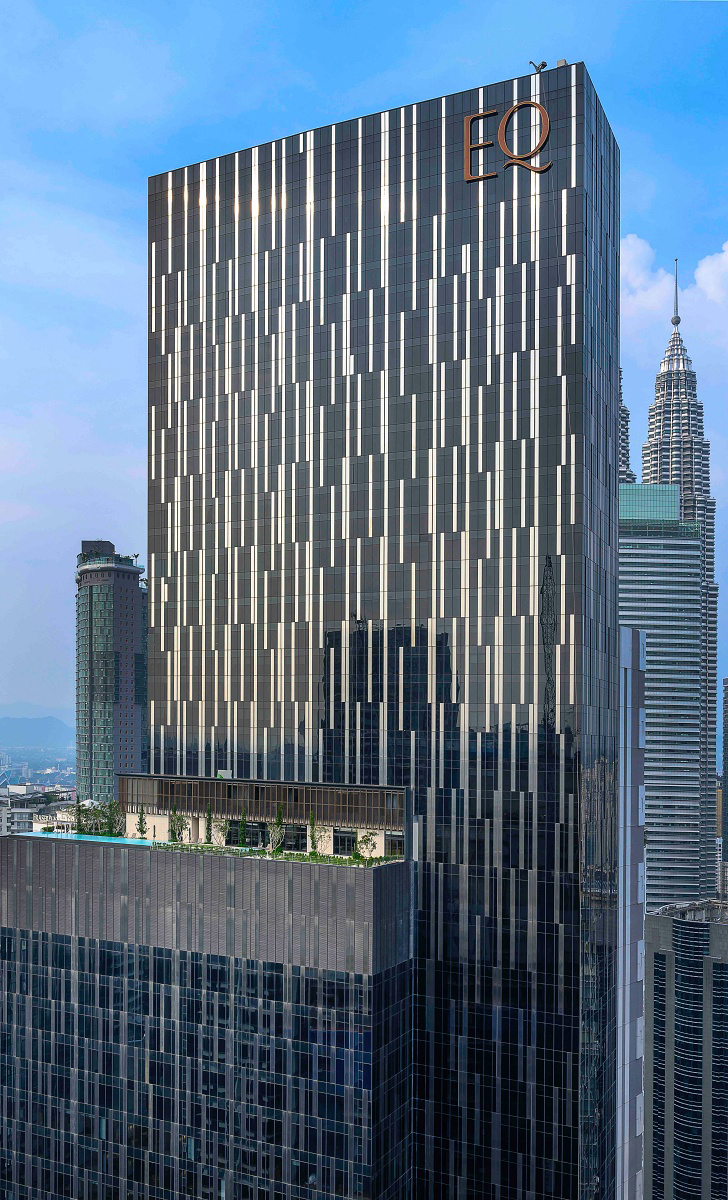
With its premium address and proximity to KLCC, one would expect to find the recently completed building in the purview of a foreign design firm, backed by local professionals, with perhaps the odd UK-or Hong Kong-based consultant thrown in for good measure. The reality is anything but. Headed by GDP Architects, an all-Malaysian project team, delivered Kuala Lumpur’s latest, and quietly impressive 53-storey high-rise tower, its highest point a staggering 230 metres above grade. Demonstrably, it’s a sure measure of homegrown capability and prowess, but building the tallest skyscraper on Jalan Sultan Ismail, however, wasn’t on the agenda at the beginning.
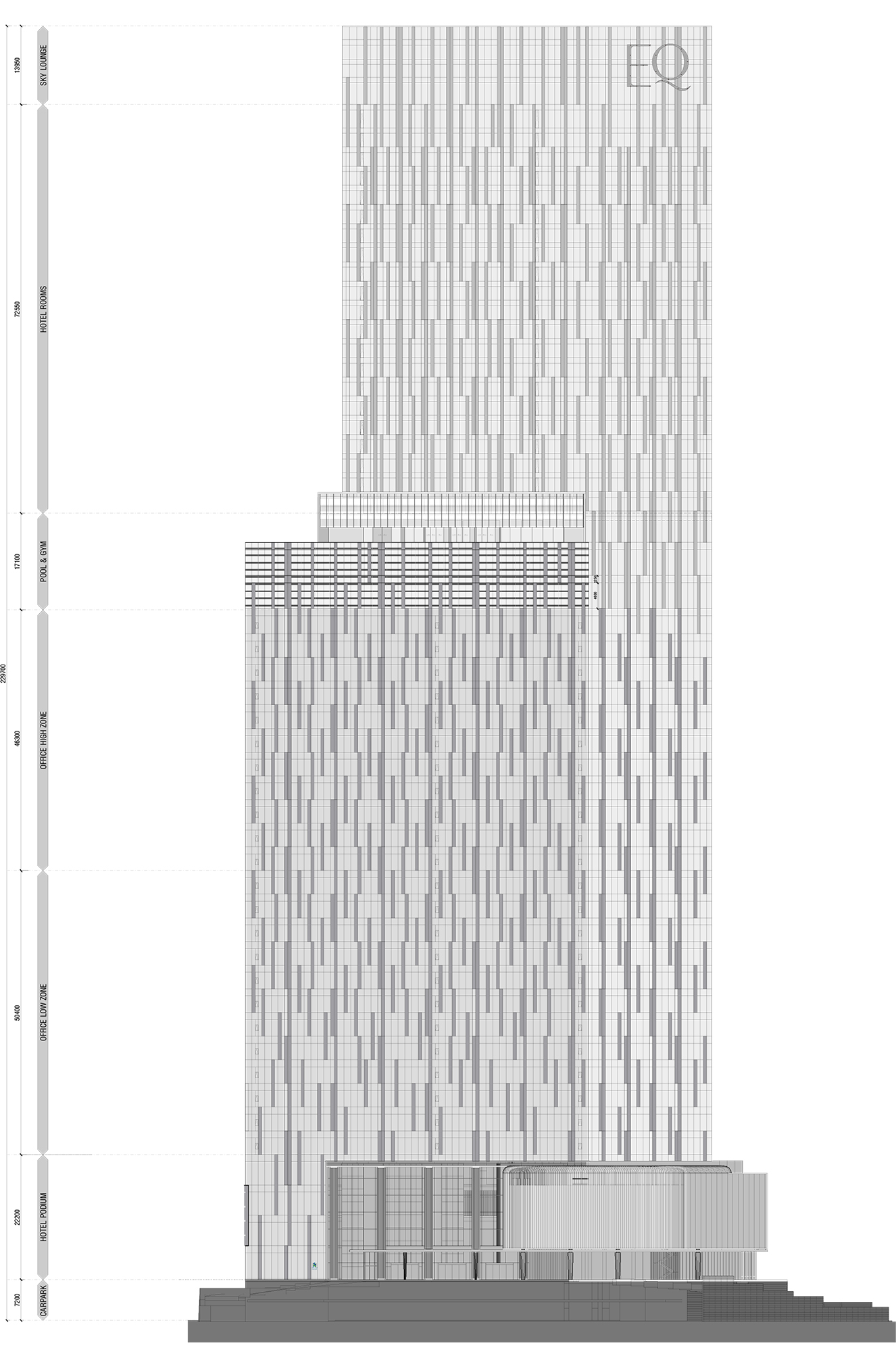
“The project started as a renovation to the original 18-storey building,” remarks Bibi See, a director at GDP Architects. “However, the authorities wanted the building to be more in line with the rest of KL’s skyline, to be of a certain density. So, they encouraged us to rebuild anew.” Client and architects embraced this new opportunity to relook the design, culminating in hotel and office levels at 23 floors each, consolidated into a vertiginous stacked monolith overlooking the main strip and the discreet Jalan Perak behind. Adds See, “The owners wanted the hotel and office to look like individual towers, but the one-acre site couldn’t accommodate that. So, we decided to stagger the building to create the two-building effect.”
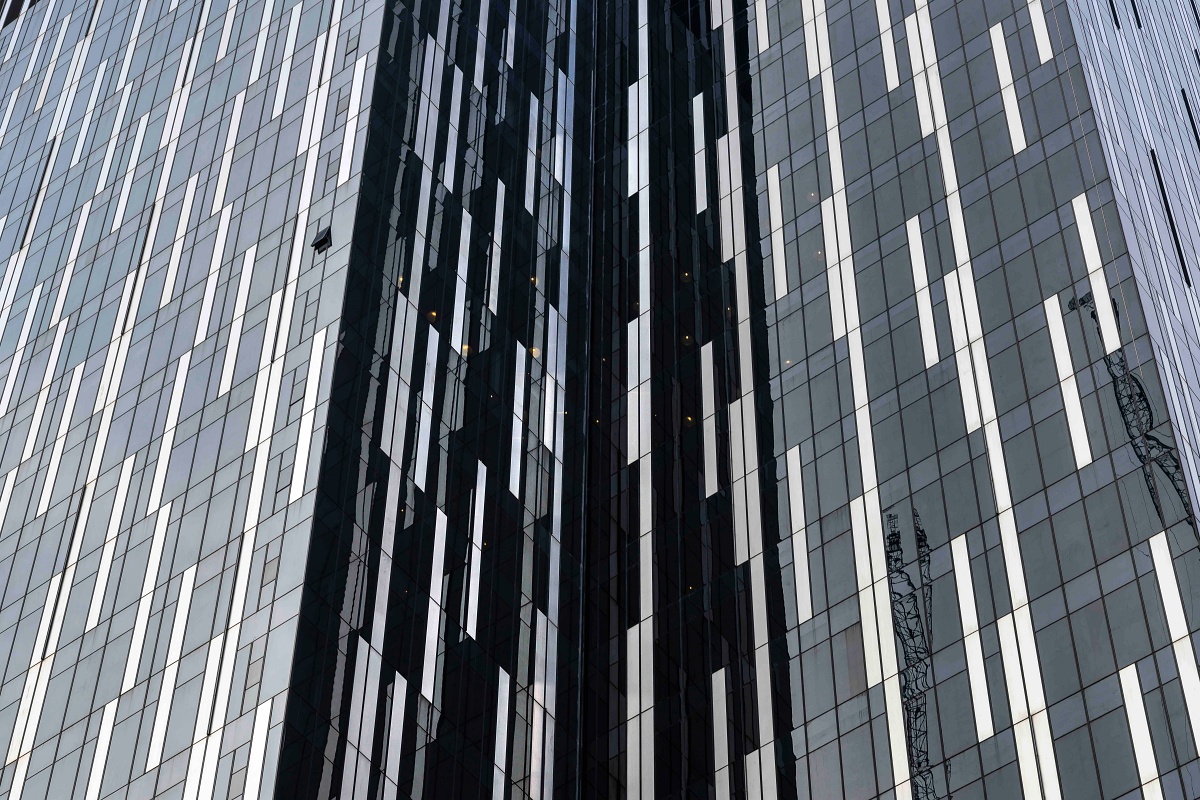
That the tower is a straight-up box, albeit tiered, is clear. But where the orthogonal façade could have easily succumbed to the usual Malaysian façade malaise, GDP opted for the exception rather than the norm, and in that endeavour largely succeeded. From conceptual studies and 3D-printed models to full-sized VMUs (visual mock-up units) erected in factory yards, the architects managed to contrive a sleek and inspired solution: horizontal spandrels are virtually banished from the building envelope, camouflaged by an erudite play of contrast through cascading stainless-steel strips set against the dark laminated-glass curtain wall panels. According to See, the design team added the vertical strips to blur the horizontal lines, “to create some randomness, to generate a pattern of falling rain, heavy on top then eventually becoming lighter”. That these striations express these, in a city infamous for its epic torrential downpour, lends a poetic note and understated symbolism to the building’s visage.
Where a typical multi-storey Malaysian podium o& en asserts itself in an ungainly manner, Plaza Equatorial’s configuration is unassuming yet pleasant to behold. As an inserted object that breaks down the building’s mass, the podium is a supersized metal pod; the bulbous projection eschews glass for a solid satin-finished façade that achieves its aquiline form through fluting tubular ribs, a recurring treatment that pervades the exterior. The hotel’s 800-pax ballroom is inconspicuously housed within, a double-volume column-free space roofed over by an outdoor function lawn, ringed by a sinuous pergola structure formed by ribs curving over the façade. Ostensibly green, the space’s landscaping and playful articulation thoughtfully communicate the pod’s intent as a relief to the regimented tower architecture.
LAYER UPON LAYER
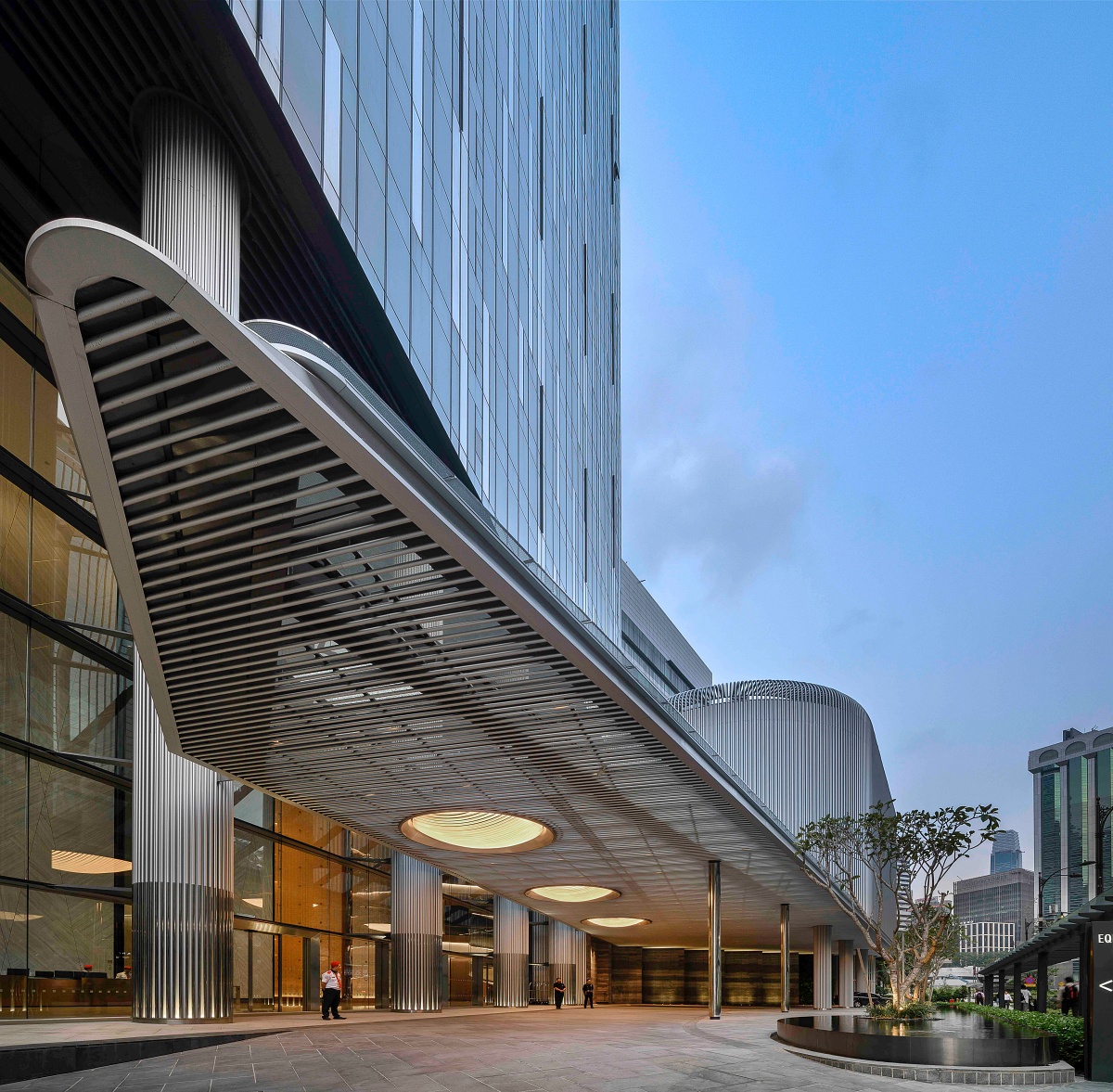
A culture of testing and prototyping seems alive and well at GDP Architects. It is apparent in the façade details, the podium pod, and in areas such as the tower’s porte-cochere. The entire drop-off area, just off the busy street, is a multi-layered and well-orchestrated one: a floating canopy with glowing spheres catches the eye upon arrival, suspended beyond a grand colonnade that both frames entrance doorways and tangentially supports the rear glass façade.
The entrance canopy, with its thrusting cantilever, elicits just the right amount of drama. Achieved via a precambered steel structure, the fritted and laminated glazed roof element gently inclines at three degrees to drain into a concealed gutter and mirror-finished stainless-steel columns/downpipes. To its underside, the same tubular ribs form a permeable screen that filters light onto the driveway, partly to shade but more so as a device to round off the canopy’s layered aesthetic. And then there are the three huge amber hemispheres; each custom-designed and about three metres in diameter, these acrylic light orbs are a feature onto themselves, single-handedly upping the arrival experience for guests by several bars. If there’s legitimate proof that entrance lighting can be exciting, and not like store-bought IP-rated LED fittings to manufacturer’s specifications, these orbs would be it.
Completing the porte-cochere is a five-pillar grand colonnade spanning over 20 metres, with a proportionate girth that visibly carries the weight of the tower. Built up over each 1.3-metre-diameter RC column are sheet aluminium and an array of 72 tubes, again in satin finish, which at the base are substituted for tubes of mirror-finished stainless steel that heighten the feel of poshness and exclusivity as one enters the building. Behind that cosmetic affectation, though, a more practical function is at work; rows of forked struts branch out from the pillars’ backs to connect to the entrance’s tall glazing. Stabilising what is effectively a semi-frameless glass system, the outriggers are invariably exposed, yet their design and welded finish remain eloquent without compromising the grandiosity on display.
Plaza Equatorial’s crystalline architectural identity is at the heart of its design, symbolising transparency, innovation, and elegance.
INSIDE MOVES
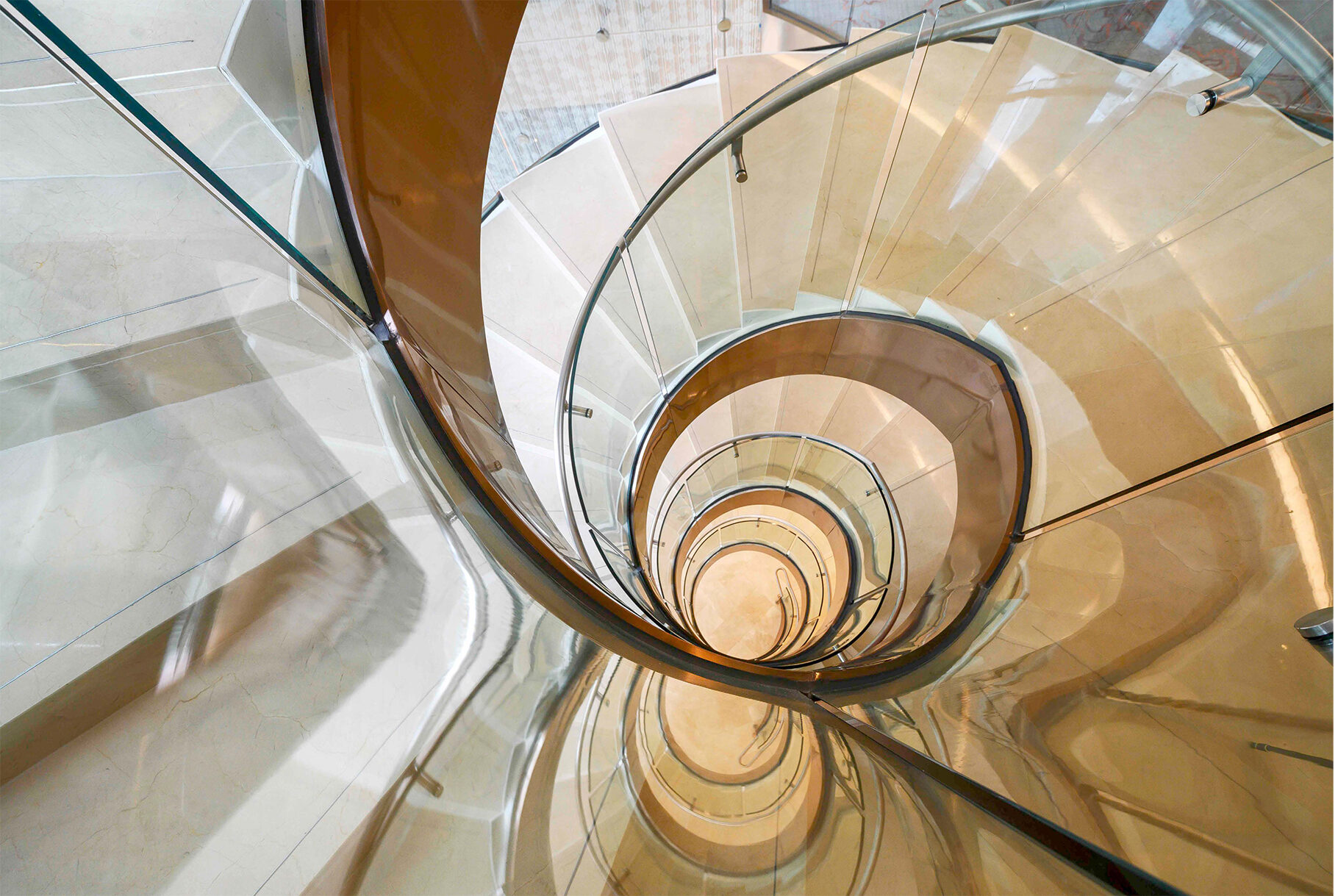
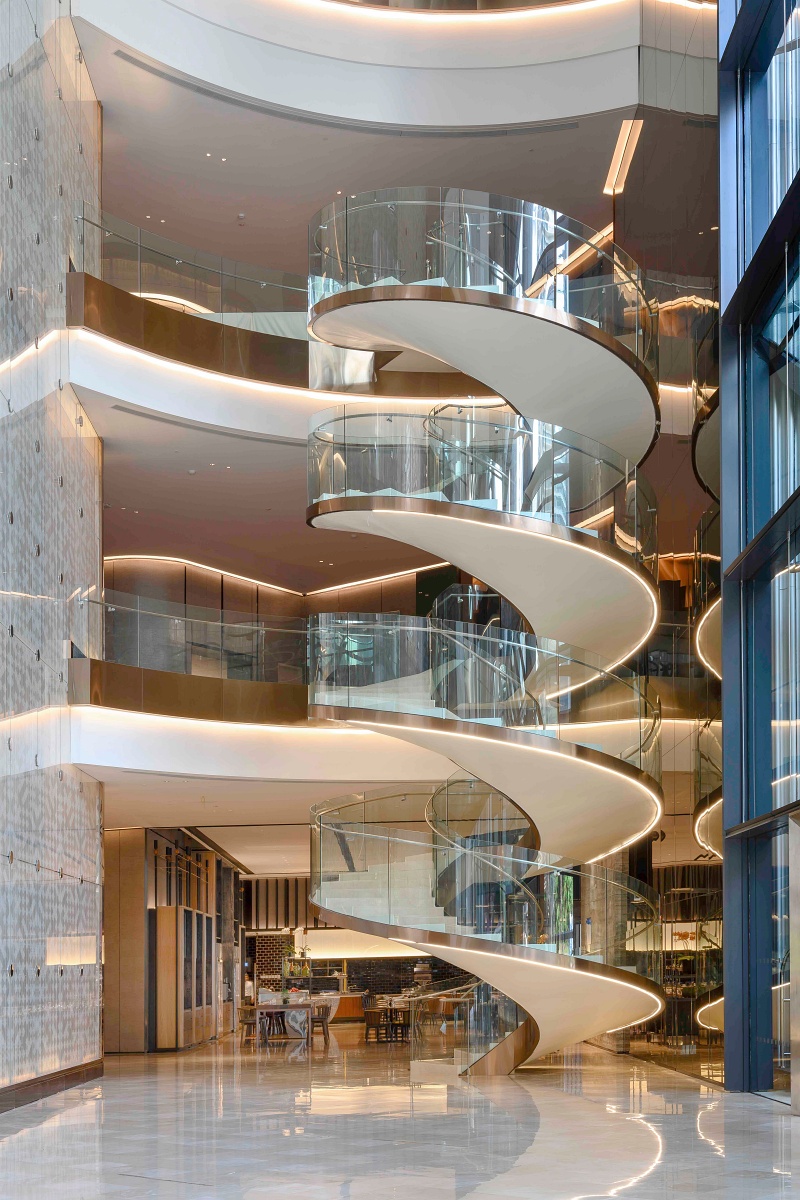
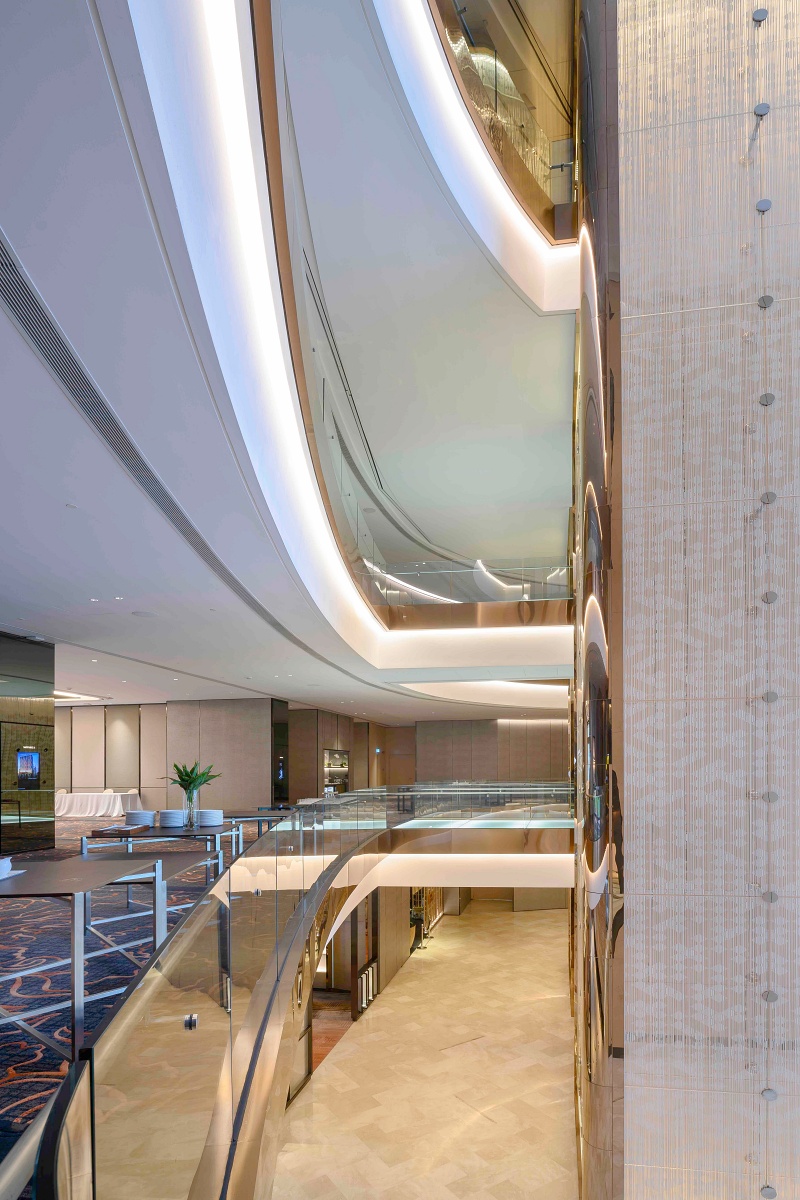
Beyond the colonnade lies a triple-height day-lit concourse replete with polished surfaces, ranging from stone to patterned glass and metal accents. In a subtle mix of contemporary Art Deco composition and Baroque flourishes, the flaunting of splendour culminates in the concourse pièce de résistance, a pristine spiral staircase that connects the entry level to podium levels 1 and 2. A wafer-thin steel plate construction defines the elegant structure, wrapped in a curved glass balustrade enhanced by bespoke lighting and trims, topped off in stone, white and rose-gold finishing.
Actual production of the signature piece was far from effortless, requiring a collaborative multidisciplinary effort. Architects and engineers worked on the BIM modelling to get the stair into shape, resolving to use layers of continuous steel plates to create the slimmest cross-section possible without compromising robustness. Mock-ups of lighting coves that trace the stair edges were also developed, while the interior designer applied the finishing touches to bring the staircase to its desired level of cra#. The concourse planning, with its dense cores symptomatic of a compressed plinth, can be marginally confusing to first-time
hotel guests.
The office core and its access gates are immediately there upon entry; turning right, the Nipah restaurant and the feature stair avails itself, the check-in counter nowhere to be seen. The different cladding of cores — the office subdued in its greys and blacks, the hotel a marked contrast of glass and bronze — alludes to the two programmes but only to those cognisant of the fact, otherwise appearing as stylised wall applications within the same space. The hotel concierge service thus becomes integral in ensuring guests reach the reception counter situated at the rear.
The transformative journey of the Hotel Equatorial Kuala Lumpur into the present-day Plaza Equatorial is a story of possibilities. Where local authorities instigated change, it took a client willing to make that change and embrace a scenario much larger in scope and investment than the one originally conceived. According to the top Hotel Equatorial management, the building has, in all regards, achieved its full potential. “We wanted to achieve a modern, practical statement and we are happy with the result. We had a very good working relationship with the architects and consultants, and we are very pleased with the efficiency and aesthetics, and the elegance of incorporating the offices with a hotel in such a practical manner…”
GDP Architects’ interpretation of the modern skyscraper that is bold, articulate and GBI gold-certified, proves that the design envelope is there to be pushed when the opportunity arises. At a time when such opportunities are few and far between, especially at this scale, the architects have seized the moment and made it count.
BEI (kWh/m²/yr):
BEI for Office:
92.39 kWh/m²/yr (BEI office baseline 250 kWh/m²/yr)
BEI for Hotel:
183.05 kWh/m²/yr (BEI2 office baseline 483 kWh/m²/yr)
Energy savings as compared
to average Malaysia office
building (%):
63% energy savings as compared to average Malaysia office building = (92.3/250 x 100)-100
62% energy savings as compared to average Malaysia hotel building = (183.05/483 x 100)-100
OTTV (W/m²):
12.9% improvement as compared to MS1525
= (43.55/50 x 100)-100
85%
% of construction waste diverted from landfill via recycling:
67.80%