FRAMING – BEGINNINGS
AM
AH
I started my early days with a passion for drawing, whether on paper or even murals on school walls. Eventually, I got the opportunity to continue my passion in the technical field in a technical school until I had to make a crucial decision whether to be an engineer or pursue my real passion which is to design something. It was the biggest decision I made and I have never regretted it. Embarking on the path to be an architect was a long journey for me but the aspiration to be somebody who could design something out of nothing had been the right decision ever.
AM
AH
I started my architectural education in the College of Preparatory Studies Programme (KPP/ITM) way back in 1985. It was a programme to prepare students under the government’s scholarship before continuing my studies abroad. After spending several years in Shah Alam, I was given the opportunity to further my studies at the University of Houston, Texas, USA up until acquiring my Bachelor of Architecture.
AM
AH
There have been tremendous changes in architectural education between my study time and the current day. I believe that the evolution of education and the advancement of technology have impacted the education approach. Studying abroad at such a young age in the 80s posed challenging tasks to a student where the limitation of finances required patience and a high level of resilience.
In general, I would say that architectural teaching methods have been very much alike after all those years. We have been driven, encouraged and guided to equip ourselves with basic and important knowledge in architecture. We did not have the opportunity to prepare presentations using any software as of today. What happened was we had to push the limit to complete the assignments manually. It was the time when everybody had to find creative ways to come up with the best approach to complete the tasks. There wasn’t any gear to help and to a certain extent, printing had never been an option. The main challenge was for us to avoid making mistakes as when that happened, we have got to redo the whole thing. Eventually, it taught us to be cautious, focus and spend more time on each task.
AM
Could you tell me more about your architecture career?
AH
After returning to Malaysia, I surprisingly found out that job opportunities were difficult in the 1990s. With a big dream and of course, being too green and fresh, I have started my career in a private architecture firm in Kedah. Over that period, then only did I realise that it was not as I envisaged when I saw that an architect’s role is an uphill task. However, the experience taught me and provided me a foundation for the next career path, feeling very insecure and dissatisfied with the work in a small city, I made the huge decision to apply for a job in JKR Malaysia. The year 1992 marked the turning point for me to step foot in Kuala Lumpur.
As the new office offered a very new experience and an entirely different atmosphere, that was the start of everything. I have had opportunities to get involved in design production, project management as well as site supervision on a full-time basis. Remarkable posts as an architect at various ministries have provided a platform for me to practice what I have learned and prospered in my knowledge of architecture. In 1985, I had the opportunity to serve in the Malaysian Embassy in Bangkok, Thailand as the 2nd Secretary (Development) to supervise the redevelopment project in Bangkok. That was my first experience working with Sumet Jumsai, one of the famous Thai architects to complete the project.
As time went by, and after spending more than three decades in government service as an architect, my experience grew due to my various architecture roles and with that, I was elected the President of the Board of Architects Malaysia (LAM). It is indeed an honour to serve the architectural communities in the nation as well as to ensure public interests are being taken care of.
STARTING POINT
AM
AH
AM
AH
The process of translating ideas onto paper is the beginning of any design process. To come up with quick ideas, I have started to produce rough sketches. Slowly the sketches developed into the final presentation. At the end of the day, I felt like these quick sketches had inspired me to keep on sketching.
As the evolution of technology has taken over the whole role of free-hand sketching, I felt that the feeling and satisfaction of free-hand sketching could not be forgotten as it brings a softness and personal touch to the presentation. They’re bound to see that computer-generated sketches could produce the actual look of any building and translate how one would envisage it. Despite that, the stiffness (in computer-generated sketches) is not what I am looking for.
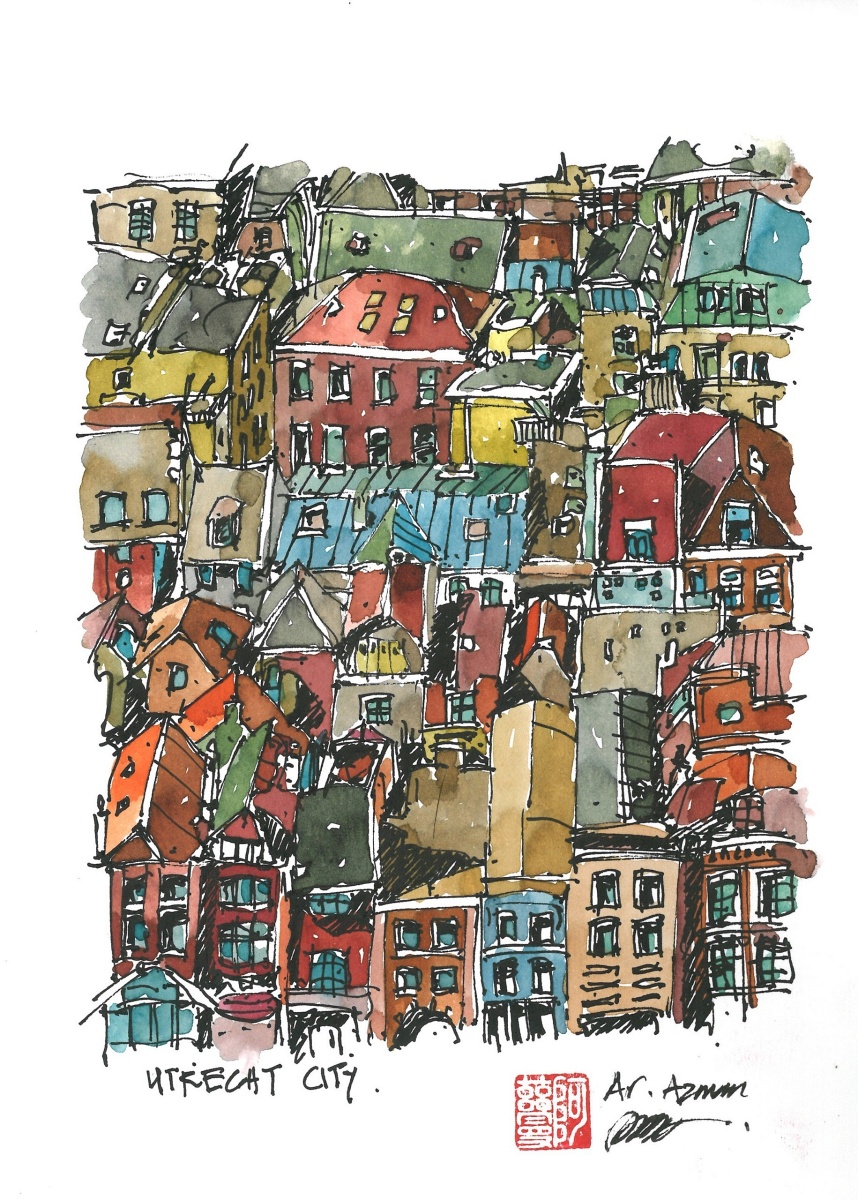
I am always fond of picturing an object as simple as we would see with our naked eyes. Such depiction of the existing objects would be more interesting and valuable if one could draw the profile and simplify them on paper. It allows me to be free as well as look at something as I wish. The simplicity and rhythm of each freehand sketch would produce a joyful feeling. That is the main reason why I keep on doing it and always appreciate every object or even building that is available around us.
AM
AH
One would have to go through periods where one would experience ups and downs with sketching style. I believe every artist would also go through this too. For me, my experience at the early stage was more to find my talent and proper it. There were times when I just threw away my work for the reason that I needed to do better. Despite all the experiences, I always find it inspiring just because I would never know how the final sketch would look like when the works are complete. It is where perseverance and patience would be the best tools for anyone who would like to sketch.
AM
AH
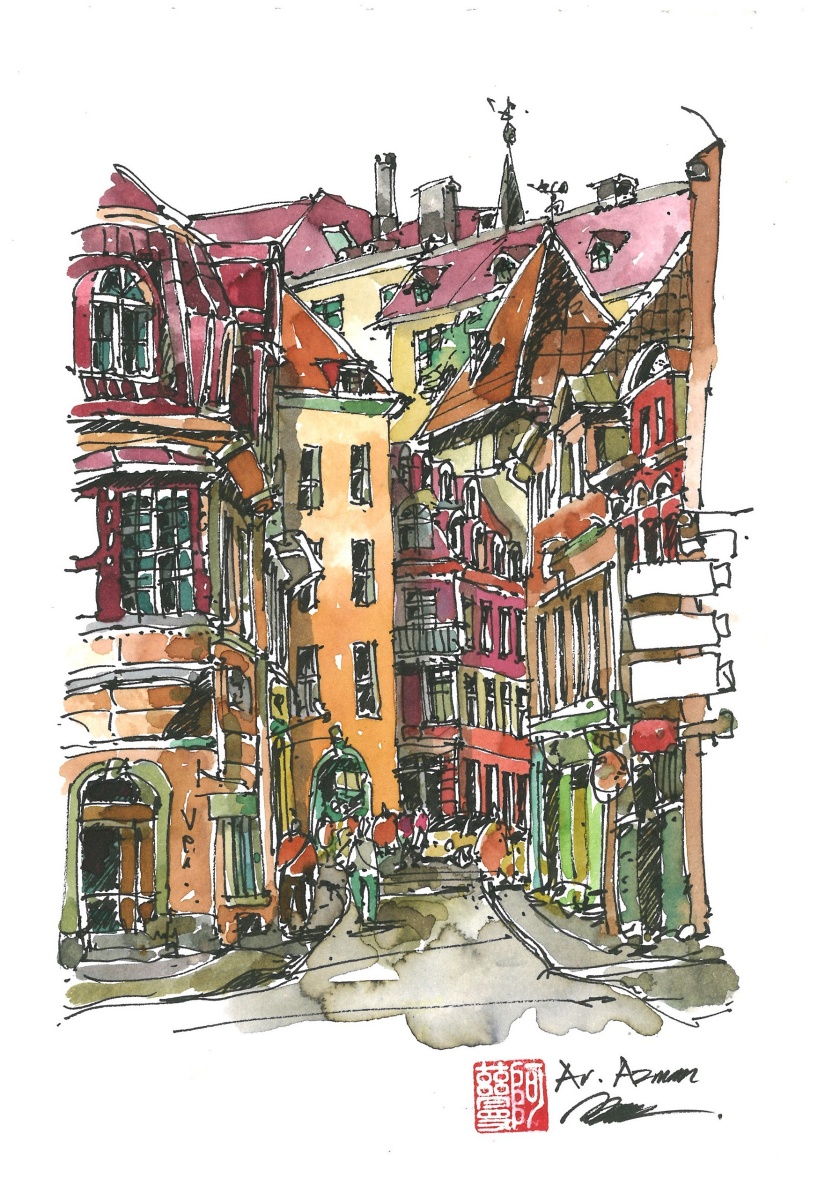
After learning about using line sketch, I have explored various techniques to finish up the work. During the exploration of these media, I noticed that the Ecoline technique suited me well and I have always fond to apply that as my finished media. Starting from there, I believe I have stuck with Ecoline together with my other tools as a permanent felt-tip pen and watercolour paper.
AM
AH
AM
AH
I have been fascinated with Ecoline due to its brightness, transparent and bold appearance. For me, Ecoline is not much different than normal water colour as Ecoline comes in liquid form. One of the main differences is that Ecoline demands for one-time application as compared to watercolour which allows for multi-layer application. For some, it may seem like the Ecoline technique is more difficult to handle than watercolour.
I think that this medium is far more difficult and sometimes not even forgiving. It is not easy to repair or make amendments once the colours have been applied. This, for me, becomes more interesting when every single colour has to be applied correctly in the first instance. It becomes even harder to maintain cleanliness around the paper due to its bold and unerasable values. In general, I believe that the harder the technique, the better it becomes to appreciate the work.
PHILOSOPHY
AM
AH
AM
What is your philosophy behind sketching? (capturing a moment in time)
AH
My inspiration towards appreciating buildings all around the world would likely be my philosophical approach. Every subject has a character and story to tell. It is indeed impossible to depict the whole story on paper but I always have my approach of not translating every single detail in the sketch. There are times when the strength of building relies on the substantial segments and it is where I would capture on paper.
AM
AH
AM
AH
AM
AH
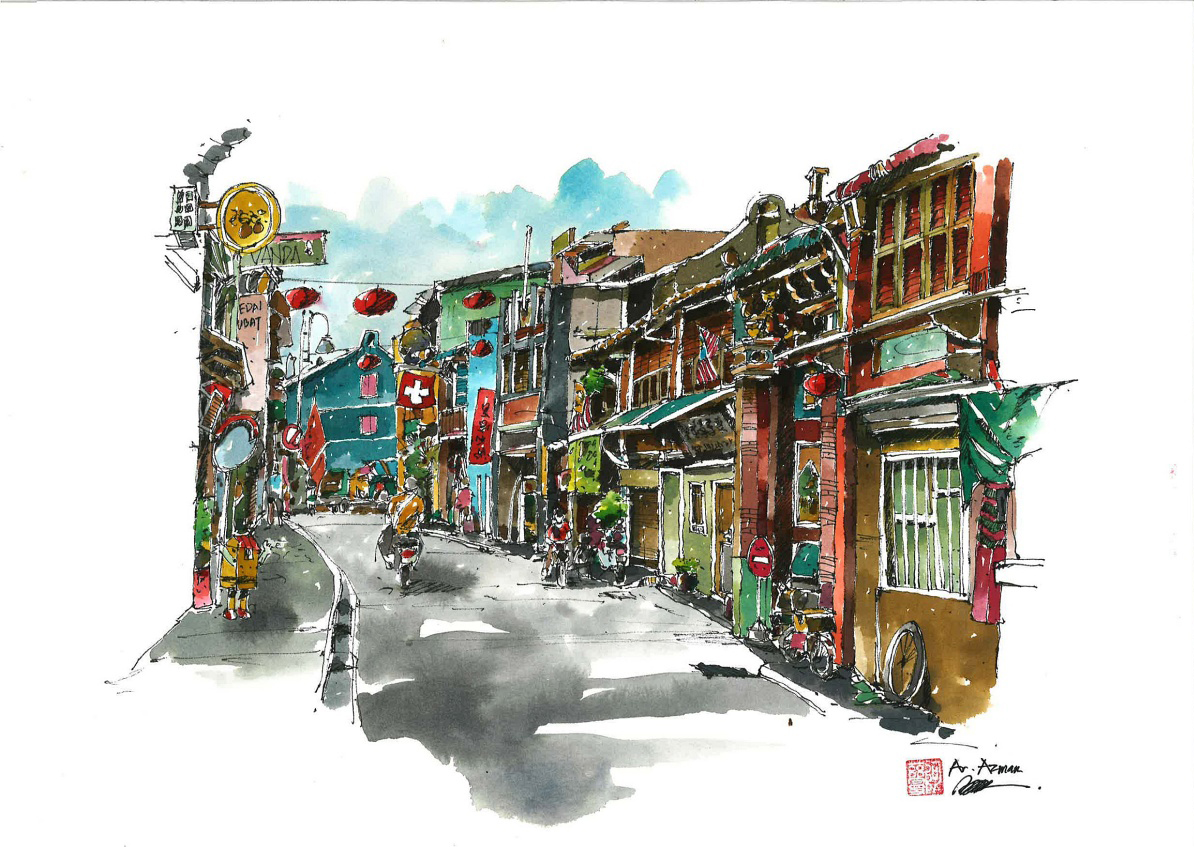
Most of the time, actual subjects have their own unique and special colours that differentiate them from others. It is important and challenging to carry and depict the original colours using any media. As such, maintaining the essence of each subject would create a more appreciative value to the viewer. However, there are cases where alternative colours ought to be applied to enhance the actual subject’s colours. It always happens when sketching subjects with plenty of details.
AM
How has sketching helped you in your architectural career?
AH
I have been practicing my sketch to convey information to others especially when dealing with details on site. It has been interesting where in some instances, a 3-dimensional sketch could be produced to show clearly my intention as what I envisaged it. As for the Ecoline technique, it has helped me to discover my talent and to prosper in my architecture career. Indeed, my career has evolved by this technique and people around me have recognised me as a ‘Sketch Architect’.
AM
In your opinion, how important is sketching to an architect?
AH
For any architect, the ability to sketch would be advantageous but it is not compulsory. Some successful architects would have different approaches without being able to sketch. I believe creativity comes in different forms and techniques. The most important factor for the architect is to convey the ideas in any way possible and come up with the best design solutions. However, for sketch enthusiasts, we could see their works would be associated with sketching.
AM
AH
The total composition of the sketch would constitute a good one. Any other important components of a good sketch would be proportion, sizes, line thickness, extent of details, confident strokes of lines, harmonious colours, cleanliness and balance. Throughout my career in sketching, I have noticed that there are times when simplicity is required for a good sketch. Trying to draw everything may not be the best solution as the whole intention is to sketch and it is different from photography where every single detail can be captured.
AM
AH
Understanding the level of expectation from the viewer would be sufficient to relay the information through sketches. I believe that one needs to take a bit of time to process what one wants to convey on paper. Unlike technical sketches to show and guide viewers, my way of sketching has evolved into recording subjects and picturing them on paper. The finished works would be able to represent the whole theme and become a means of direct communication.
PROCESS – LINES
AM
How would you start a sketch?
AH
Normally, I would find the right time for me to start sketching. It has to be when I have the right piece of mind to ensure the quality of the sketch is as I have expected. Having the right mind and physical would help me to focus and apply the right techniques. There are times when I start the sketch on-site or even right in front of buildings. Everything has to depend on the availability of surroundings and when the weather permits me to do so. Other than that, there were times when I would take photos and start sketching at my studio. In any situation, my preparation would start with my sketchbook and pen. The audience of my work has been asking whether I would start all sketches using pencil as the first line. It has been my style of not using any pencil line to start the sketch with, nor using any eraser or ruler. I would be sitting or even standing to start pen line as it allows me to be free and that sense of freedom would enable me to see the subjects as their whole properties and record that on paper.
AM
AH
The moment I lay the first line on paper, I normally try to finish up the line sketch until satisfactorily completed. However, there are some sketches that I had to stop in the middle of the process as it demands a longer time due to the complexity and the big size of the paper. Most of the time, I would start to finish up directly with the application of Ecoline colours on the line sketch. However, there are instances where I would keep the original line sketch by making copies of them for future use.
Some may wonder how to put all the subjects to fit the available space on paper. There is an opinion to start from the bottom up or even from the top down. For me, the biggest secret of any sketch is to start the first line from the centre. It allows us to determine the sketch size as well as control the border of the paper.
At the start of the colouring process, I would normally arrange all the Ecoline bottles after uncapping them side by side to ensure I would be able to choose the ones that I wanted to use. Taking some of these colours and putting them together on a palette would be the next step to mixing them. The whole purpose of doing this is to produce secondary colours that would be fit to be the final colours that I wish to use. Applying and mixing colours with enough quantity of water is crucial to produce colours that would flow nicely and absorb sufficiently on paper. This is the time when soft tissue paper could be used to dab on the colours to create depths and produce desired tones of colours.
AM
How long would a sketch usually take? Do you give yourself a set amount of time or a timeline?
AH
For me, the whole idea of doing any sketch is not to spend too much time on each of them. It is not like other artworks where very much details are drawn. A sketch shall be quick and easy to be completed. I would normally spend the shortest period possible ranging from 20 minutes for simple subjects to a maximum of 3 hours for intricate sketches. The ability to sketch in the quickest time possible inclusive of the final colour touch would benefit the artist where the quantity of sketches could be produced.
As loose as the sketch could be, I normally do not set any time limit from inception to completion. However, there are times when I have a completion target date as requested and I have to give more attention and focus to complete the whole work. I believe that should be the time when all the energy and emotion are demanded to produce such works. Despite that, the rest of the work has been done during my leisure time without any pressure and determination of time. We have to let it be free and we shall make sure the disruption is avoided whilst producing sketches.
AM
AH
AM
AH
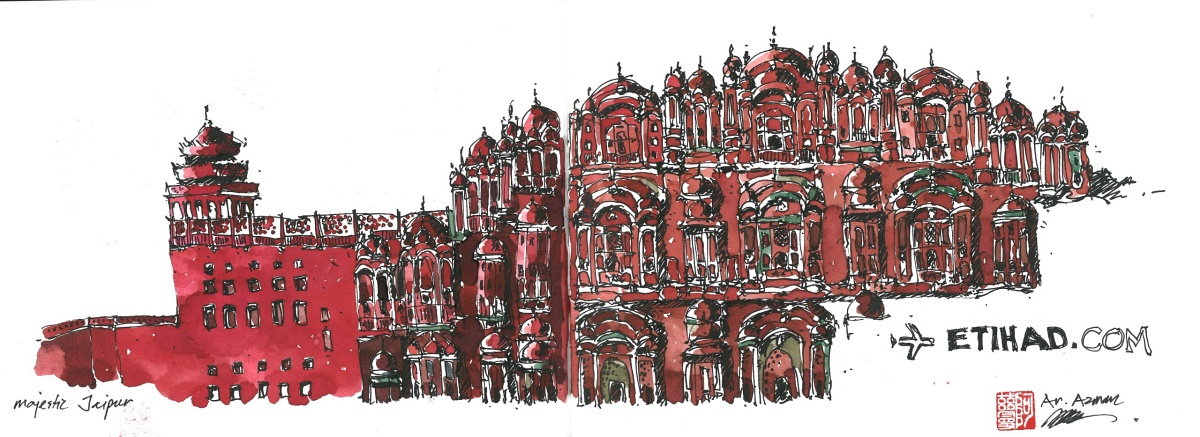
I believe that my travel time has been the most productive time to come up with sketches. Seeing other places has inspired me to appreciate more of the buildings abroad. Splendid heritage buildings have given me opportunities to record them in my sketchbook. There have been times when my sleepless long flights allowed me to come up with sketches.
My habit of sketching whilst other flight passengers were sleeping has been a bit unique even for myself. That has been the memory that will be kept together with notes that I regularly wrote at the side of each sketch to record my feelings at each particular time. Although writing a diary has never been my passion, writing and recording my feelings during the journey in my sketchbook has become my habit.
AM
Do you ever go back and add on or alter previously completed sketches?
AH
One of the useful tips that I have been teaching to architecture students is knowing when to stop. One needs to identify the level of satisfaction as to the level of completeness in sketching. Once the artwork or sketch has reached the final level, that would be the right moment to stop. For me, the moment each sketch is considered complete, that would be the time to call it a final. Immediately after signing the sketch as well as putting our trademark (in my case, I have my name stamp in red colour), that would not be any further alteration required.
MEMORIES
AM
AH
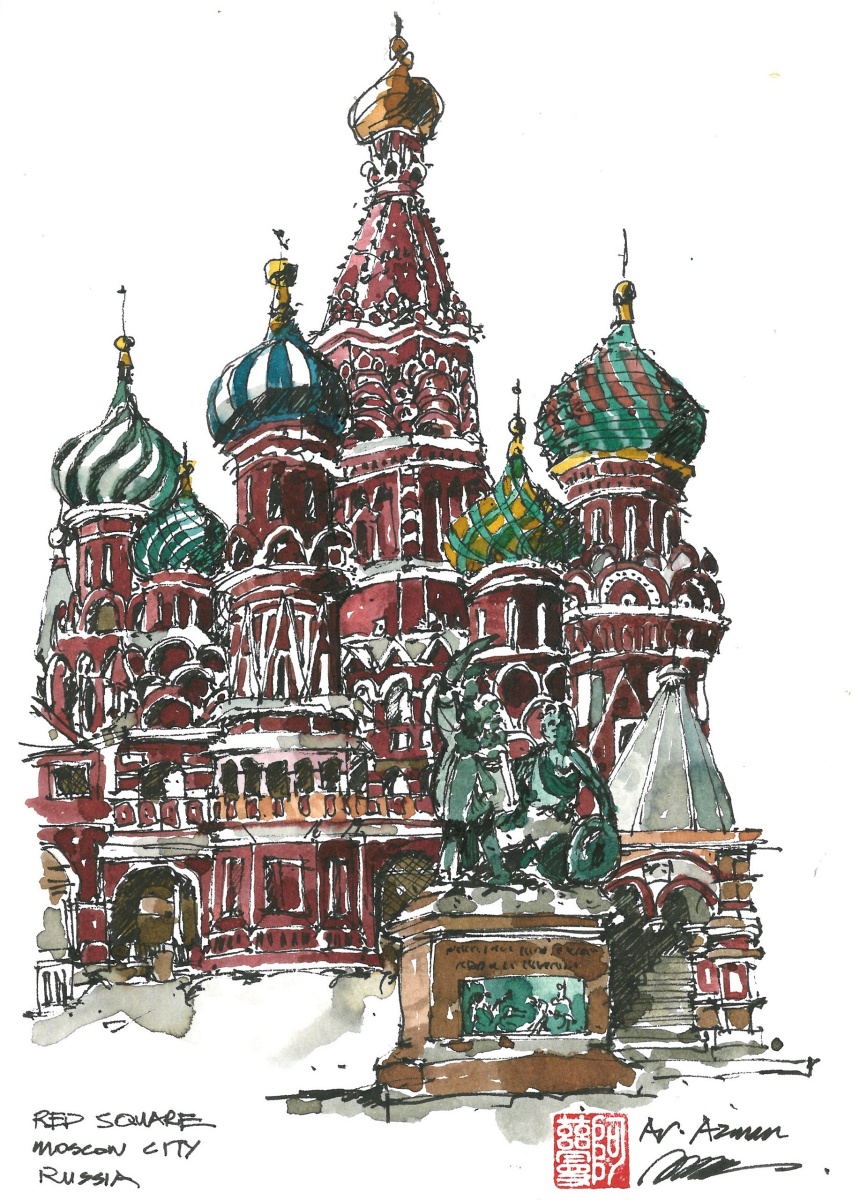
The most memorable sketch that I have done is the one that I started with a line sketch whilst standing right in front of the Red Square building in Moscow, Russia. As I can recall, the coldness of snow in Moscow has taken a toll on me but the opportunity to capture such a majestic building pushed me to take out my handglove and start the sketch. Despite the sketch could not be completed on-site, I find that the experience has pushed me to continue doing something that I’m fond of.
Another memorable sketch that forced me to take the longest 3 hours’ time is the line sketch of Seoul City which was taken from Namsan Tower. After completing the whole sketch, I decided not to apply any colour to it due to the experience that I had whilst in Seoul and not to lose all the details on the buildings. With such a memorable view of a concrete jungle and being softened by the hills and coastal view of Seoul, the sketch has given effects on me to appreciate such a bustling city life, the calmness of the ocean and indeed the whole landscape of Seoul.
AM
What were some interesting experiences that you had while sketching or travelling?
AH
Sketching on-site better known as urban sketching seems to become a trend all around the world not only for architects but also for every background of sketchers. Whenever I happened to be sketching on-site, most of the experiences would be dealing with spectators. It was interesting when people started to look at what I was doing and showed their interest in the work. Some would even approach me in person and show their interest and sometimes just to check what is happening. Despite the interest and attention given to me, I feel like I would prefer to work on my sketch in the studio as I feel that focus and concentration can only be attained while I am alone.
Sketching while I am on a long flight, however, seems to be more interesting when other passengers show their interest and do not pose as distractions as compared to on-site sketching. There was a memorable experience when a flight attendance has been trying to identify what I have been doing for hours. In the end, without hesitation, some other attendees approached me and only found out about the sketch. Throughout the trip, it was nice when I received special treatment when almost all flight crews were aware of that and approached me to see my work.
ADVICE
AM
AH
It is undeniable that sketching is of the utmost importance for architecture students. I believe that is the main reason why sketching by either pencil, pen or other media has been included in the curriculum. We can see some architecture schools are having activities on sketching including sketch competitions.
That would be a platform to discover and encourage students’ creativity and ability to sketch. Regardless of the technological advancement in this digital era, students are still required to come up with ideation in sketch form before possibly finishing the design using other computer software. It shows the importance of the ability to sketch among architecture students whilst they are in architecture schools as well as would be useful when they start a career in the real architecture world.
AM
Do you think students nowadays are losing the ability to sketch?
AH
AM
What advice would you give students who are starting/getting back into sketching?
AH
The ability to sketch or draw with a free hand can be mastered by anybody as long they possess passion, patience and skill. For me, there are some other tips for students who wish to pursue or start this skill:
Talent and creativity are in them
Once they have passion and creativity, learning and continuing with practice would be the key ingredients to success. Students have to give space to their ability to embark on something creative such as sketching even though the use of technology happens to be the current trend in producing artworks.
Never underestimate yourself
There are times that they might think that it is impossible for them to draw. Previous experience may have been the hurdle for them to try again and try more. I would advise that giving up on this would be the end of the skill. They have got to venture and prove to themselves that they can do that if they want to retry.
Never stop practising
To master sketching, never-ending practice must be upheld to ensure the skill can be improved. Working on a simple sketch would be better than stopping entirely. Students may find better ways of sketching through practice. Another method to practise is to replicate what others are doing and identify their skills to help elevate their skills as well.
Never trying to fill in the blanks
The Ecoline technique is very different from watercolour in the sense that we do not need to colour the entire paper. Simply leave some areas uncoloured to create borders and enhance the sketch style. The most important target for the sketch is to highlight the subjects and allow some white areas to form part of the sketch.
Be patient to find your style
With passion and perseverance being the utmost values in them, the students would be able to find their own styles. It may take a while but never-ending practice and patience will bear fruits. They have to discover their styles and have to be different. They should not be afraid of trying to be different as long as they can equip themselves with full dedication.
AM
What do you think students should learn first in their architecture education?
AH
Architecture students have to go through a lot during their early days in architecture schools since the architect’s role demands various skills and knowledge. Starting the whole thing as a basic skill would enable them to learn and subsequently to understand the knowledge. I think the ability to design would be the most important skill for architecture students. To be able to do that, they have to discipline themselves. That would be the success recipe to get through the long journey before they can call them architects.