

Building a strata development is never a straightforward exercise, especially when it features integration of residential, commercial, retail, hotel, or office components. These developments bring tremendous value and investment potential — but also introduce layers of legal, technical, and governance complexity, all at the same time.
To safeguard viability, prevent future disputes, and ensure long-term sustainability, conducting a comprehensive and ongoing Feasibility Study is essential. A one-off assessment is insufficient; building professionals, like architects, must continuously reevaluate assumptions as design evolves, authorities impose new requirements, and even as market realities evolve.
Below are three critical dimensions where ongoing feasibility assessments provide impeccable insights:
1 ALLOCATION OF SHARE UNITS: ENSURING FAIRNESS AND GOVERNANCE SUSTAINABILITY
In strata schemes, Share Units (SUs) determine voting power (hence collective decision-making), maintenance contributions, and overall influence within the Management Corporation (MC). In integrated developments, misalignment in share unit allocation is a constant basis of disputes. Why ongoing feasibility studies matter:
Design changes impacting SU distribution
As building plans evolve, floor areas, facility percentages and shared components may shift. These directly impact how share units should be apportioned under the Strata Management Act (SMA) and Strata Titles Act (STA). Without updated feasibility checks, developers risk ending up with skewed contributions or disproportionate voting rights across different components. The current regulatory regime, which offers only an inflexible SU prescription from Day 1, is not helpful for future market adaptation.
Integrated schemes require balanced representation
A mixed-use project may contain retail owners, office tower owners, residential parcel owners, and hotel operators. An ongoing feasibility review during planning and construction helps ensure SU distribution reflects each component’s actual usage, benefiting operational fairness.
Avoiding future disputes
An unclear or ill-considered SU allocation can lead to resistance in JMB /MC meetings, financial imbalance, or even legal challenges. Early recalibration prevents costly restructuring later, especially prior to the application and issuance of Strata Titles.
2 UNDERSTANDING OF PARCELS (MP VS AP): CLARITY IN OWNERSHIP AND RESPONSIBILITY
Integrated strata developments typically involve multiple types of parcels:
• Main Parcels (MP) – e.g., residential units, office suites etc.;
• Accessory Parcels (AP) – e.g., car parks, storage, balconies, etc.;
• Common Property (CP) – shared facilities and area incapable of separate individual ownership; and
• Limited Common Property (LCP) – exclusive-use zones for specific components only in exclusion of the othercomponents in the same strata community at the required Comprehensive Resolution by the Management Corporation.
Understanding the overlap and correlation among these categories is the key to determining operational responsibility, cost-sharing, and rights of use. Adding to the above equation is also the further specialisation of the parcel in a potential strata title delineation that can take the form of:
• Unit to unit;
• Multiples of units;
• Floor by floor;
• Multiple floors;
• En bloc building to building; to even
• Multiples of en bloc buildings.
All the above strata mutations can affect the SU allocation and the practical enjoyment of CP (including maintenance accessibility and the costs allocation accordingly) within the same strata scheme. Why ongoing feasibility studies matter:
Design modifications change parcel boundaries
A shift from open car parks to mechanical parking, or converting a floor to shared facilities, converting AP to CP or vice versa, are all significant development disruptors; updating the strata integration feasibility shall ensure the ownership structure is legally workable and practically sustainable.
Mixed-use arrangements intensify interdependency
For example, an office parcel may depend on a retail parcel’s loading bay, or a hotel component may require a dedicated entrance. Ongoing feasibility studies during the design stage prevent operational conflicts by identifying interdependencies early.
Correct titling ensures smooth management
Misclassification of spaces can lead to:
i. Disputes over maintenance obligations
ii. Incorrect billing
iii. Complications in subsequent LCP establishments
iv. Adverse impact on property value if usage rights are not well-defined
v. Continuous feasibility analysis enables the strata plan, proposed by-laws, and actual design to remain consistent throughout the development.

3 FLEXIBILITY, ADAPTABILITY AND SUSTAINABILITY: SAFEGUARDING A FUTURE-PROOF DEVELOPMENT
Modern integrated developments must be agile, able to adapt to evolving market demands, regulatory changes, and long-term maintenance needs. Why ongoing feasibility studies matter:
Market trends shift quickly
Retail formats change, co-working replaces traditional office layouts, and EV charging becomes essential, amid the ongoing global trend toward an energy transition away from fossil fuels toward new energy sources such as solar and hydrogen. Feasibility studies help anticipate demand shifts and allow early redesign and pre-designation of space.
Sustainability requirements are increasing
Environmental, ESG, and energy efficiency expectations are rising. Feasibility studies can identify opportunities to integrate green features, reduce long-term operating costs, and improve compliance with future regulations.
Operational adaptability must be built-in
Integrated projects with flexible infrastructure:
i. Scalable M& E systems
ii. Resilient traffic/parking management
iii. Convertible spaces, etc.
Ongoing feasibility exercises assess whether such adaptability remains feasible as design iterates, especially in the planning and construction stages.
Future maintenance burden must be predictable
Sustainability is not only environmental it is also financial sustainability. Feasibility studies help ensure maintenance costs are balanced across parcels and that the MC remains financially stable in the long term.
CONCLUSION: FEASIBILITY IS NOT A DOCUMENT — IT’S A CONTINUOUS PROCESS
For integrated mixed-use strata developments, a feasibility study should not be a one-off, once-and-for-all kind of exercise. It is a living assessment tool that evolves with design development, authority feedback, market conditions, and operational considerations. By continuously reviewing:
i. Share unit allocation,
ii. Parcel classification and boundaries, and
iii. Long-term flexibility, adaptability and sustainability, developers and investors can minimise risk, avoid future legal disputes, and create developments that remain valuable and functional for decades.
Of course, the biggest elephant in the room is that professionals tend to work in silos, and the architect should take on the role of a project manager who cuts across multiple disciplines to form an informed professional judgement to ensure the success of the
Integrated Mixed-Use Development as a going concern.
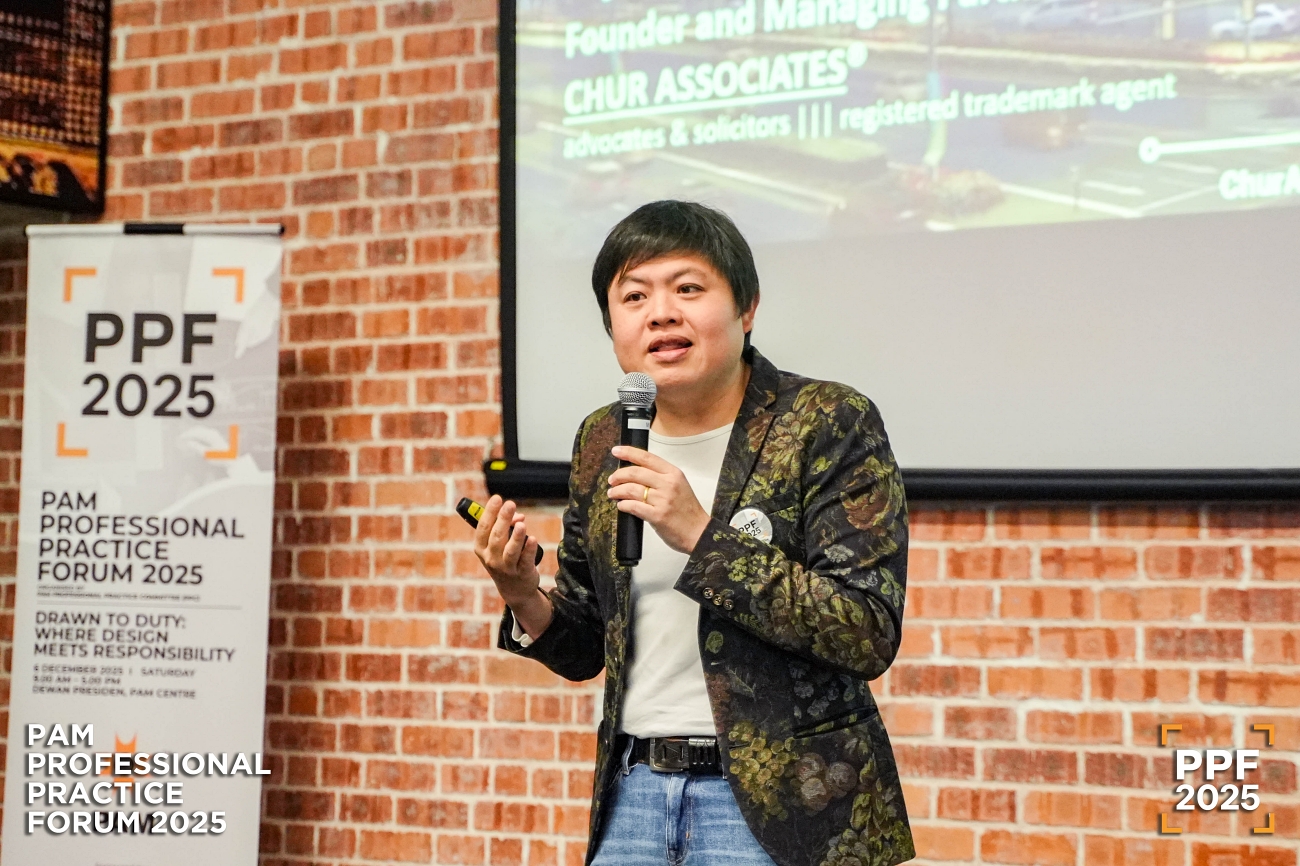
MR CHRIS TAN CHUR PIM
MANAGING PARTNER, CHUR ASSOCIATES
Chris Tan founded Chur Associates® in 2003 after becoming a practising lawyer in 2000, specialising in corporate real estate and strata law. He advises developers, GLCs and REITs on strata development, regulation and management. He is the author of Strata OMG – Owner’s Manual & Guidebook and serves as a panel judge for The Best Managed Property Awards by EdgeProp.my. He also lectures at Universiti Kuala Lumpur, sharing his expertise with practitioners and future strata professionals alike.