PROJECT OVERVIEW
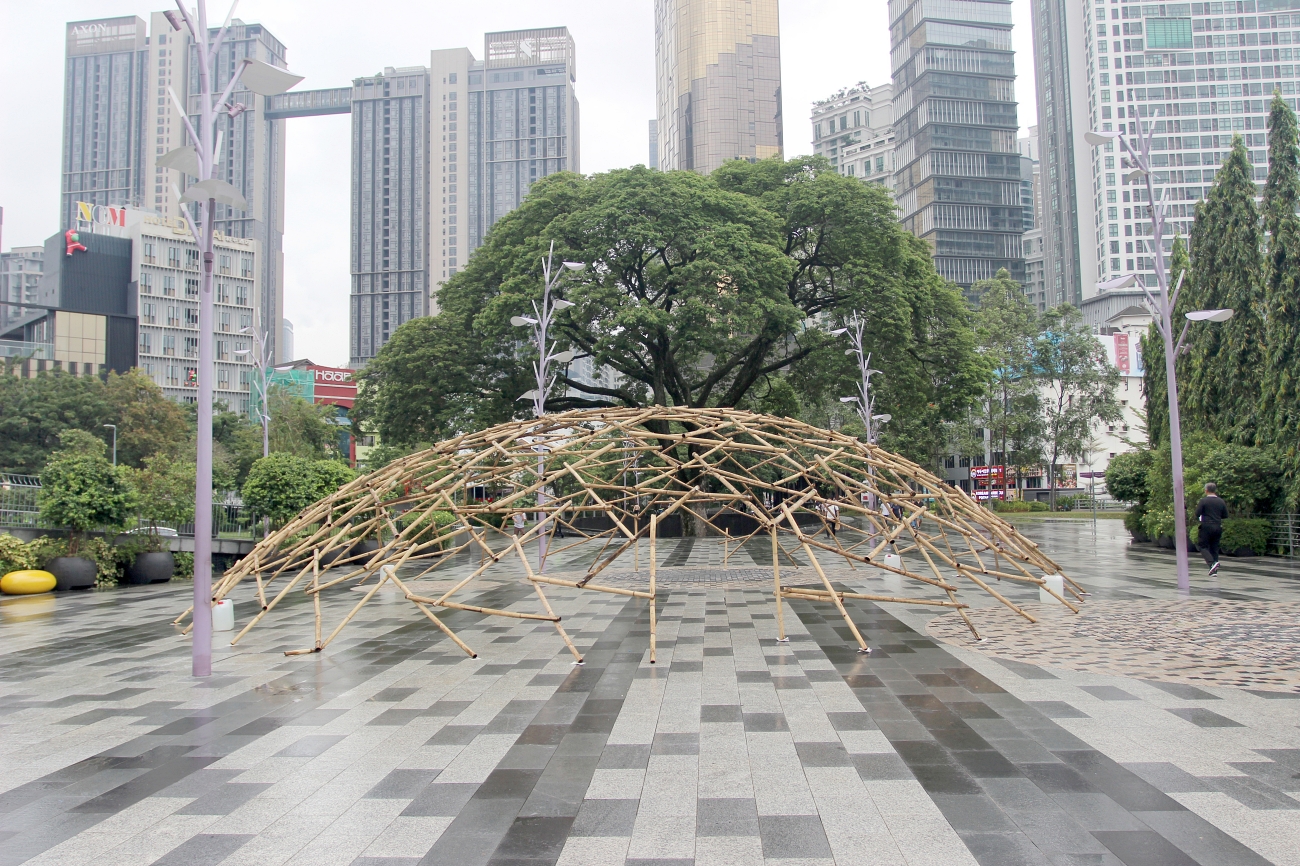
Can a large span structure emerge from short lengths of bamboo, modest joints, and the absence of heavy machinery? The Bamboo Dome responds not with architectural theatrics, but with structural intelligence. Developed through a design research collaboration between industry and academia, the project revisits the reciprocal frame. In this system, stability is achieved not through a dominant centre, but through mutual dependence among elements.
Constructed through hands on student involvement at Taylor’s University, School of Architecture, Building and Design, the dome frame demonstrates how computational design and vernacular logic can work in quiet concert.
Lightweight, column-free, and materially efficient, the structure reveals a form of making that privileges assembly over imposition. Its open lattice reads less as enclosure and more as shelter. Light passes through it, air moves freely, and the structure breathes with its surroundings. In this way, the bamboo frame echoes the wisdom of Southeast Asian vernacular architecture, where buildings are not sealed objects but living thresholds between ground, climate, and sky.
RECIPROCAL FRAME STRUCTURAL SYSTEM
At the core of the project is the reciprocal frame, a structural system formed from short linear members that depend upon one another for stability, without recourse to a central column or hierarchical load path.
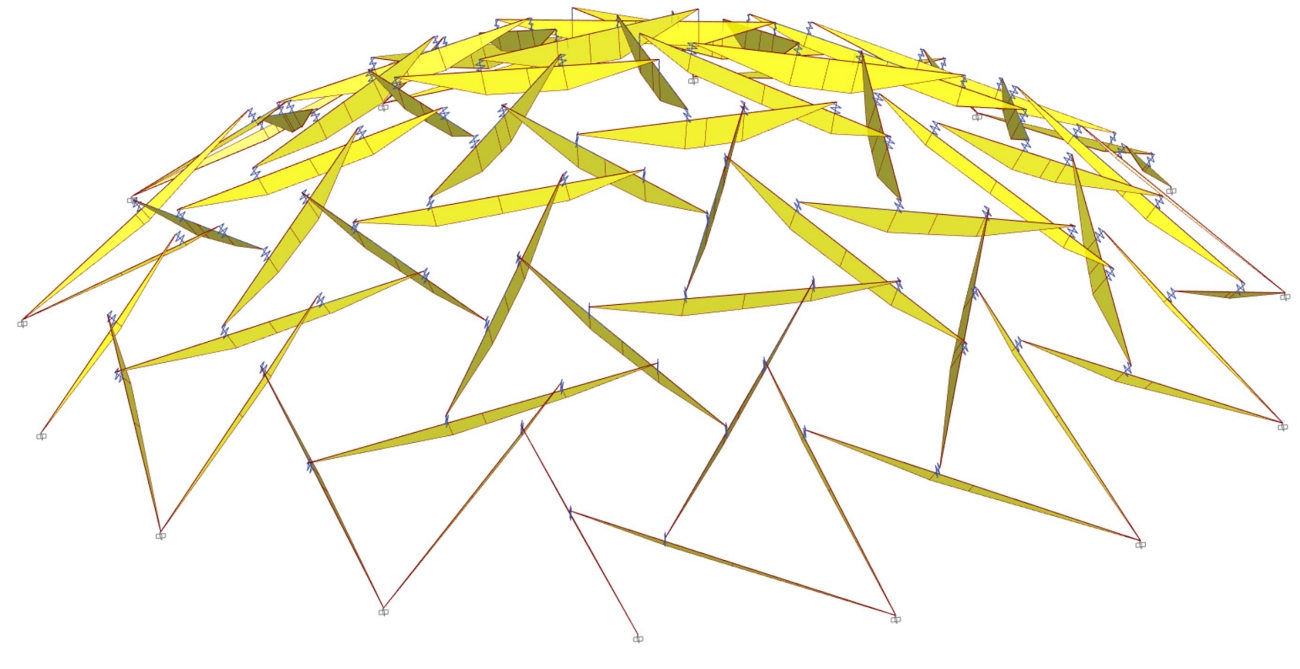
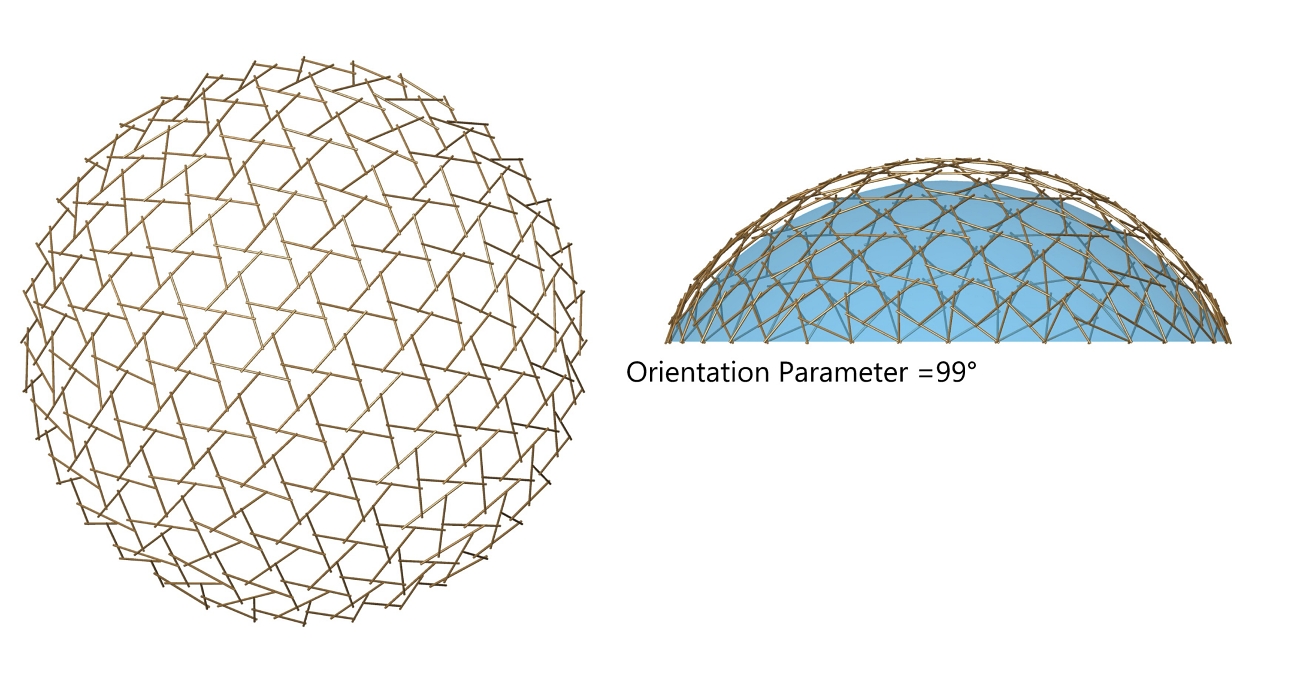
Where conventional beam and column construction directs forces in orderly descent, from slab to beam to ground, the reciprocal frame disperses load across the whole assembly. Each member carries and is carried in turn, producing a structure that is both redundant and resilient, its strength emerging from collective balance rather than singular support. It creates a structurally redundant and robust assembly. (Figure 1)
This structural logic enables generous column-free spans to be achieved using components that are modest in length and weight. Its principles are not new. Historical precedents can be found in timber architecture, most notably in twelfth-century Japan, where structures such as the Great South Gate of Tōdai ji reveal how geometric insight and skilled craftsmanship were employed to achieve stability without a central support. In contemporary practice, reciprocal frames have been revisited through computational design, allowing greater formal precision and geometric control. The bamboo frame extends this lineage, aligning inherited structural wisdom with present-day tools, while placing constructability and material efficiency at the forefront of its architectural ambition.
MATERIAL CHOICE AND JOINT STRATEGY
Bamboo was chosen not as an aesthetic gesture, but as a material grounded in place. Widely available across Southeast Asia, it offers a favourable strength-to-weight ratio, natural flexibility, and low embodied energy, qualities long understood in vernacular construction. In this project, however, bamboo is asked to perform within a contemporary structural system, requiring a careful balance between tradition and standardisation.
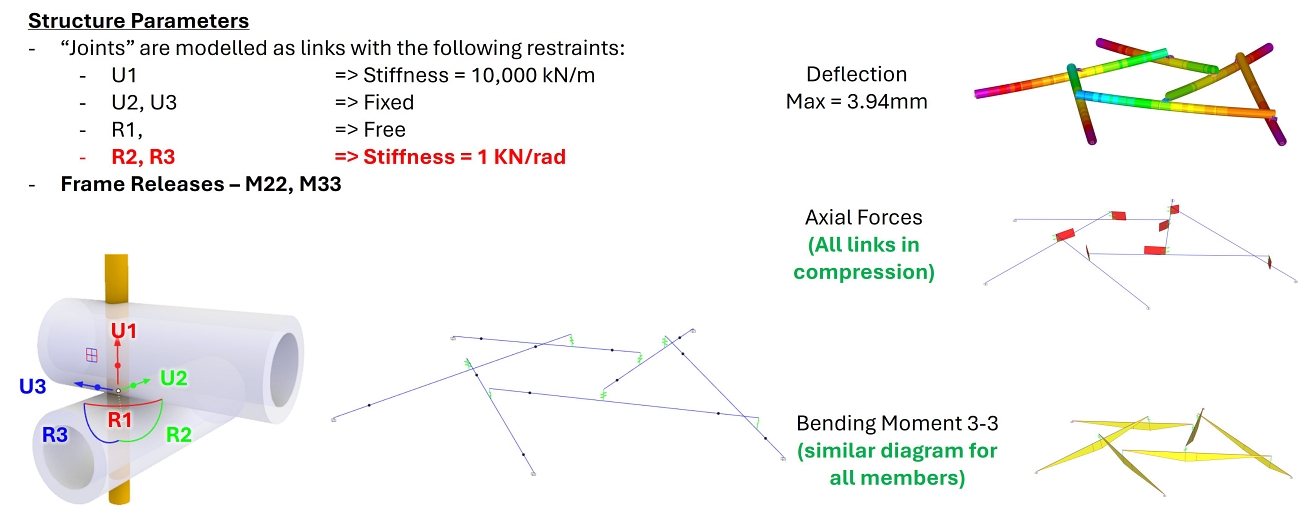
Rather than relying on traditional bamboo joints such as lashings or mortar-filled steel connections, which are labour-intensive and difficult to standardise, the project employs simple dowel (bolt) joints throughout. These joints act structurally as pin connections, carrying minimal bending moment. This simplifies fabrication, reduces construction time, and allows the structure to be assembled without heavy machinery, scaffolding, or specialised skills. (Figure 2)
Yet working with bamboo is not without its challenges. Natural variability, dimensional tolerance, and sensitivity to moisture introduce uncertainties that are often absent in industrial materials. These challenges are amplified in curved reciprocal structures, where the accumulation of short members can generate outward thrust and unintended deformation. Small geometric deviations at the local scale may, if unchecked, translate into significant distortions across the whole structure. Addressing this requires precise geometric definition, consistent joint detailing, and a clear understanding of structural behaviour, ensuring that material intelligence and geometric discipline work in concert.
COMPUTATIONAL DESIGN WORKFLOW AND STRUCTURAL MODELLING
To manage geometric and structural complexity, the bamboo frame was developed using a fully computational design workflow. Here, digital tools do not replace tradition, but extend it, offering a contemporary means of engaging with a structural logic that has long relied on intuition, experience, and craft. What was once resolved through hand and eye is now explored through mathematics, algorithms, and models, allowing inherited knowledge to be tested, refined, and carried forward.
The process began with defining a guide surface that established the intended overall form, span, and spatial performance of the dome. This surface was subdivided into a mesh, each edge corresponding to a potential bamboo member. Through controlled geometric transformations, these edges were rotated and repositioned to generate reciprocal units, ensuring mutual support without a central structural anchor. Mutual support was achieved by solving interdependent geometric equations, ensuring that each member rested correctly on its neighbours.
Structural behaviour was assessed using three-dimensional computational models capable of predicting deformation and load distribution in pin-jointed reciprocal frames. Unlike shell structures, which primarily resist forces through membrane action, reciprocal frames behave as assemblies of beams subject to bending, tolerance accumulation, and global deflection. For students involved in the project, this process transformed abstract structural principles into observable consequences, bridging theoretical understanding and physical outcome. (Figure 3)
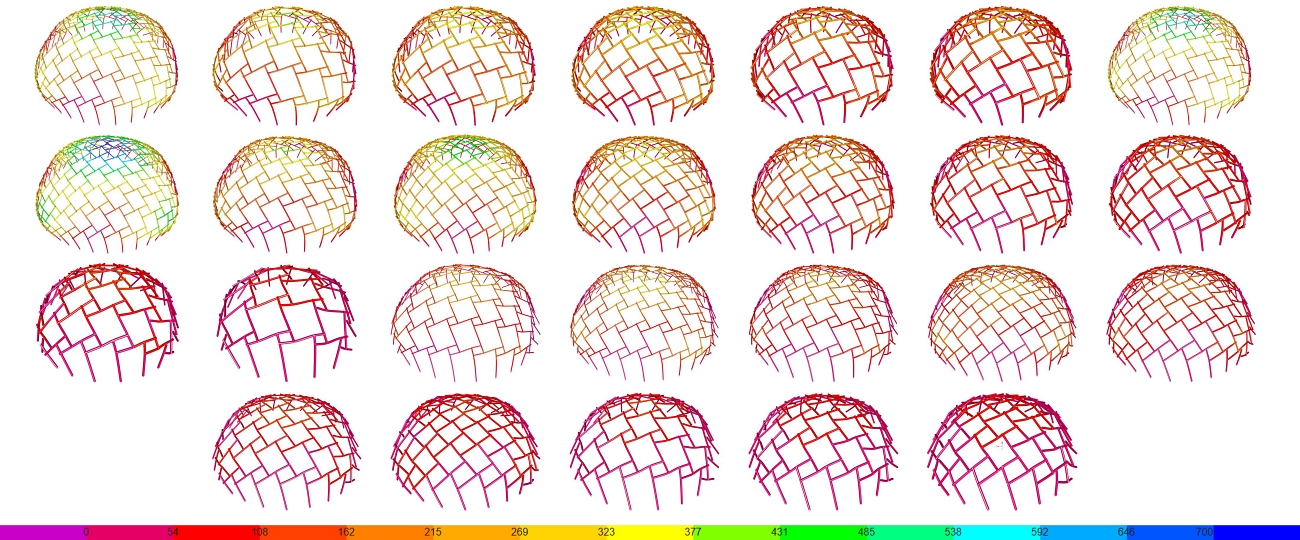
By evaluating these behaviours in advance, the design team reduced reliance on trial-and-error construction, a constraint historically accepted in craft-based building. Instead, digital simulation offered a means of learning through prediction and verification, allowing design decisions to be tested before they were built. The workflow thus became both a design tool and a pedagogical framework, aligning computation and craftsmanship, and enabling bamboo, a material rooted in tradition, to be engaged with the precision and responsibility demanded by contemporary architectural practice. (Figure 4)
FABRICATION AND ASSEMBLY
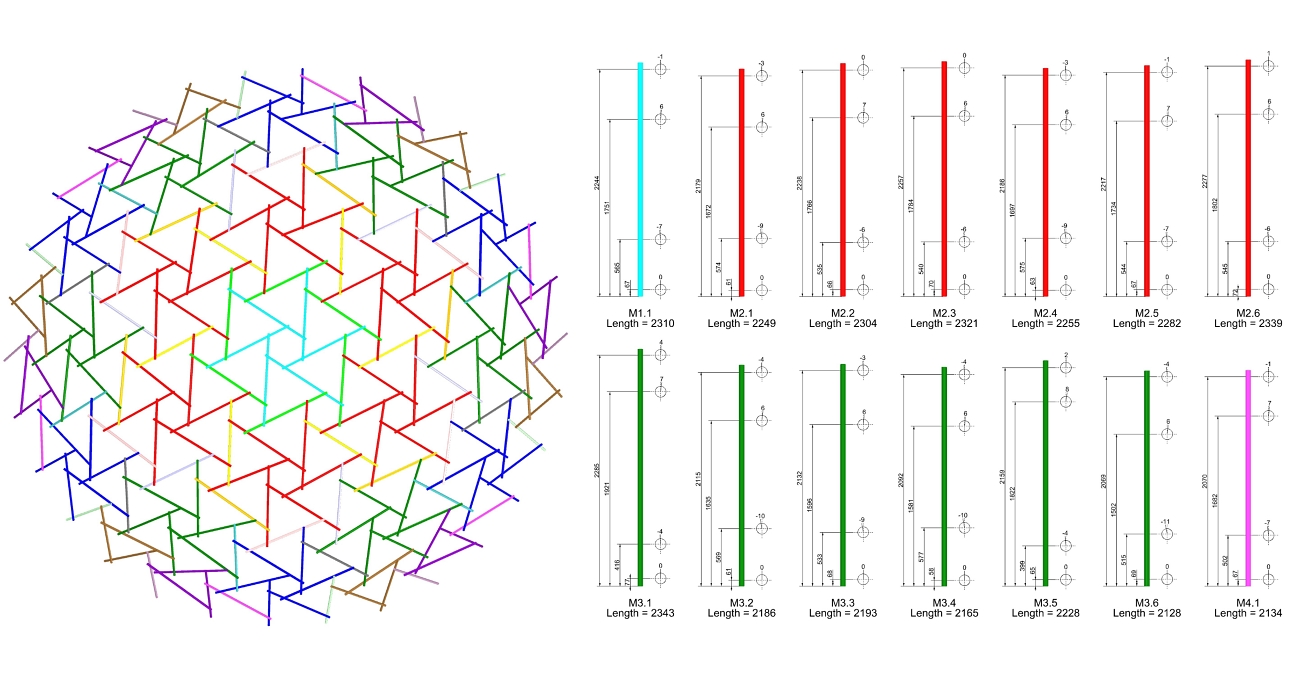
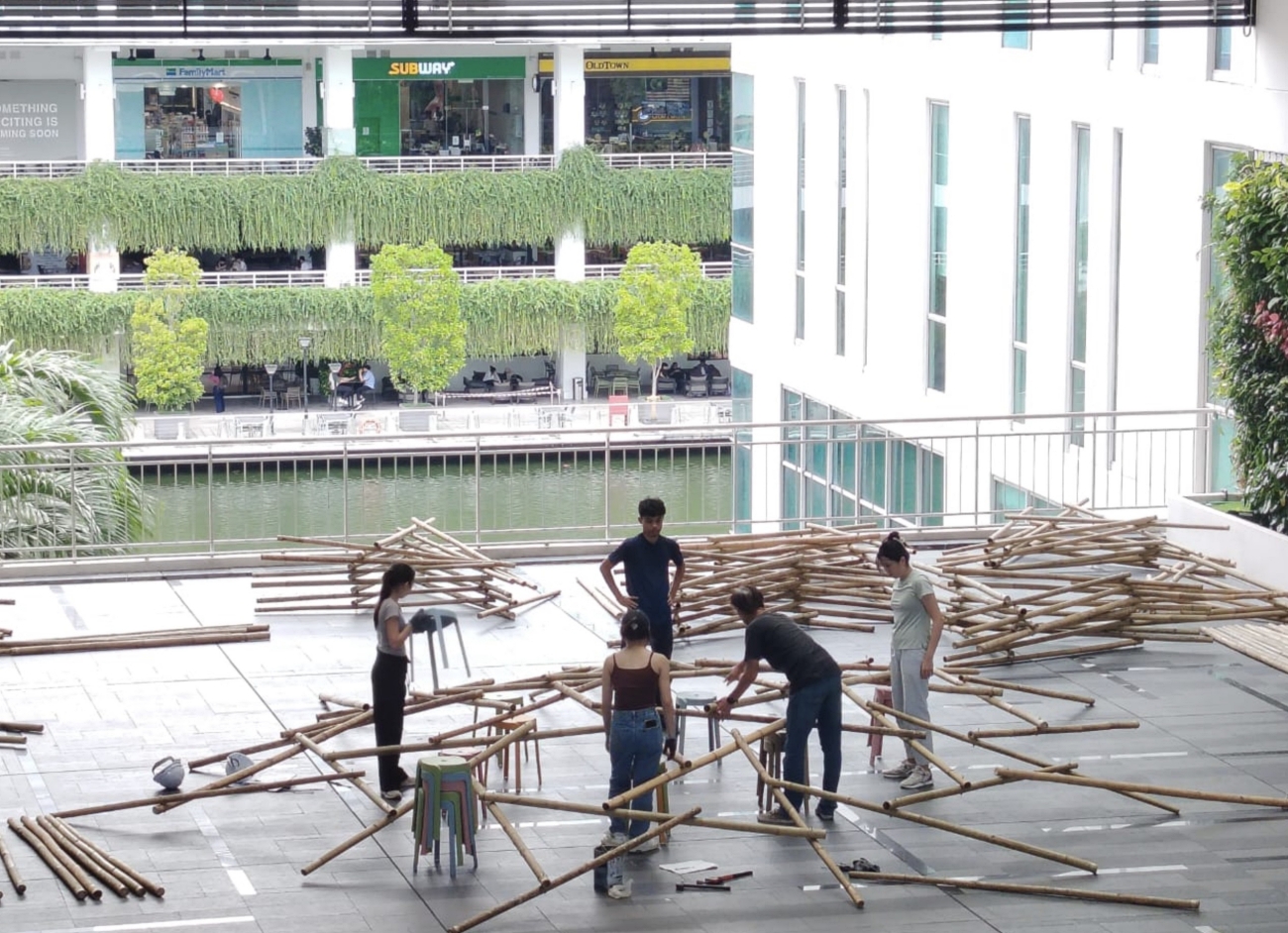
The digital model extended beyond design intent to become an instrument of making. It served simultaneously as drawing, instruction, and guide, translating geometry into action with clarity and restraint. The completed structure comprises 210 bamboo members connected through 780 precisely drilled joints, each derived directly from the computational model. By exploiting sixfold symmetry, the system reduced complexity through repetition. Thirty-five unique member types were identified, each repeated six times, allowing variation to emerge from order rather than excess. Member lengths, joint locations, orientations, and assembly sequence were derived directly from the model. This approach minimised on-site error, shortened construction time, and ensured consistency across the structure, allowing the reciprocal logic to be realised as intended. (Figure 5)
The first bamboo frame was assembled using bamboo members measuring between 1.90 m and 2.15 m in length, achieving a clear span of 13.8 m and a height of 3.6 m. It was installed for The Dome & The Aperture exhibition at Taylor’s University from 19 September to 3 October 2025. The structure was subsequently dismantled and reassembled at Raintree Plaza, TRX, from 19 September to 24 December 2025. Its successful relocation underscored the frame’s modularity and structural resilience, demonstrating how a system built from modest components can adapt to multiple contexts without loss of integrity.
FUTURE APPLICATIONS
The bamboo frame unites computation, material intelligence, and hands-on construction into a single architectural proposition. Through its digital workflow, precise fabrication, and repeated assembly across different sites, the project demonstrates how complex spatial and structural outcomes can emerge from simple components when guided by coherent geometry and reciprocal logic. What begins as a computational surface becomes a buildable system, realised faithfully through careful assembly, where each member both carries and is carried. Lightweight, column-free, and materially efficient, the frame transforms modest bamboo, short joints, and careful planning into a structure that breathes, admits light and air, and responds to its environment with quiet intelligence.
While functioning as a temporary shelter, a research demonstrator, and a structural prototype, the principles of pin-jointed reciprocal frames extend beyond bamboo and frames, offering possibilities for timber, paper tubes, plastics, and glass, as well as more complex geometries. By emphasising material efficiency, ease of construction, and reduced reliance on heavy machinery or specialised labour, the project exemplifies an architecture built through balance rather than imposition. In doing so, this project answers its own central question: a large span structure can emerge from short bamboo members and modest joints, not through spectacle, but through structural intelligence, collective effort, and the seamless alignment of traditional
wisdom with contemporary computational tools.
ACKNOWLEDGEMENTS
In this collaboration we would like to give special thanks to Mr Wong Kok Meng of Trunorth Sejati Sdn Bhd and Mr Tan of Kimmean Engineering Works Sdn Bhd, Taylors University Architecture Students who participated in the built and Ar. Dr. Sze–ee Lee who conceptualized and coordinated the project.
Structural Design:
Fromweb Sdn Bhd
Computational Design:
Alex Chow Autonomous Designs Sdn Bhd (ACAD)
Taylor’s University Students:
Afrin Begam, Amber Lim, Ameer Nabil Ramli, Charmaine Soo Junn Yi, Jessica Lee Zhi Lyn, Lama Fahd, Lim Xi Yun, Loke Qian Dong, Ng Jian Ping, Sangetha Krishna, Tan Jun Kai, Tehjyajoshi, Tong Xuan / Boey, Umama Umer, Wan Muhamad Haiqal, Chee Weng Hou / Izen