In this reflective conversation, Kaiyi Wong discusses how his Malaysian pragmatism and UK philosophical training shape a practice that balances structure and spirit, culminating in his identity-driven solo exhibition, What Holds the Glow, and a confident, evolving artistic voice.
Interview by Cheah Ee Von
Photos by Aaron WongYS
Nice to meet you again, Kaiyi. Could you briefly share your background in architecture and how your education in Malaysia and the UK has shaped your current practice?
KYW
Thank you for the interview. I am honoured to share this conversation with you. I completed my undergraduate degree at UCSI, which gave me a solid and practical foundation — how buildings come together, how offices work, and how to be productive under pressure. My first internships made me realise, quite quickly, that only a fraction of what we learn in school translates directly into practice. That experience was intense, but important. It also made me question what kind of architectural life I wanted.
I eventually decided to pursue a master’s degree at the University of Sheffield. Studying in the UK was transformative. The pedagogy there was far more exploratory and philosophical. Tutors pushed us to question intention, meaning, and narrative before jumping into form. It was not just about producing work, but about articulating why you do what you do, and how ideas translate into something tectonic, buildable, and real.
In many ways, my education balances two worlds: Malaysia trained me to be efficient, pragmatic, and grounded; the UK trained me to think critically, reflect deeply, and communicate ideas with clarity. That balance continues to shape my work today.
CEV
Congratulations on your recent solo exhibition at Core Design Gallery, by the way. Could you share why this moment felt right for you to stage your first solo?
KYW
This exhibition marked a personal turning point. I came into the art world through architecture and commercial commissions, and for a long time I was questioned — by others and by myself — about whether I was “serious” as an artist. I do not come from a fine art background, and that carries its own prejudice.
A solo exhibition removes all excuses. There is no client, no brief. It becomes an act of self-definition. This show was my way of stating clearly that I am committed to this practice — not as a hobby, but as a vocation. Core Design Gallery gave me that trust. Chun, who is also an architect, understood the position I was in. He allowed me full freedom to explore, and that freedom was essential.
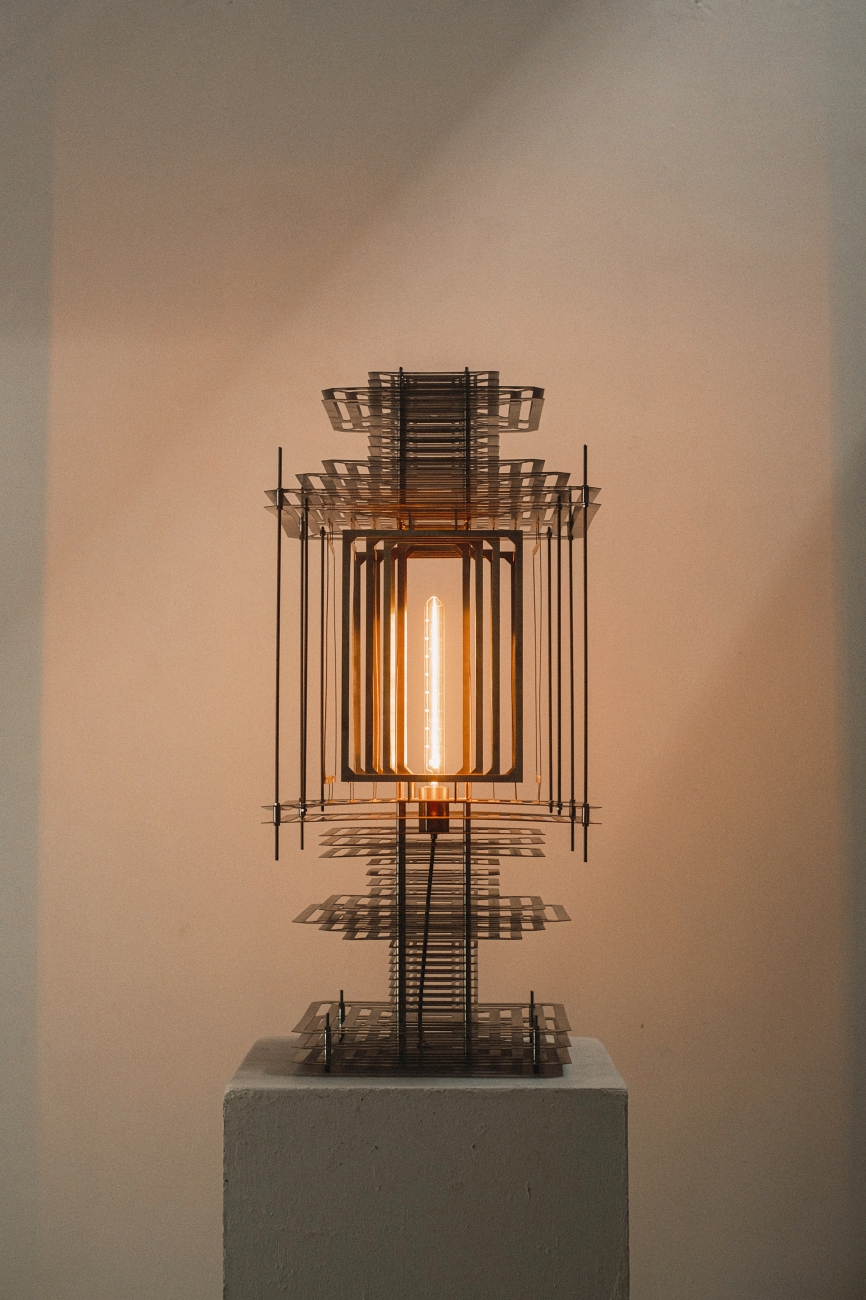
Stillness (2025) draws from the Hakka Tulou, creating a space for reflection, introspection, and quiet return
CEV
Could you explain the concept of your solo show — What Holds the Glow?
KYW
The work grew out of questions of identity. Studying in the UK made me acutely aware of my own cultural fragments — things I had absorbed growing up in Malaysia without consciously questioning them. Lanterns, temple roofs, family rituals, ideas of balance and restraint. These were familiar, but unexplored.
I began researching my Hakka heritage and discovered how architecture, culture, and behaviour are deeply intertwined — how values are passed down through spatial traditions. This led me to Song Dynasty philosophy, which emphasises balance, modesty, calmness, and honesty. These are not just aesthetic qualities, but ways of living.
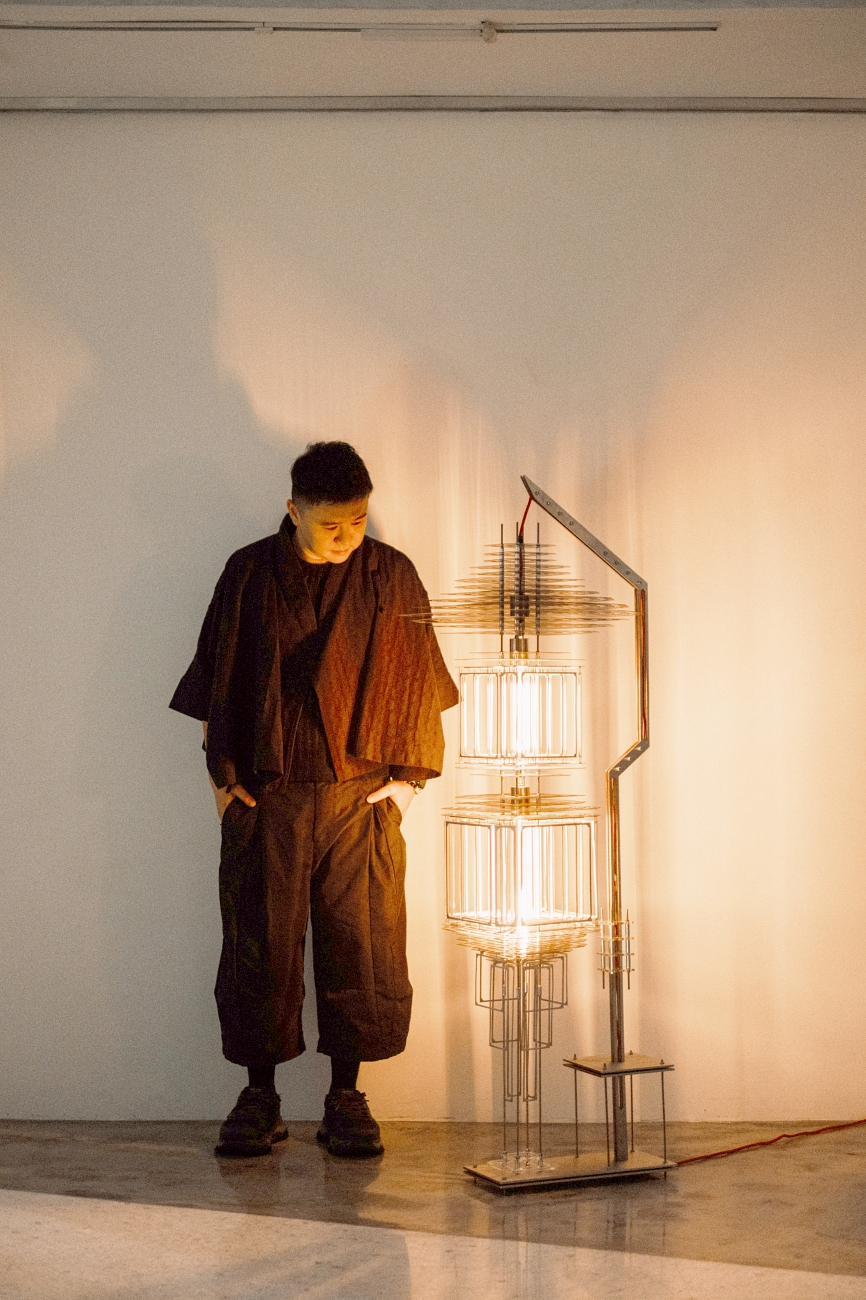
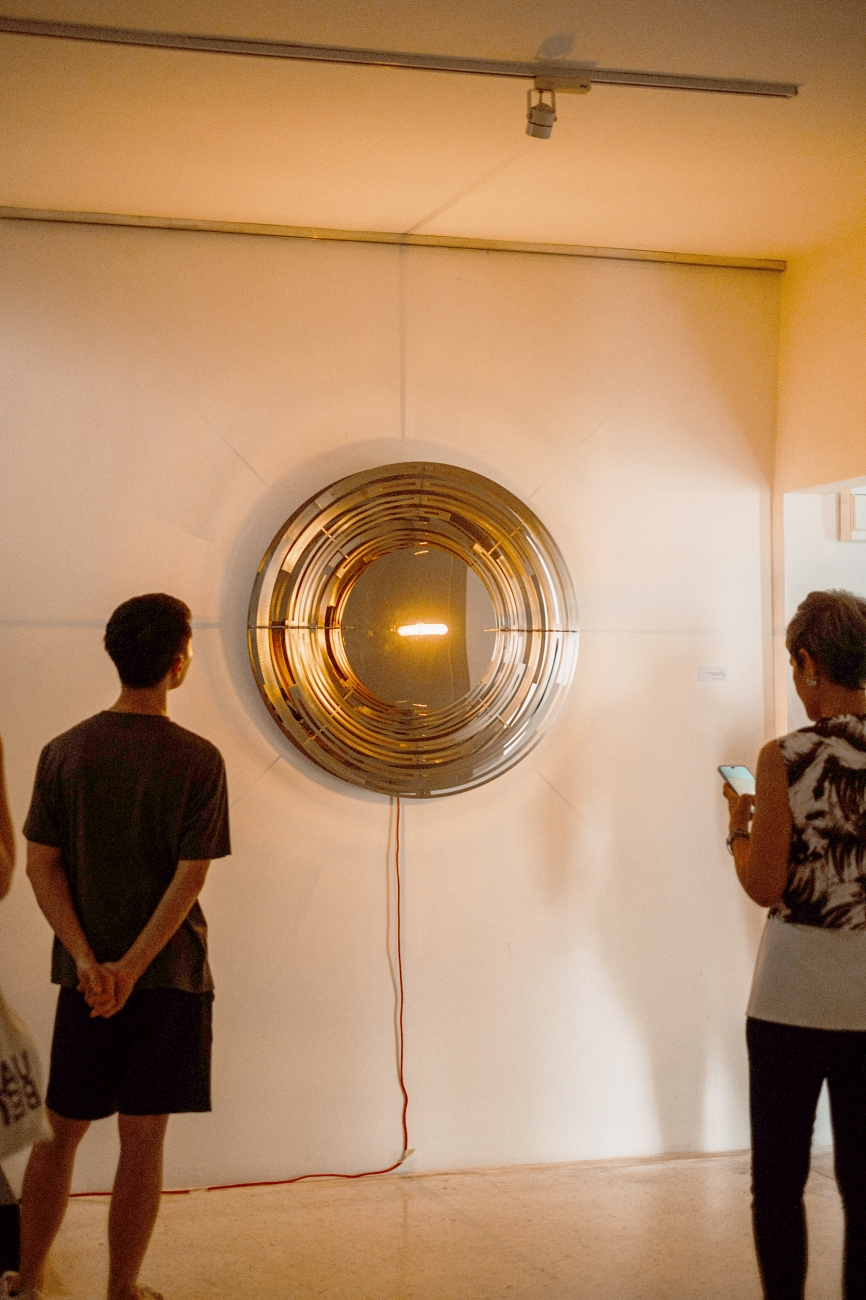
Those principles shaped the exhibition. Each piece embodies a specific value — Composure, Equilibrium, Existence, Stillness. Architecturally, the works literally hold light. Conceptually, they ask: if we strip away façade and material excess, what remains? What holds our inner glow — our values, character, and sense of self?
The title plays on that duality: glow and soul. Structure and spirit.
CEV
Your commissioned works differ noticeably from this exhibition. How do you navigate personal expression within commercial projects?
KYW
Balance. Clients usually approach me because they are already familiar with my language. I am very clear from the beginning that I will interpret their brief through my own lens. That said, it is always a negotiation.
I believe in mutual respect. Clients are not paying for pure self-indulgence — they need their needs met. My approach is to identify what truly matters to them, fulfil those core requirements, and then use the remaining space to inject my own narrative. When clients feel heard, they become more open to unexpected ideas.
Over time, consistency helps. When you develop a recognisable approach — certain obsessions with material, structure, or storytelling — you no longer need to convince people so much. They come to you because of that voice.
Axis (2025) reflects the idea of an inner principle, where structure becomes a guide for balance and direction
CEV
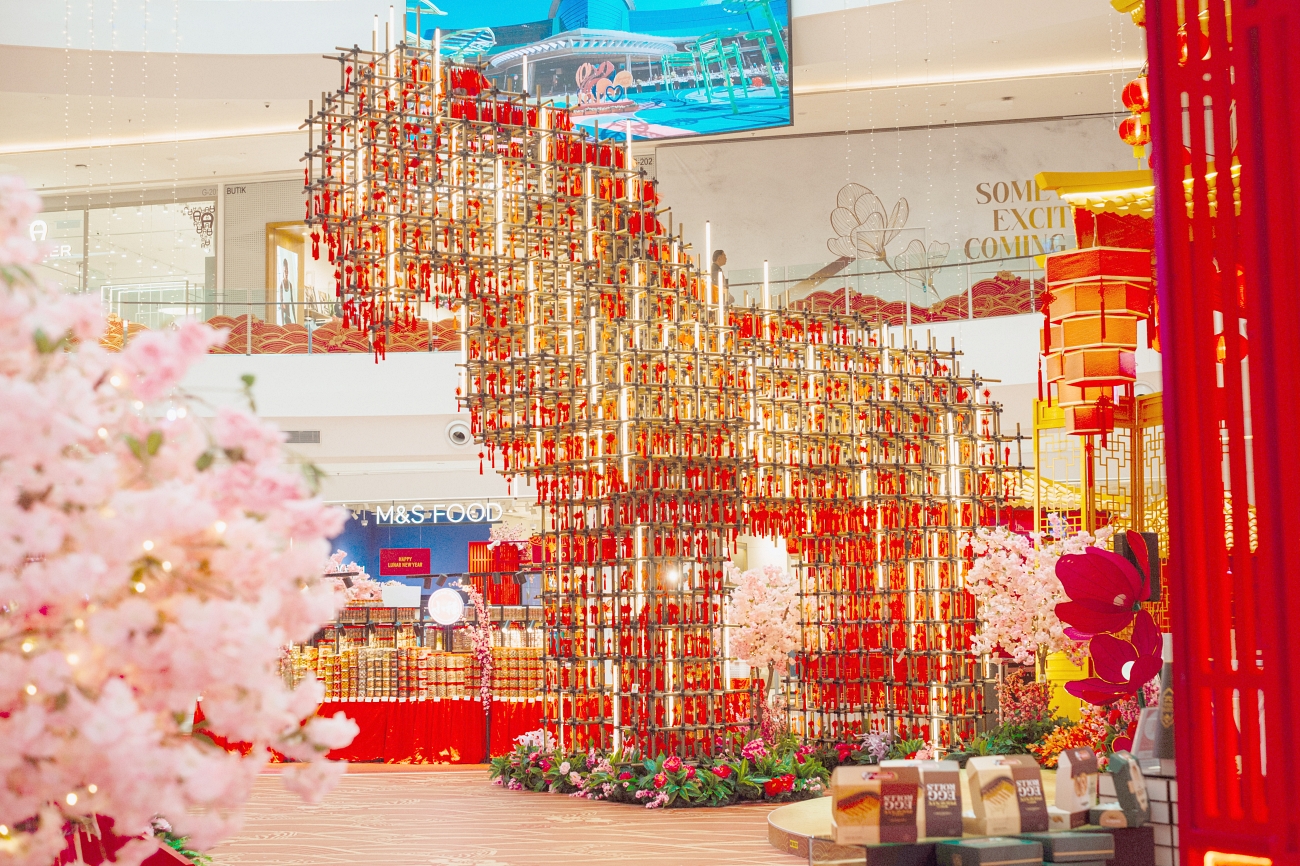
Your other recent project—the 7 metre tall Trojan of Light installation at IOI Mall — was monumental in scale. How does working at a large scale differ from working at a smaller one?
KYW
Large-scale work is unforgiving. Every technical decision multiplies in cost, logistics, and risk. One miscalculation can cost thousands. You have to simplify, plan meticulously, and think about materials, joints, assembly, transport, and safety far in advance.
Smaller works, by contrast, allow for experimentation. You can afford to fail, rebuild, and refine. That freedom lets you push technical and conceptual boundaries in different ways. Scale doesn’t define difficulty — it defines responsibility.
CEV
Many students struggle with open briefs. Do you have advice on developing one’s own perspective while still responding to constraints?
KYW
Having your own voice is no longer optional — especially in an era shaped by AI. Students must learn to think critically and independently.
It is okay to imitate at first. Find practitioners you genuinely admire and study them deeply. Over time, patterns emerge — your own obsessions, instincts, and questions. That repetition becomes identity.
At the same time, understanding the brief is crucial. Even fulfilling half of a client’s expectations can buy you the freedom to explore the other half on your own terms. Good design is not rebellion — it is alignment.
Trojan (2025) installation expresses an honest tectonic language, designed to adapt and transform across different festive context
CEV
Finally, what aspects of architectural education have been most valuable to your current practice?
KYW
Confidence and communication. Architecture trains you to speak clearly, defend ideas, manage teams, and solve problems under pressure — even when you don’t yet have all the answers.
Leadership roles during university taught me how to work with people. Practice taught me speed, accountability, and pragmatism. And my time in the UK taught me empathy — how to critique constructively, how to listen, and how to bring people along with you.
Architecture gave me more than a skillset. It gave me a way of thinking — and that continues to underpin everything I do.