
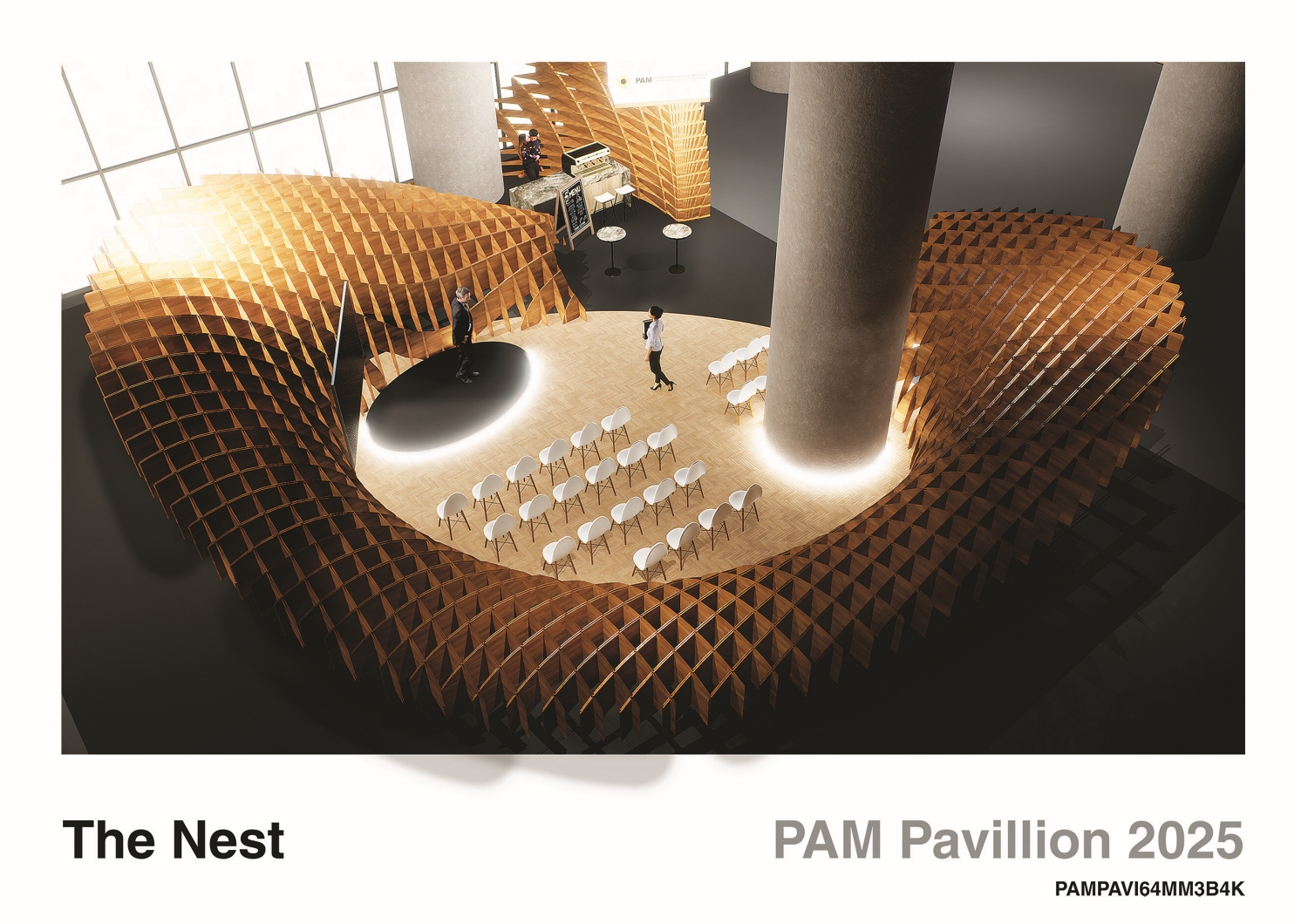
The winning design stands out for its parametric elegance and deep integration of digital fabrication with traditional materiality. Achieved through a series of small, modular timber components, the pavilion exemplifies how advanced computational design can produce a visually compelling and constructible form. What makes it especially noteworthy is its precision and efficiency: each element is CNC-ready, minimising waste and optimising buildability. This isn’t a case of digital design forits own sake, but a purposeful application of technology that elevates both form and function.
More than a technological showcase, the pavilion embodies a contemporary Malaysian design ethos by merging innovation with cultural authenticity. It honours Malaysian timber not just as a surface treatment, but as a core structural and experiential element. Drawing inspiration from tanggam
—a traditional Malay woodworking technique involving interlocking joinery—the design evokes the tactile warmth and spatial richness of vernacular architecture. However, instead of replicating tradition, it reinterprets it through the lens of modern digital tools and fabrication methods. In doing so, the pavilion acts as a bridge between past and future, symbolising a progressive yet rooted approach to architectural identity.
Malaysian timber, with its innate strength, beauty, and sustainability, plays a pivotal role in pushing the boundaries of modern architectural design. Its adaptability to digital fabrication processes like CNC milling makes it a material that speaks to both heritage and innovation. By embracing timber as a structural system—rather than just a decorative element— architects are unlocking its full potential as a cornerstone of a new regional language. This approach positions Malaysian timber as both culturally resonant and technologically forward, allowing for architecture that is expressive, efficient, and ecologically sound.
Sustainability is not just a benefit of using timber; it is an imperative. As climate challenges intensify, architects must turn to renewable, low-carbon, and locally sourced materials. Malaysian timber meets all these criteria while also embodying the narratives and identity of place. Designing with such materials allows architects to create spaces that are not only environmentally responsible but also deeply meaningful and rooted in context. Among the competition entries, several emerging trends were apparent. Chief among them was a growing interest in digital craftsmanship—not for visual complexity, but to enhance sustainability, buildability, and material efficiency. Tools like parametric modelling and CNC cufling are being used in the service of smarter, more responsible construction. Furthermore, there is a noticeable shift in how timber is perceived: not merely as a finish, but as a complete system—modular, structural, and reconfigurable.
The Nest draws its inspiration from the elegant undulations of the cosine wave and a bird’s nest – translating mathematical rhythm into spatial poetry. It is a celebration of form, precision, and material honesty, brought to life through locally sourced timber.
Crafted through laser-cut precision, the pavilion’s waNe structure forms a flowing canopy that mimics the smooth curvature of a waveform. This structural logic allows for a light yet strong framework showcasing the synergy between digital fabrication and traditional materials.
WINNER B
WEAVESCAPE
by Ar. Esmonde Yap Shiwen
Weavescape: Crafting a Tapestry of Timber Futures is a dual-shell pavilion that redefines Malaysian timber architecture by challenging the notion that timber is limited to straight, perpendicular structural use. The design experiments with a modular bending system to form two intersecting self-supporting arches, relying on gravity and natural load transfer principles. The pavilion uses Jelutong, a lightweight Malaysian hardwood with fine, straight grain, chosen for its ease of bending and crafting.
Construction employs a reinterpretation of the traditional tanggam joining method, using only dowels to allow for flexible, tool-free assembly and disassembly, maximising reuse potential after the exhibition. This approach aligns with sustainable and circular design principles promoted by the Malaysian Timber Council, offering full reusability without permanent fasteners.
The intricate spatial experience of Weavescape invites visitors into a sensory journey of light and shadow, while evoking cultural references to Malaysian weaving traditions such as the tanjak. The result is a poetic yet practical timber expression that blends material innovation, structural clarity, cultural storytelling, and sustainable vision -designed to captivate architects, industry experts and the public alike.
Weavescape ultimately elevates timber design in Malaysia and positions it on a global stage through its sculptural presence, demonstrating the untapped potential of local wood species in bending, fluidity and innovative jointing systems.
WINNER C
THE HEXAMORPH PAVILION
by Ar. Nuradelin Binti Ahmed
The modular design of the project enables the reconfiguration of components into various spatial and functional arrangements, fostering adaptability and multipurpose use. Hexaunity is more than a spatial framework – it represents a shared ambition to unite architects, designers, and built environment professionals. Rooted in the harmony of the hexagon, the pavilion celebrates collaboration and togetherness with the support of Pertubuhan Arkitek Malaysia (PAM).
The use of orange in the design draws from the PAM logo, reflecting its vibrant identity while paying tribute to its role in shaping Malaysia’s architectural community. Theme: interconnected hexagonal modules.
In an age of environmental urgency, Adrianta argues that façades must serve more than symbolic roles-they must become climate-conscious elements that actively improve energy performance and user well-being. The façade, therefore, transforms from a passive surface into a responsive, breathing layer that interacts with the tropical environment. It becomes a vital component in designing buildings that are both environmentally adaptive and socially resonant.
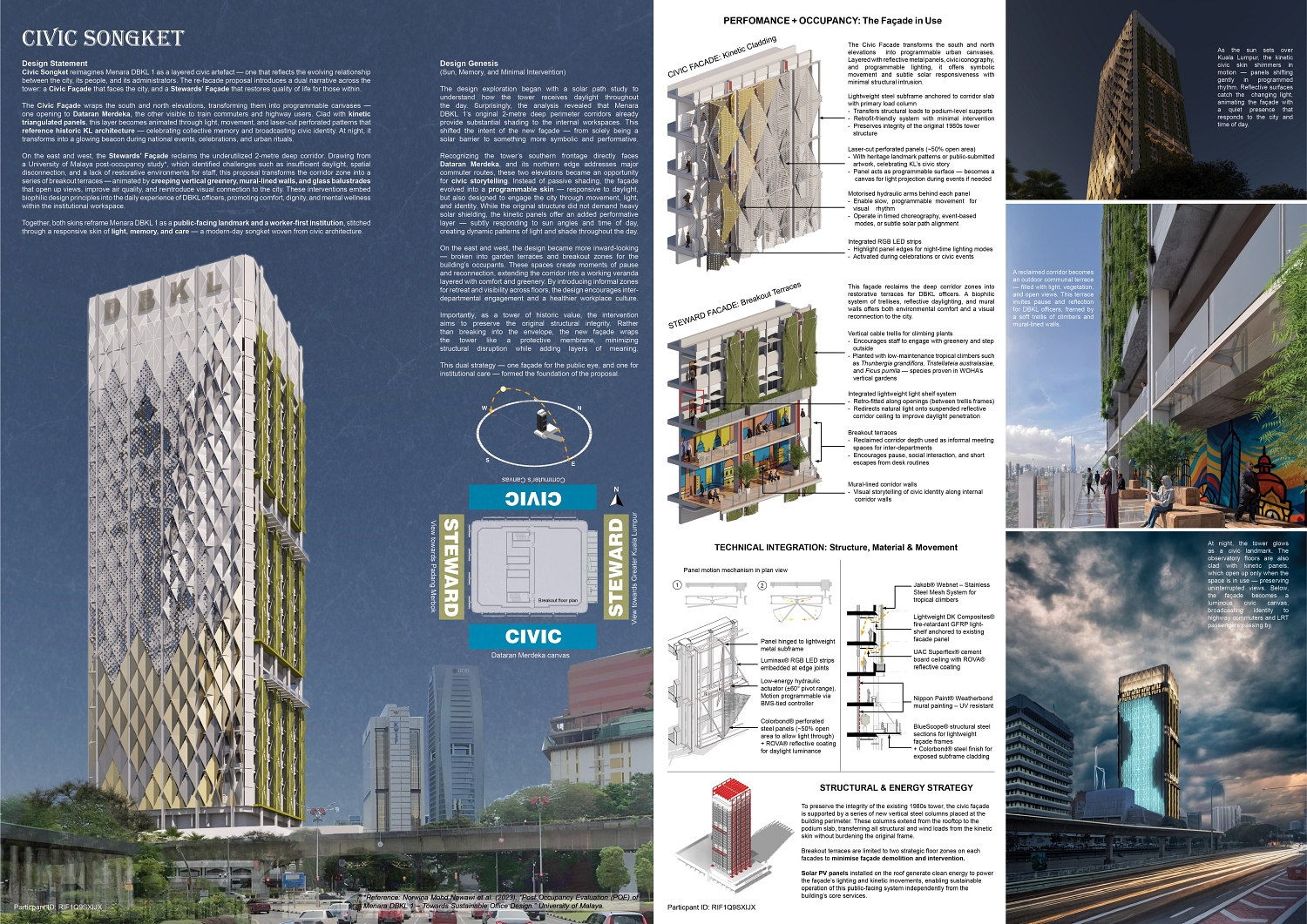
He also characterises the built environment as a “living canvas,” where Malaysian architects can celebrate the convergence of innovation and heritage. This poetic framing challenges the profession to design boldly, yet responsibly -anchoring each design in relevance, resilience, and a deep sense of place. Supporting this vision, Ar. Azlan Syarawi Mohd Mokhtar reflects on a specific competition entry that excelled in delivering a dual narrative: a civic façade and a steward’s façade. Each side of the building responds to its surrounding urban conditions with clarity and purpose. The kinetic articulation and clear demarcation between zones signal a sophisticated grasp of how façades can perform differently within a single project.
Ir. Ng Pek Har adds a technical perspective, praising the adaptive reuse of under-utilised deep corridor spaces. By transforming them into breakout zones connected to external daylight via terraces and balconies, the proposal injects vibrancy and function into existing spatial limitations. The inclusion of motorised fins that respond to climate enhances its sustainable credentials, showcasing an active relationship between form and environmental performance.
Civic Songket reimagines Menara DBKL 1 as a layered civic artefact-one that reflects the evolving relationship between the city, its people and its administrators. The re-façade proposal introduces a dual narrative across the tower: a civic façade that faces the city, and a stewards’ façade that restores quality of life for those within.
The civic façade wraps the south and north elevations, transforming them into programmable canvases-one opening to Dataran Merdeka, the other visible to train commuters and highway users. Clad with kinetic triangulated panels, this layer becomes animated through light, movement and laser-cut perforated patterns that reference historic KL architecture -celebrating collective memory and broadcasting civic identity. At night, it transforms into a glowing beacon during national events, celebrations and urban rituals.
On the east and west, the stewards’ façade reclaims the under utilised 2-metre-deep corridor. Drawing from a university of Malaya post-occupancy study, which identified challenges such as insufficient daylight, spatial disconnection, and a lack of restorative environments for staff, this proposal transforms the corridor zone into a series of breakout terraces – animated by creeping vertical greenery, mural lined walls, and glass balustrades that open up views, improve air quality, and reintroduce visual connection to the city. These interventions embed biophilic design principles into the daily experience of DBKL officers, promoting comfort, dignity and mental wellness within the institutional workspace.
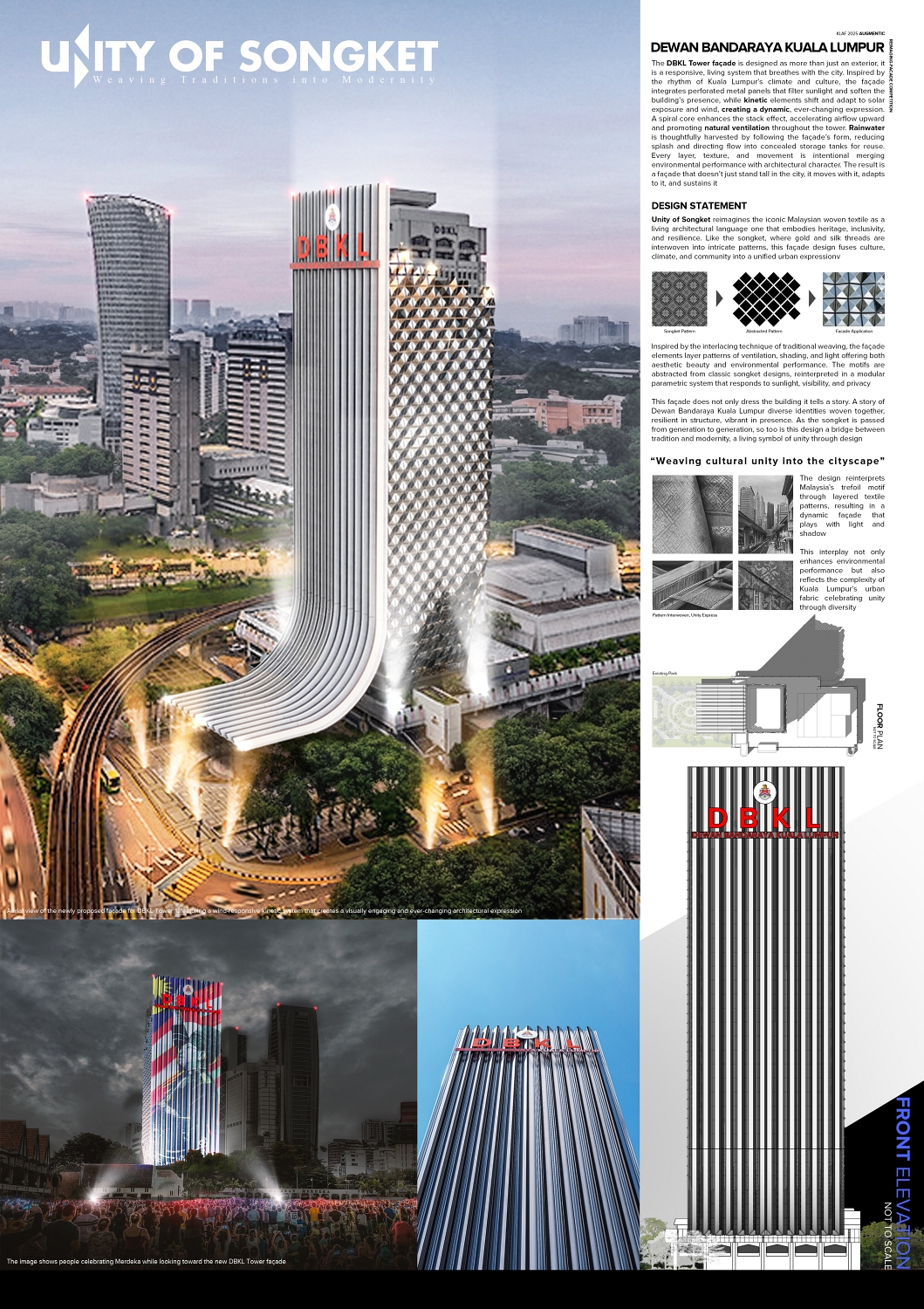
Unity of Songket reimagines the iconic Malaysian woven textile as a living architectural language, one that embodies heritage, inclusivity, and resilience. Like the songket, where gold and silk threads are interwoven into intricate patterns, this façade design fuses culture, climate, and community into a unified urban expression.
Inspired by the interlacing technique of traditional weaving, the façade elements layer patterns of ventilation, shading, and light, offering both aesthetic beauty and environmental performance. The motifs are abstracted from classic songket designs, reinterpreted in a modular parametric system that responds to sunlight, visibility and privacy.
This façade not only dresses the building; it tells a story. A story of Dewan Bandaraya Kuala Lumpur’s diverse identities woven together, resilient in structure, vibrant in presence. As the songket is passed from generation to generation, so too is this design a bridge between tradition and modernity, a living symbol of unity through design.
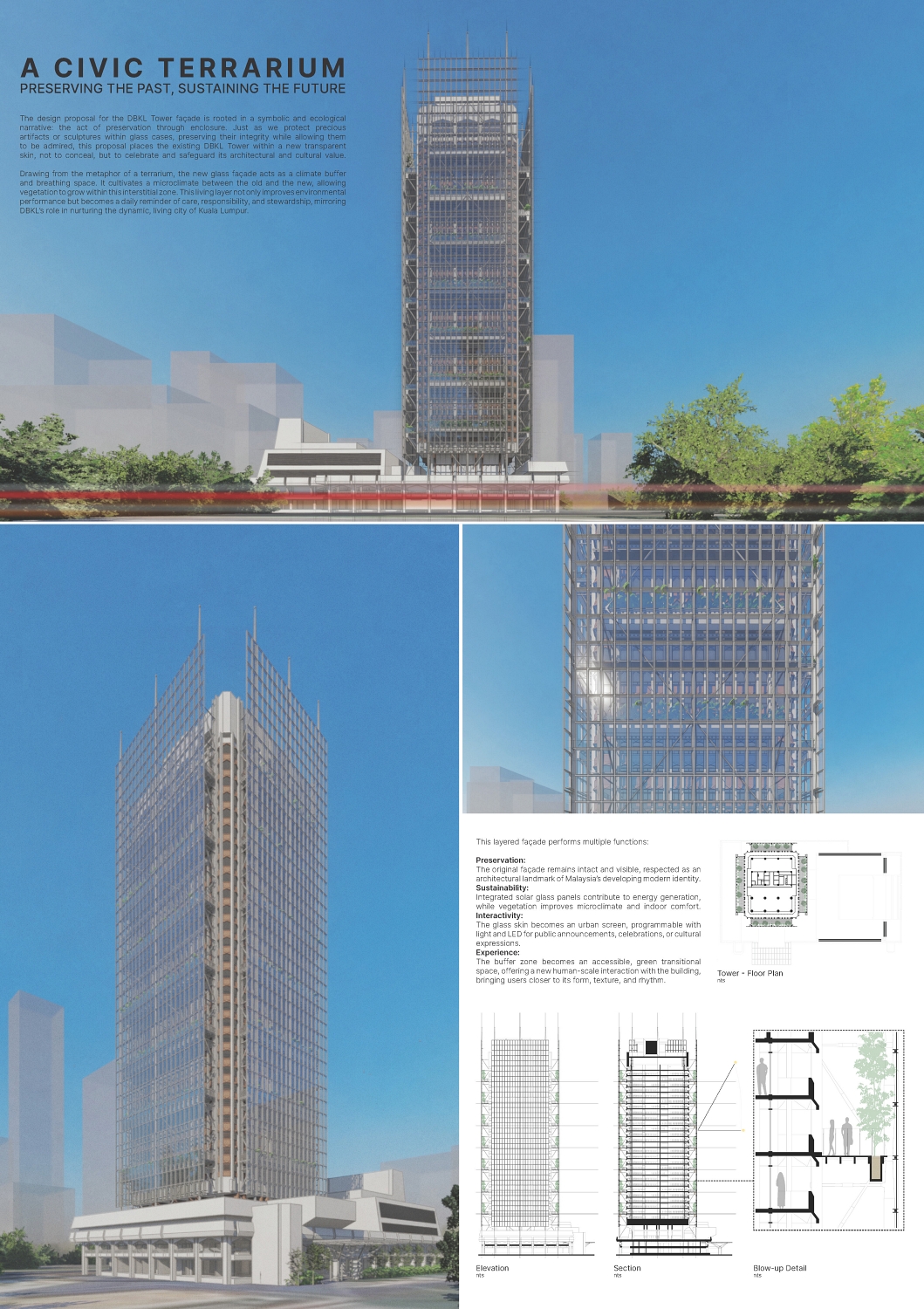
The design proposal for the DBKL Tower façade is rooted in a symbolic and ecological narrative: the act of preservation through enclosure. Just as we protect precious artefacts or sculptures within glass cases, preserving their integrity while allowing them to be admired, this proposal places the existing DBKL Tower within a new transparent skin, not to conceal, but to celebrate and safeguard its architectural and cultural value.
Drawing from the metaphor of a terrarium, the new glass façade acts as a climate buffer and breathing space. It cultivates a micro-climate between the old and the new, allowing vegetation to grow within this interstitial zone. This living layer not only improves environmental performance but becomes a daily reminder of care, responsibility and stewardship, mirroring DBKL’s role in nurturing the dynamic, living city of Kuala Lumpur.
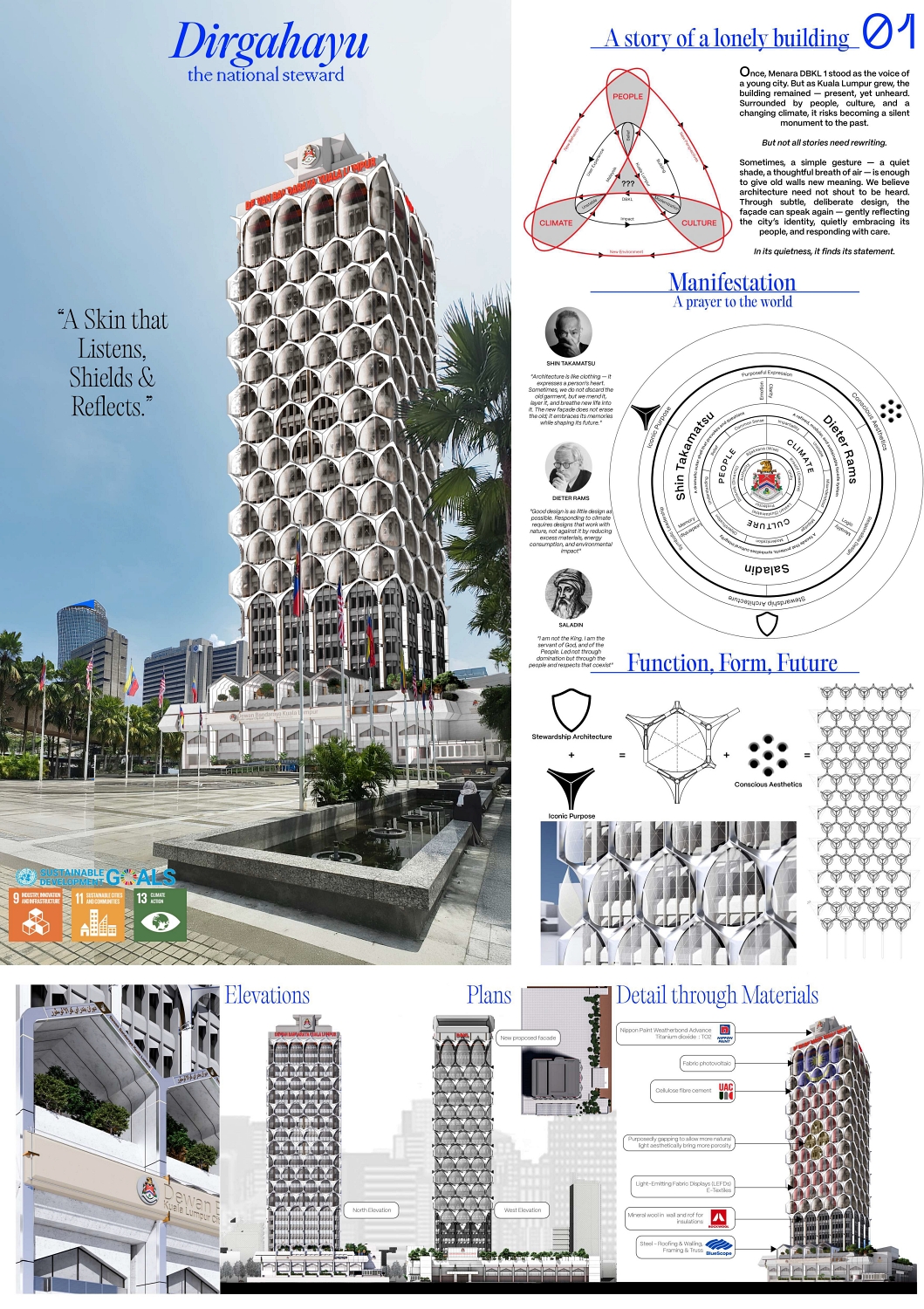
Once, Menara DBKL 1 stood as the voice of a young city. But as Kuala Lumpur grew, the building remained present, yet unheard. Surrounded by people, culture, and a changing climate, it risks becoming a silent monument to the past. But not all stories need rewriting. Sometimes, a simple gesture – a quiet shade, a thoughtful breath of air is enough to give old walls new meaning. We believe architecture does not shout to be heard. Through subtle, deliberate design, the façade can speak again – gently reflecting the city’s identity, quietly embracing its people, and responding with care. In its quietness, it finds its statement.
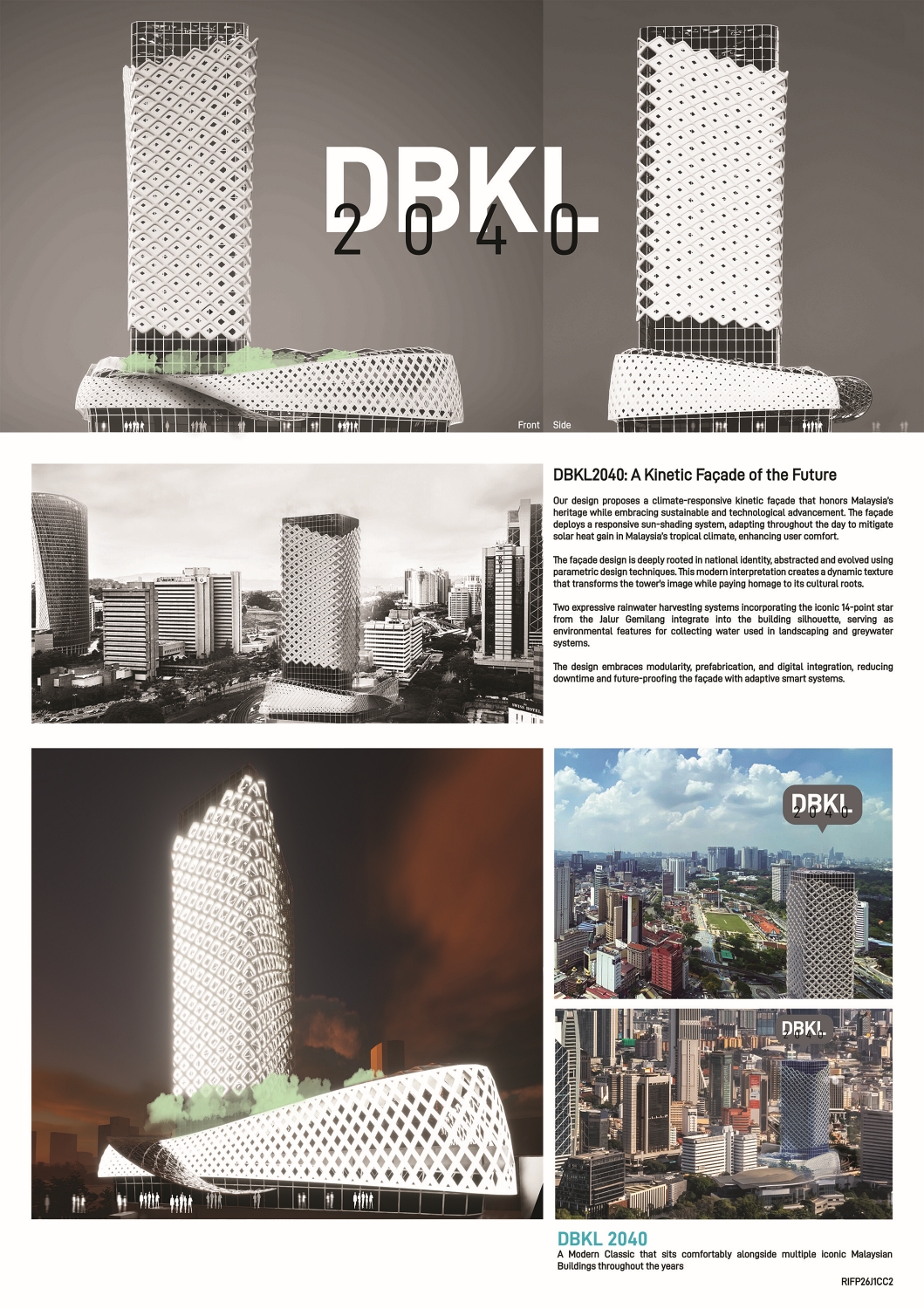
Our design proposes a climate-responsive kinetic façade that honours Malaysia’s heritage while embracing sustainable and technological advancement. The façade deploys a responsive sun-shading system, adapting throughout the day to mitigate solar heat gain in Malaysia’s tropical climate, enhancing user comfort.
The façade design is deeply rooted in national identity, abstracted and evolved using parametric design techniques. This modern interpretation creates a dynamic texture that transforms the tower’s image while paying homage to its cultural roots.
Two expressive rainwater harvesting systems incorporating the iconic 14-point star from the Jalur Gemilang integrate into the building silhouette, serving as environmental features for collecting water used in landscaping and greywater systems. The design embraces modularity, prefabrication, and digital integration, reducing downtime and future-proofing the façade with adaptive smart systems.
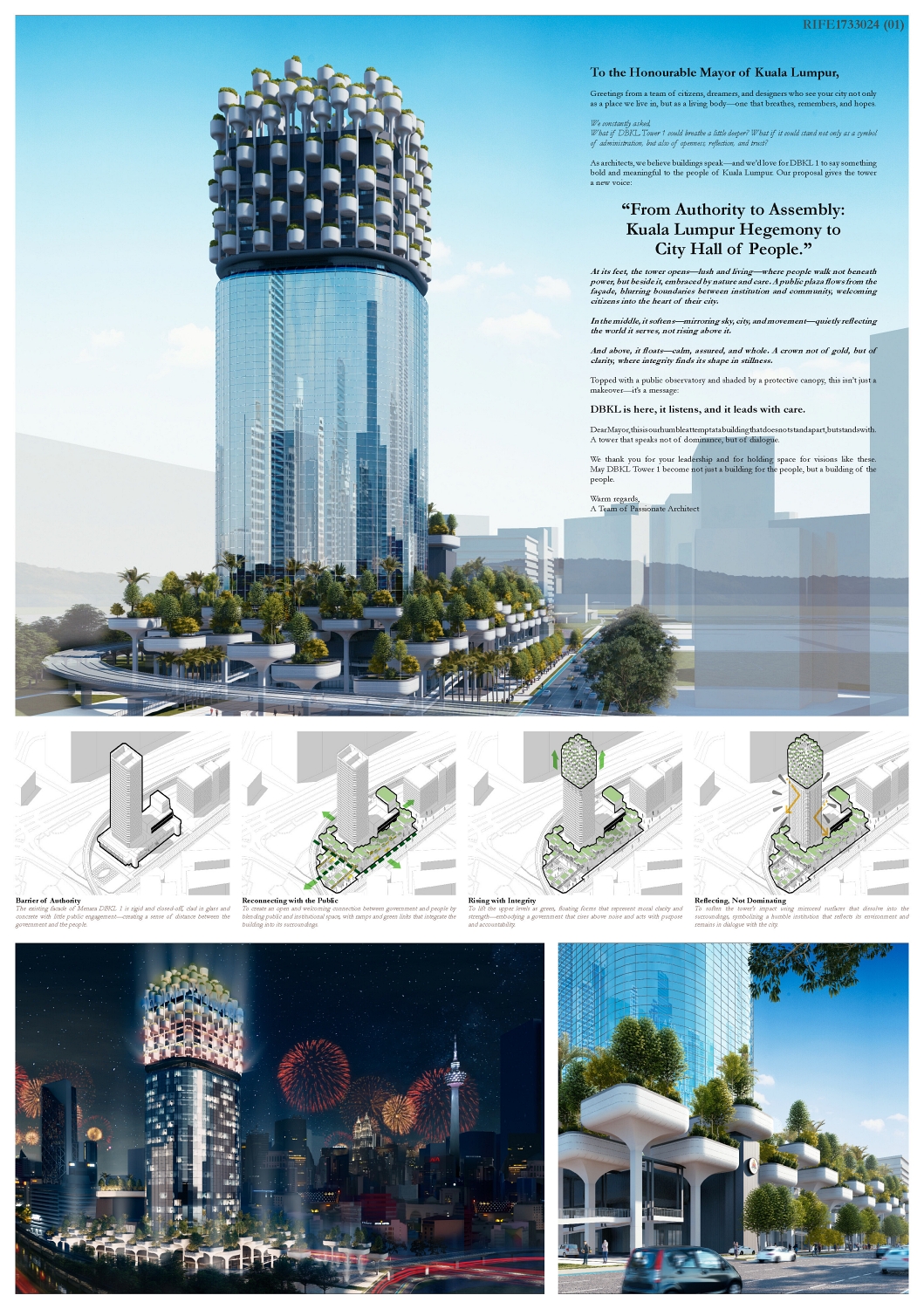
At its feet, the tower opens – lush and living – where people walk not beneath power, but beside it, embraced by nature and care. A public plaza flows from the façade, blurring boundaries between institutions and community, welcoming citizens into the heart of their city.
In the middle, it softens – mirroring sky, city and movement – quietly reflecting the world it serves, not rising above it. And above, it floats – calm, assured and whole. A crown not of gold, but of clarity, where integrity finds its shape in stillness. Topped with a public observatory, and shaded by a protective canopy, this isn’t just a makeover – it’s a message.
Our architectural vision embraces DBKL’s mission, “A City For All”, as outlined in the Kuala Lumpur Structure Plan 2040. It reflects the richness of Kuala Lumpur’s past, the civic engagement of its present, and the innovation of its future. This proposal is a layered narrative – a thoughtful weaving of the city’s tangible and intangible memories that have shaped its identity across generations. Design approach recognises that a truly inclusive cityscape does not separate periods but interlaces them. Through architectural form, materiality and spatial design, we unify the past, present and future into a singular civic landmark. The design embodies a layered timeline – merging heritage, civic identity, and aspiration into one architectural expression.
Layer 1 – foundation base (1980 – Past), rooted in the establishment of the DBKL Tower, this base reflects Kuala Lumpur’s historical and cultural foundations. It draws from colonial influences, Sultan Abdul Samad, and Merdeka-era development through grounded materiality and subtle traditional motifs.
Layer 2 – Civic Identity (2025 – Present), representing DBKL’s current role as a living civic institution, this layer promotes accessibility, inclusivity, and public engagement. Vertical louvres introduce a sense of transparency and openness, reinforcing a governance model that is visually and physically connected to people.
Layer 3 – The Aspirational Crown (2040 – Future) Rising above, a sculptural, futuristic “crown” element inspired by the National Flower, Hibiscus, Symbolises Kuala Lumpur’s ambitions towards sustainability, digital innovation, and smart city transformation. This uppermost layer integrates green features, a rooftop gallery, and observation decks – projecting the city’s vision forward.
Together, these three layers form a unified and meaningful civic landmark – celebrating the past, serving the present and aspiring toward the future. A cityscape that truly belongs to all, growing across generations.growing across generations.
KLAF 2025Titiwangsa Pavilion Competition
THE COMPETITION SEEKS CREATIVE DESIGN PROPOSALS FOR A FUN PAVILION THAT ENHANCES THE PARK’S VALUE AND FUNCTIONALITY WHILE INTEGRATING HARMONIOUSLY WITH THE SURROUNDING NATURAL ENVIRONMENT.
BY THE CONVENER
The KLAF 2025 Titiwangsa Pavilion Competition, themed “Reconnecting Public to Nature,” is a visionary initiative that challenges architects to reimagine public architecture as a bridge between people and the natural environment. Set within the iconic Titiwangsa Park, the competition calls for designs that not only inspire and educate but also reflect the Malaysian architectural identity through creativity, sustainability, and inclusivity.
Prof. Adj. Adrianta Aziz emphasised the importance of architecture as a tool to serve the public meaningfully. More than just a built structure, the Pavilion is envisioned as a symbol of national pride and a space that reconnects society with nature. The competition, held in collaboration with DBKL and key industry partners, highlights a collective commitment to shaping spaces that enrich lives while staying rooted in context and culture. Adrianta also called on Malaysian architects to dream boldly, act responsibly, and ensure their designs reflect identity, resilience, and relevance.
Ms. Puteri Khairul Fathiah Fahimudin extended her congratulations to all participants and praised the overall quality of the submissions. She noted that the winning design stood out for its sculptural form, strong response to the site context, functionality, and interactivity. She expressed enthusiasm for its installation at Titiwangsa Park, scheduled during the KL Park Festival from October 17th to 26th, 2025. The Pavilion promises to be a landmark piece that enhances public experience and reaffirms the role of thoughtful architecture in shaping vibrant, connected urban spaces.
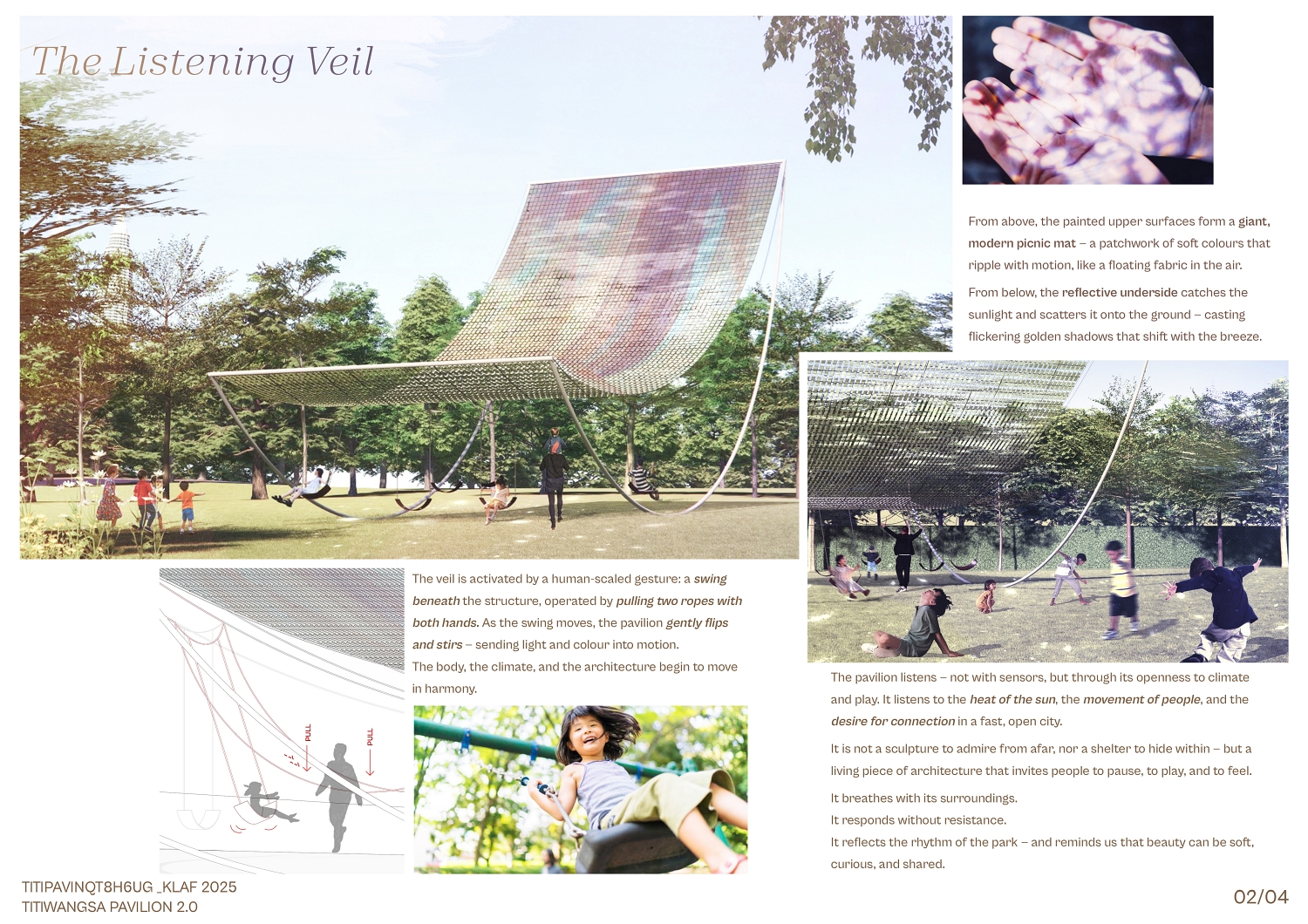
A kinetic pavilion of light and colour that breathes with the environment – inviting people to feel the sun, the wind, and the rhythm of the day. The veil is activated by a human-scaled gesture: a swing beneath the structure, operated by pulling two ropes with both hands. As the swing moves, the pavilion gently flips and stirs-sending light and colour into motion. The body, the climate, and the architecture begin to move in harmony.
From above, the painted upper surfaces form a giant modern picnic mat – a patchwork of soft colours that ripple with motion, like a floating fabric in the air. From below, the reflective underside catches the sunlight and scatters it onto the ground – casting a flickering golden shadow that shifts with the breeze.
The pavilion listens – not with sensors, but through its openness to climate and play. It listens to the heat of the sun, the movement of people, and the desire for connection in a fast, open city. It is not a sculpture to admire from afar, nor a shelter to hide within – but a living piece of architecture that invites people to pause, to play, and to feel.
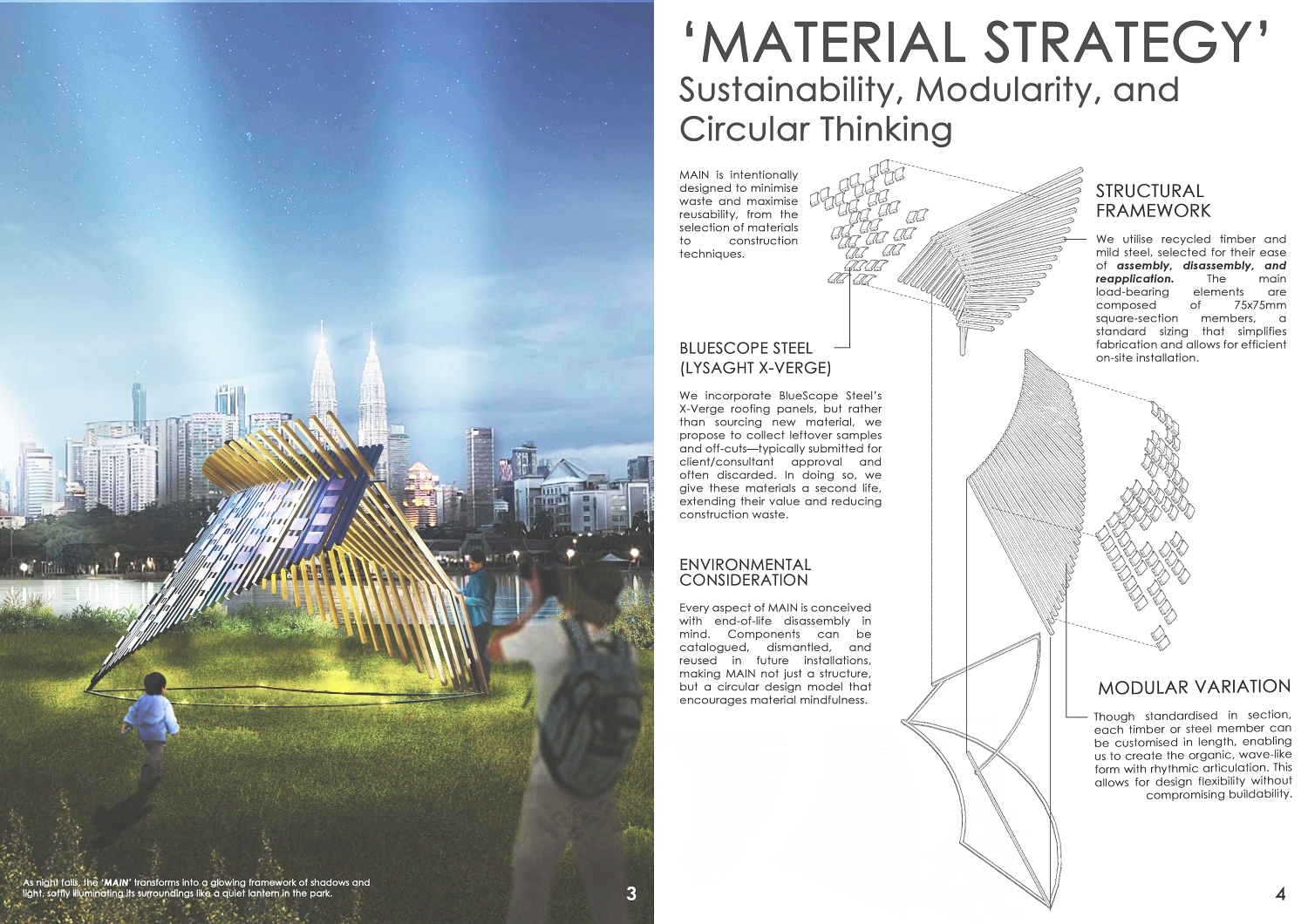
The name itself captures the dual identity of the project: a place to “main” (play) and a structure that serves as a “main” attraction. Designed as an interactive sculpture and shaded rest stop, MAIN blurs the boundary between art, architecture, and public space.
At its core, MAIN is an exploration of transformation – how ordinary architectural components can be reimagined through design ingenuity. What begins as a standard pergola module evolves into a visually engaging, organic form that invites curiosity, rest and reflection. This approach responds directly to the KLAF 2025 theme of “Augmentic”, which challenges designers to amplify architecture through innovation – not by inventing new materials, but by rethinking how we use the ones we already have.
The project aims to heighten public appreciation for how architecture can evolve, adapt and contribute to climate awareness. By integrating aesthetic playfulness with construction logic, MAIN becomes not just a pavilion, but a conversation starter – about the future of material use, and climate-responsive design.
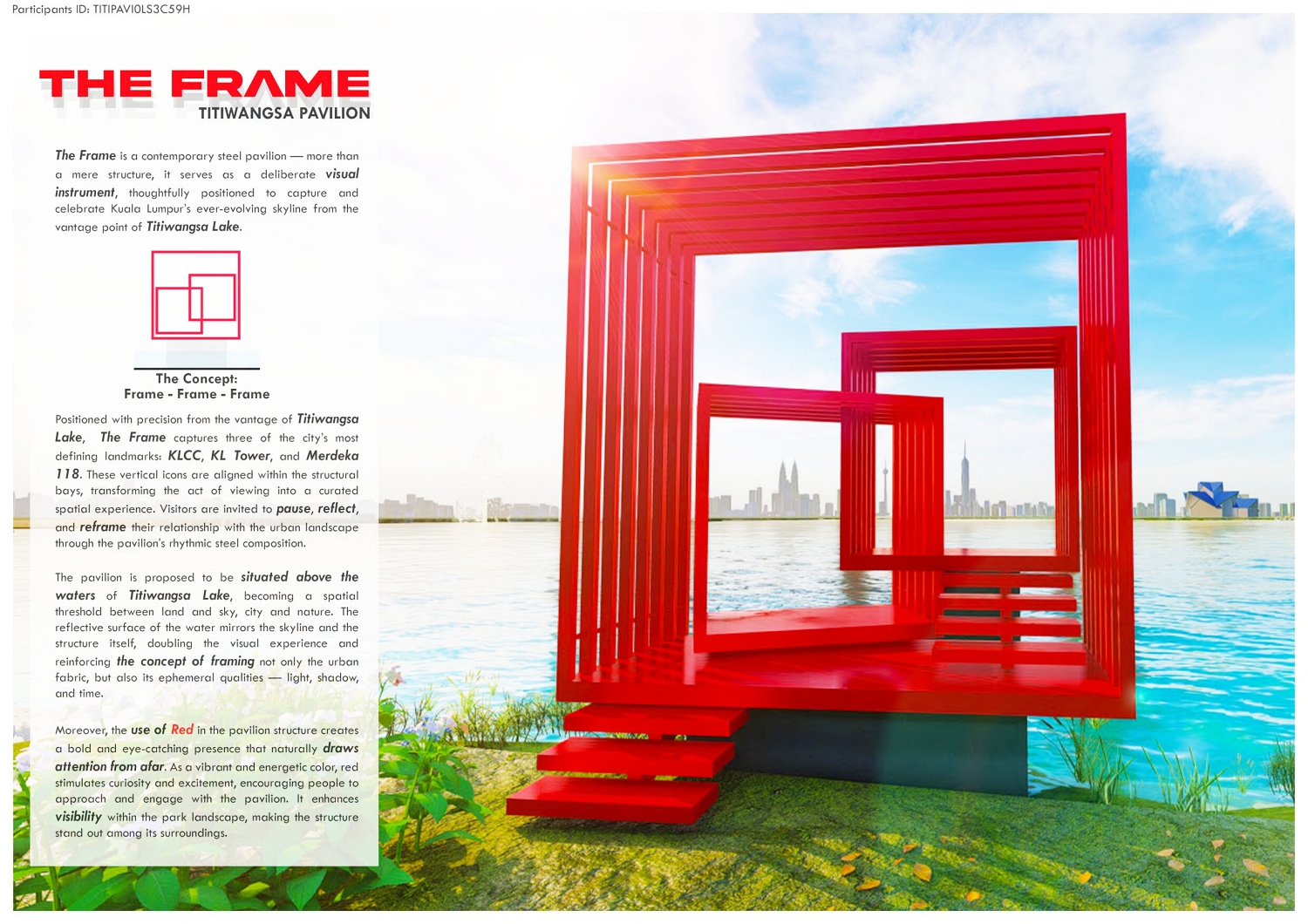
The Frame is a contemporary steel pavilion – more than a mere structure, it serves as a deliberate visual instrument, thoughtfully positioned to capture and celebrate Kuala Lumpur’s ever-evolving skyline from the vantage point of Titiwangsa Lake.
Positioned with precision from the vantage of Titiwangsa Lake, The Frame captures three of the city’s most defining landmarks: KLCC, KL Tower, and Merdeka 118. These vertical icons are aligned within the structural bays, transforming the act of viewing into a curated spatial experience. Visitors are invited to pause, reflect, and reframe their relationship with the urban landscape through the pavilion’s rhythmic steel composition.
The pavilion is proposed to be situated above the waters of Titiwangsa Lake, becoming a spatial threshold between land and sky, city and nature. The reflective surface of the water mirrors the skyline and the structure itself, doubling the visual experience and reinforcing the concept of framing not only the urban fabric, but also its ephemeral qualities – light, shadow and time.
Moreover, the use of red in the pavilion structure creates a bold and eye-catching presence that naturally draws attention from afar. As a vibrant and energetic colour, red stimulates curiosity and excitement, encouraging people to approach and engage with the pavilion. It enhances visibility within the park landscape, making the structure stand out among its surroundings.