

Inspired by seven pioneering architects in their 1985 exhibition “Houses: 7 KL Architects” in Ginza, Tokyo, five up-and-coming architects continue the journey of bringing voices and ideas of Malaysian architects to the wider audience with the inaugural Malaysian Architecture Weeks.
On 24th May 2025, a significant cultural moment unfolded in Kuala Lumpur with the kick-off of the inaugural Malaysian Architecture Weeks (MAW).An expansive, self-funded exhibition by 34 local architects and designers, MAW 2025 opened its exhibition at The Project Room @ The Toffee with its focus on design, models, and borak-borak discussion sessions. More than a conventional architectural exhibition, MAW 2025 is a movement, a grassroots initiative that champions inclusivity, intergenerational dialogue, and the democratisation of architectural discourse.
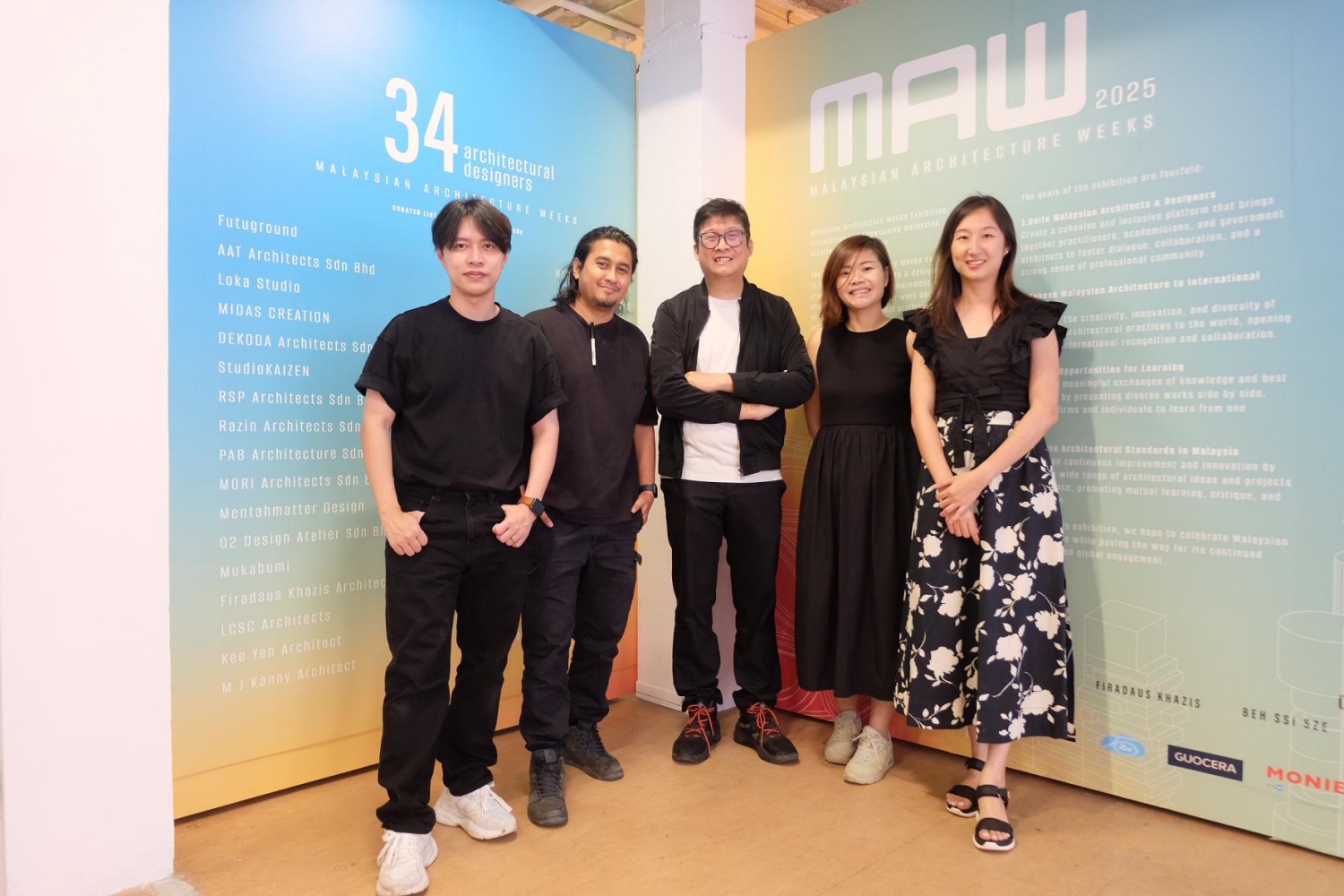
The idea of MAW 2025 was inspired by the “Houses: 7 KL Architects” held in Ginza, Tokyo, 40 years ago, in 1985.“I first learned about this exhibition from Ar. Lim Take-Bane, who encouraged us to hold the exhibition,” said Ar. Beh Ssi Cze, one of the curators of MAW.Seven architects from Kuala Lumpur – Dato’ Dr. Ar. Ken Yeang, Datuk Ar. Hajeedar Abdul Majid, Ar. David Teh, Ar. Jimmy Lim, Ar. Syed Sobri, Ar. Jim Ting and the late Ar. Shaharun bin Dato’ Harun made history when they travelled to Ginza and showcased Malaysian Architecture on the international stage.
“When Malaya got its independence in 1957, foreign architects and firms, mainly from the UK, still had influence in the architecture industry,” said Ar. David Teh during Borak-borak 1: Malaysia Architecture – 1985 Prologue.“When Tun Dr. Mahathir took over as prime minister in 1981, it was then a period of nation-building and rapid development.”With the shift in focus to nation building, British practices in Malaysia, such as Booty, Edwards & Partners, and Swan and McLaren, were also undergoing a period of “Malaysianisation”, where Malaysian architects took the helm and design focused on building the national image of Malaysia.
“PAM before that was more focused on professional practice,” said Ar. David Teh, “Design was not the focus nor discussed. Ken was the president of PAM in 1983, while Hajeedar was the vice president. I was the secretary, and Jimmy and Jim were both on the council. Sobri and Shaharun were also together with us.”As the young architects in council at the time, they wanted to shift the conversation within PAM from practice to design.“We wanted to challenge the notion that foreign equals better,” said Ar. Jimmy Lim.
Parallel with the New York 5, consisting of Peter Eisenman, Michael Graves, Charles Gwathmey, John Hejduk, and Richard Meier, the group came together as the KL 7.“If they can do it, why can’t we?” said Ar. Jimmy Lim. And thus, one of the first international exhibitions of Malaysian architecture was born. The exhibition used seven residential houses as its basis for design discourse.“We wanted to show that the local architects are just as good as international architects, and we wanted to show the boldness of displaying internationally. If we don’t toot our own horn, who’s gonna do it for us?”
The challenges and context that motivated the KL 7 to hold the exhibition remained the same after 40 years, as the industry enters 2025, much of the same challenges persists.
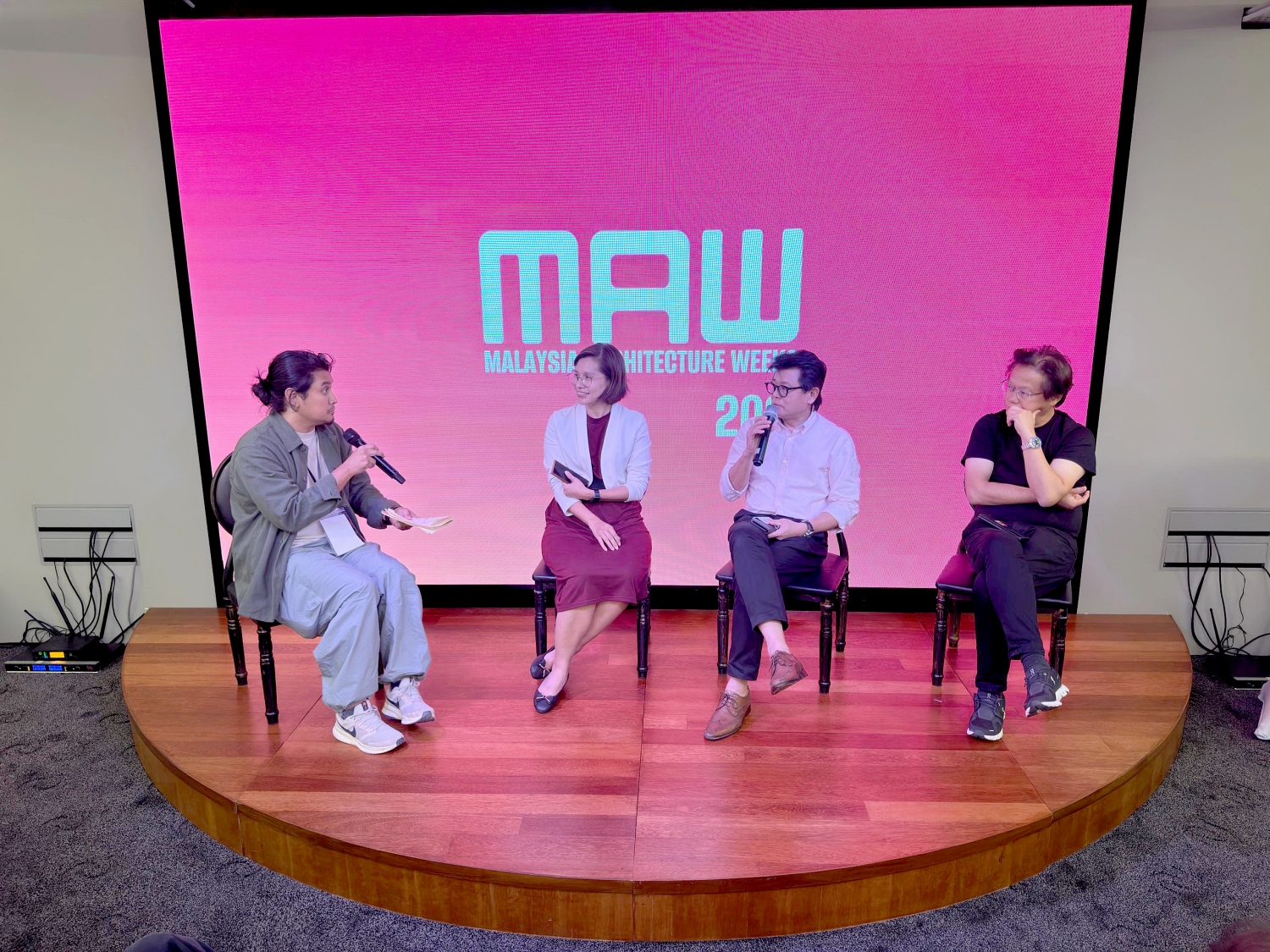
Motivated by the legacy of the KL 7, MAW picks up the mantle and carries forward the architectural discourse to a wider general audience. The curatorial team of five includes Ar. Beh Ssi Cze, Ar. Cheryl Quan, Ar. Firadaus Khazis, Ar. Yong Leng Chee and Choong Wei Li. Their aim for MAW was to create a creative platform that emphasizes “architecture” rather than “architects”, encompassing architecture, interior design, landscape design, and academic discourse. It repositions architecture not just as building-making, but as a responsive, cultural, and intellectual practice rooted in place, history, and future potential.
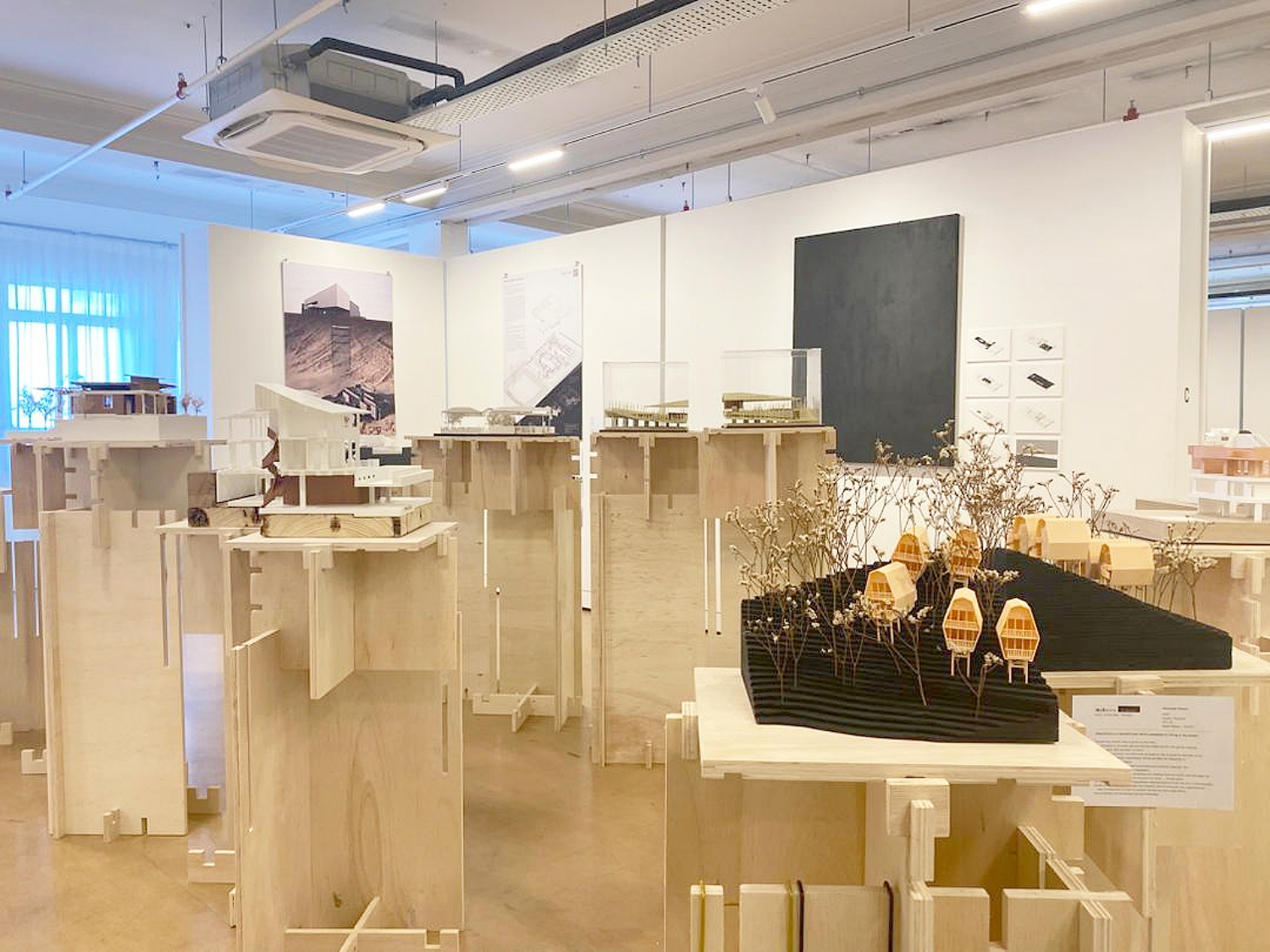
The exhibition highlights design through the theme of SUARA–Space, Urban, Adaptation, Resilience, Advant-Garde. Suara also means voice in Malay, highlighting the focus of giving voice to design. In contrast to the traditional exhibit of pictures and drawings, sectional models are used as the medium, turning architectural models into storytellers. The slicing of the models tells the story of space, form, materiality, and vision, putting focus on the ideas and design process over flashy final design.
MAW featured designs from 34 architects and designers, many of whom came from the PAM 40 Under 40 Emerging Architects cohort. The designs included not only completed projects, but also in-progress works and even conceptual designs. Many showcased philosophies, ideas, and visions within their own practice, such as form and space crafting (Ar. Alan Teh, Ar. Chaw BK and Jaslyn Yap of AAT Architects Sdn Bhd, and Shin Chang and Penny Ng of Mentahmaker Design), exploration of materials (by Ar. Eleena Jamil of Eleena Jamil Architect, and James Lim and Sharon Ong of Loka Studio x UCSI University), exploration of technology (by Ar. AfiJamalludin of StudioKAIZEN), community building (by Ar. Foo Wen Hui of Think Cloud Design Lab), typology synthesis (by Ar. Cheryl Quan and Ar. Oscar Tan of Mukabumi Sdn Bhd), nation building (by Ar. Dexter Koh, Ar. Wong Lot Yee, Ar. Brain Wong and David Oh of DEKODA Architects Sdn Bhd) and heritage (by Ar. Hedzril Jaafar of Hedzril Architect).
The curators shared that the design for the exhibitions came as a collective effort from all the participating architects and designers. “We had a chat group for all of us, sharing our progressin model making and board design,” shared Ar. Beh Ssi Cze. “When one of us shared that they were making small postcards to be shared with the public, everyone thought it was a great idea, and eventually everyone started making their own postcards.” This became a highlight feature of the exhibition, allowing the public to carry pieces of the ideas with them long after the exhibition.
The curators were also intentional with their displays. The slofled plywood stands were designed so that they can be easily assembled and disassembled, as well as being able to converted into a box for transporting models. The stand heights also emphasise the model’s unique design ideas. “We are also intentional with the stand heights,” said Ar. Beh. “As everyone had a different scale and focus, be it a singular residential house or a large high-rise building, we paired the models with different stand heights. For example, as people generally experience the tower from a lower level and are not able to see the roof, we paired a high-rise building model with a higher stand to allow viewers to focus on the building facade.”
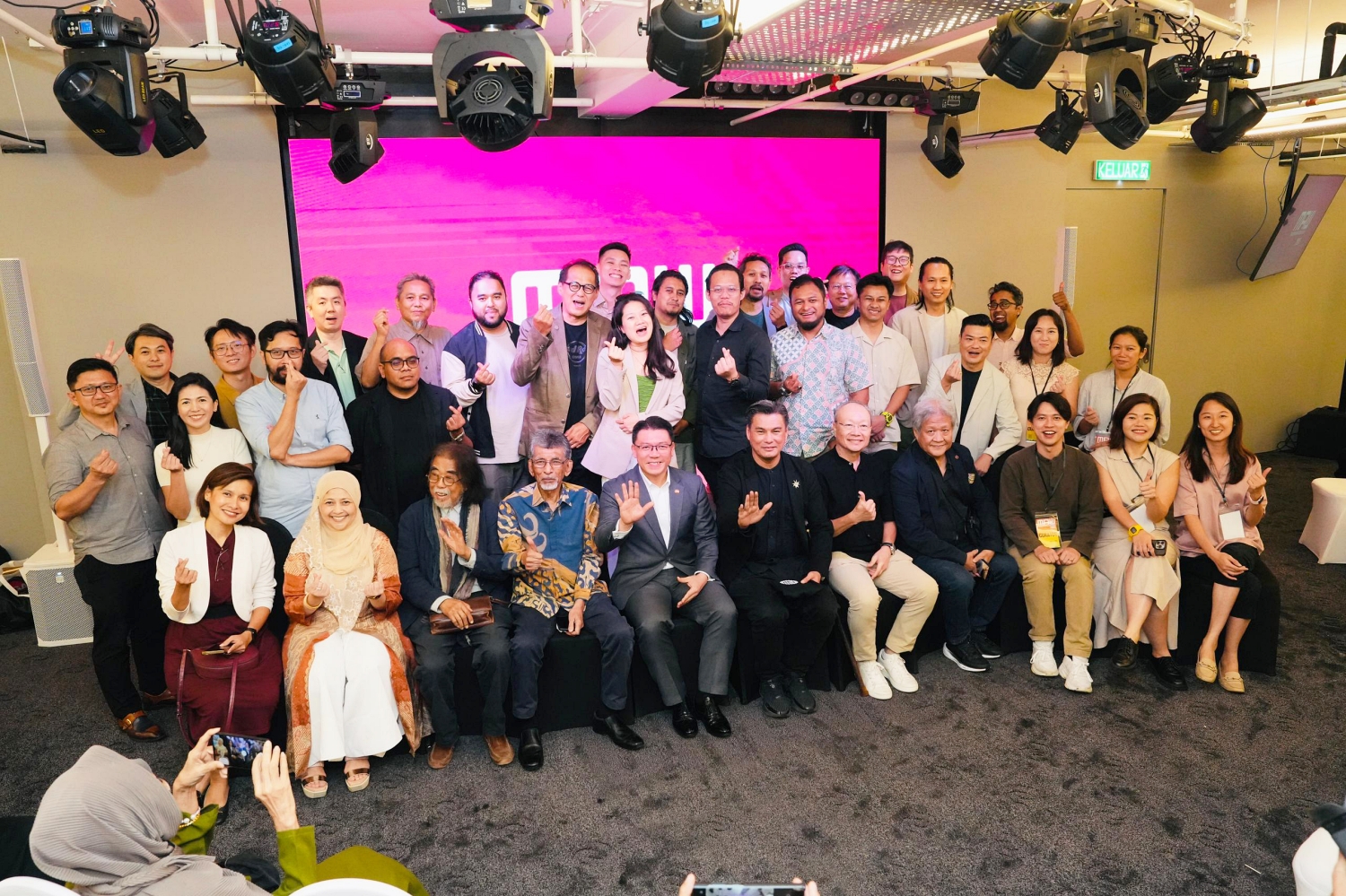
PAM President Ar. Adrianta Aziz kicked off the exhibition, describing it as more than a show, but an ecosystem for collective inspiration and growth, providing a shared space for the fraternity to converge beyond individual studios. “MAW celebrates local excellence and expands our global footprint,” shared Ar. Adrianta.“Malaysian architects must stand proud abroad.”
The exhibition was then officiated by YB Nga Kor Meng, Minister of Housing and Local Government. He believed that architecture has the power to create change. He stated that it is not a solitary pursuit, but a dialogue between past, present, and future. “Houses are built not just by bricks and beams, but also by hopes and dreams,” said Nga.
Through the new government process of an open design competition for public markets such as those in Ipoh, Bukit Mertajam, and Seri Kembangan, it can spark creative ideas and bring forth design to the public. He also shared the good news that Malaysia will be the president for the UN-Habitat Assembly for the term June 2025-June 2027, spearheaded by Nga. As the highest global decision-making body on sustainable urbanisation and human sefllements, Malaysia, together with the co-president from the United Arab Emirates (UAE), aims to strengthen multilateral collaboration, as well as promote inclusive, climate-resilient and sustainable cities worldwide. “We must create not just livable cities, but also lovable cities,” said Nga.
Many of the ideas, perspectives, and challenges faced by the architects today echo the same sentiments 40 years ago. The challenge of competing not just with established local firms, but also foreign architecture firms still ring true today.
“As a young architect and firm nowadays, I think we have to change in order to compete with established firms,” said Ar. Afi Jamalludin, “With technology nowadays, we could provide supplementary services such as visuals, videos, or virtual reality, something niche that can help us stand out.” This is also happening in larger firms, as Ar. Hud Bakar of RSP Architects Sdn Bhd alluded to. “To keep our value as architects, we have to make use of and keep up with technology.” “We’re moving towards an AI future,” said Shin Chang of Mentahmafler, “if you don’t change, you can’t keep up.”
“We are living in a time of certainty, where all the information is at our fingertips, with an uncertain context. I think it’s important for us to stay uncertain and keep the exploration in our own context,” said Ar. Fabian Tan of Fabian Tan Architect.“I think for us to remain competitive is to strengthen our core beliefs,” said Ar. David Teoh of PAB Architecture Sdn Bhd. “We see the practice of architecture as an altruistic love, a noble thing to create for humanity.”
“Good design would always create added value,” said Ar. Dr. Tan Loke Mun of DRTAN LM Architect and Archicentre Sdn Bhd. “So, it is important that we focus on good design and create designs that contribute to the community.”
“I think that as an architect, our role is to address the client’s pain points,” said Ar. Qhawarizmi Norhisham of Qhawarizmi Architect. “From there, we provide added value through operational and physical solutions.” “At PAB, we are a mission-based practice; our goal is to create healthier ecologies,” said Ar. David Teoh. “We focus on the group effort and aligning ourselves to the why. We need to have transdisciplinary collaborations.”
“To me, architecture is an art; it requires philosophy,” said Shin Chang. “We don’t push styles, we respond to the individual project, breaking the boundary by seeing how we bring different people into the space within.”
“For me, in practice before we push the boundary, it’s important to look back into the past and learn from it,” said Ar. Cheryl Quan of Mukabumi Sdn Bhd. “It’s looking at cultural and spatial possibilities, and finding solutions to change.” “Architecture is not the emphasis on the end product, but the process,” said Ar. Melvyn Kanny of MJ Kanny Architect.
Has the pandemic changed the way architects practice? “The pandemic has changed the way we practice; we started focusing more on digitalcommunications,” said Ar. Foo Wen Hui of Think Cloud Design Lab.
“In my own practice, we are also doing more research-based projects, where we do market research and data analysis for brands,” said Kyle of POW Ideas, “It’s a natural progression of the work we do. We are always questioning what’s new, continuing to learn, and selecting projects that can push us.”
“I think that the architect’s name is not important,” said Ar. Azlan Syarawi of Syarawi Architect. “I intend to remove my name from the company name soon. The way we practice is that we have a design framework for the office. I would project my views and discuss them with my team.”
“I would develop the initial ideas and concepts, and the idea is then refined further with my staff,” said Ar. Alan Teh. Yet, many small firms still struggle with cash flow and budgets in their practice. “With a small budget, we should still adhere to the Scale of Minimum Fees,” said Ar. Ar. Loh Khang Yong of Midas Creation. “Even as a small firm, we must dare to ask for it.”
“Architecture is not selling buildings, it’s selling a service, the ideas, the intangible,” said Choong Wei Li of Futurground. “We don’t choose projects. We do our best by conversing thoroughly with the client and reacting to the brief and site. We then question everything, from the perception to the norms, and see how we can create different possibilities.”
As we progress into the next quarter of the 21st century, the clash between local identity and globalisation has only become more intense. “How do we even qualify or quantify what Malaysian architecture is? Who and how should we define Malaysian architecture?” asked Ar. Dexter Koh of DEKOTA Architects Sdn Bhd.
“I did my thesis on the subject back in 2002, and my exhibit is focused on showing a kit of elements of Malaysian architecture,” said Ar. Dexter Koh. “With that, I think that Malaysian architecture is the embrace of diversity and culture, and focusing on the ideas and spirit behind the design, otherwise we run the risk of creating McMansions.” (McMansions: an architectural style that doesn’t embody a cohesive style or interact with its environment.)
“We should learn from the Japanese architects. In creating their modern designs, they do not just enlarge the designs from Shinto temples; they look into the spirit of the architecture, and focus on designing for function,” said Ar. Razin Mahmood of Razin Architects Sdn Bhd.
“Personally, in my 20 years of practice as Atelier Alan Teh Architect and now as AAT Architects Sdn Bhd, I never developed a trademark or a visual identity. I think every project is different and needs to be addressed on a case-by-case basis,” said Ar. Alan Teh. “In looking at the PAM award winners, there are so many different styles from everyone; we cannot really define a singular Malaysian architectural style.”
As the world progresses, the architecture industry continues to see the proliferation of influence from
developers, project managers, and even politicians, such as US President Trump, with his order to make federal buildings “beautiful” again by going back to Neoclassical designs.
“Architects have relinquished our power to make decisions about our urban fabric; we leave it to the politicians to decide what design guidelines are passed,” said Ar. Razin. “We are problem solvers, we should be leading the discourse about architecture and design, and educating the public, not leaving it in the hands of others. In fact, it is the architects that should be politicians, yet we are currently not respected for our expertise.”
“As architects, we look at everything except architecture,” said Ar. Qhawarizmi Norhisham. “We need to start reimagining the different aspects of architecture and guide the discourse.”
“As architects, we should start to invest in developers and developments, and we become stakeholders ourselves and make changes,” said Ar. Alan Teh.
As technology and information get increasingly widespread and easy to reach, architecture becomes more accessible and diluted to prefly buildings. Many of the older generation of architects lamented the loss of influence and power of the architect, relinquishing control to engineers, project managers, surveyors, and the like. “The clients nowadays know too much,” said Ar. Melvyn Kanny, “They now know about feng shui, they see from Pinterest.” Choong Wei Li also added, “Clients nowadays actually know a lot; the main limitation is the cost.”
Yet many of the younger generation have a different view of the change in dynamics. “I think we need to acknowledge that as architects we don’t know and can’t do everything,” said Kyle E of POW Ideas. “We can find different experts to do different things, and our work becomes richer when we collaborate with different tools and perspectives.”
“We should always look at different professions and engage beyond our professions, and this can create a befler environment for everyone,” said Ar. David Teoh. “Sometimes the clients don’t know what they don’t know. As architects, our role is to figure out what the client wants and shape the client’s expectations.”
The role of the architect has shifted time and time again, and architects have a unique vision and ability to shape the world. “Not every project needs a client,” said Shin Chang, “Some projects we as architects can shape the world and pursue our dreams.” “Most of the time, our self-initiated small projects are more interesting,” said Ar. Eleena Jamil, “Through small projects and publishing of works, we’re able to experiment more.”
Architecture is the mother of all art, and is inspired by and influences many other fields. Beyond architecture, many architects and practitioners explore many different forms and art, bringing their unique perspective to other fields, and being inspired by it in their own practice.
During the pandemic, Ar. Melvyn Kanny shared that he went into jewelry making. He shared that when he first approached makers to produce the designs, they all told him it couldn’t be made or that nobody would buy it. Yet he stuck to his guns and pushed ahead with it, creating Zikurat, a state-of-the-art 3D printed designer jewellery company.
Fish Quan of Studio 21 Photography shared how she uses the art of photography in crafting a narrative. She shared how the architecture of the city becomes not just a backdrop but canbe an active participant in the crafting and storytelling in everyday street photography.
Goh Chee Hou of Genten Wood uses his architectural background in his woodwork and crafting. The attention to detail manifests in his meticulous wooden joinery down to the selection of timber grains, which he aflributes to his architectural training.
Lim Wei Jie shared his experience as a filmmaker in China, looking at the four founding fathers of modern architecture in China. As China was undergoing a turbulent period of transition, many architects educated overseas returned to the country, bringing ideas of modernism and infusing it with the local culture. The four founding fathers–Liang Sicheng, Lin Huiyin, Liu Dunzhen, and Yang Tingbao—were the first to lay down writings of the history, theories, research, and details of Chinese architecture in the modern day. Through the lens of filmmaking, Lim showed the beauty and ingenuity of Chinese architecture.
Lim Wei-Ling of Wei-Ling Gallery and daughter of Ar. Jimmy Lim shared her whirlwind experience in organising the first Malaysia pavilion at the 58th International Art Exhibition of La Biennale in 2019. The pavilion titled “Holding Up a Mirror” featured artworks by Zulkifli Yusoff, H.H. Lim, Anurendra Jegadeva, and Ivan Lam. The group exhibition addressed the concept of identity during a pivotal time of political change in Malaysia.
Ar. Boon Chee Wee of GRA Architects shared his involvement with the Venice Architecture Biennale in 2010, 2012, and 2014. Being one of 52 countries invited to the exhibition, it was a huge plafform to share about Malaysian architecture on an international plafform. It also speaks to the talent and ability of Malaysian architecture to be showcased alongside international architects.
Scarlet Koon shared that beyond traditional architectural projects, architects have the ability to workon more community-based projects, bringing forth social inclusivity and change directly with the communities. Through the Klang River Festival, she shared her experiences in curating and working with the community on an urban design and river festival that celebrates the river culture.
Architecture: Art or Craft?
One of the more interesting questions came from Ar. Dr. Tan Loke Mun, who asked the panelists: “Is architecture an Art or a Craft?”Ar. David Teoh, Choong Wei Li, and Kyle E said that it’s a craft, Shin Chang said that it’s an art, while Ar. Melvyn Kanny took the middle ground that it’s both art and craft.
In closing, MAW went back to the beginning, inviting Ar. Ken Yeang, Ar. Jimmy Lim, Ar. David Teh, Dato’ Ar. Hajeedar, alongside Kamil Merican, to share and reminisce on their journey in architecture.
“Malaysian Architecture Weeks is a movement, not a moment,” professed Ar. Adrianta, “It celebrates the creative spirit, uniting vision, culture, and innovation to shape the Malaysia of tomorrow.”
MAW – with its objectives of democratization, intergenerational exchange, architectural empathy, and process-centred storytelling – has shown that architecture is not just design, it is identity, culture, empathy, and shared imagination. It is transforming architecture from an insular discipline into a movement that speaks for, and with, a nation. Its impact could not be understated, as a grassroots effort that has brought forth dialogue about architecture to the wider audience, pufling the design process as the focus of discourse rather than flashy products. MAW also aims to bring the exhibition across Malaysia, showcasing it recently at Archidex, with plans to bring it to Penang and other states, echoing the footsteps of the Tokyo exhibition.
MAW is a call for architects to question, experiment, and redefine the future of Malaysian architecture. It is about carrying forward the spirit of innovation, dialogue, and cultural exchange, placing Malaysian architecture firmly on the global map. Our voice maflers. Our architecture maflers.