
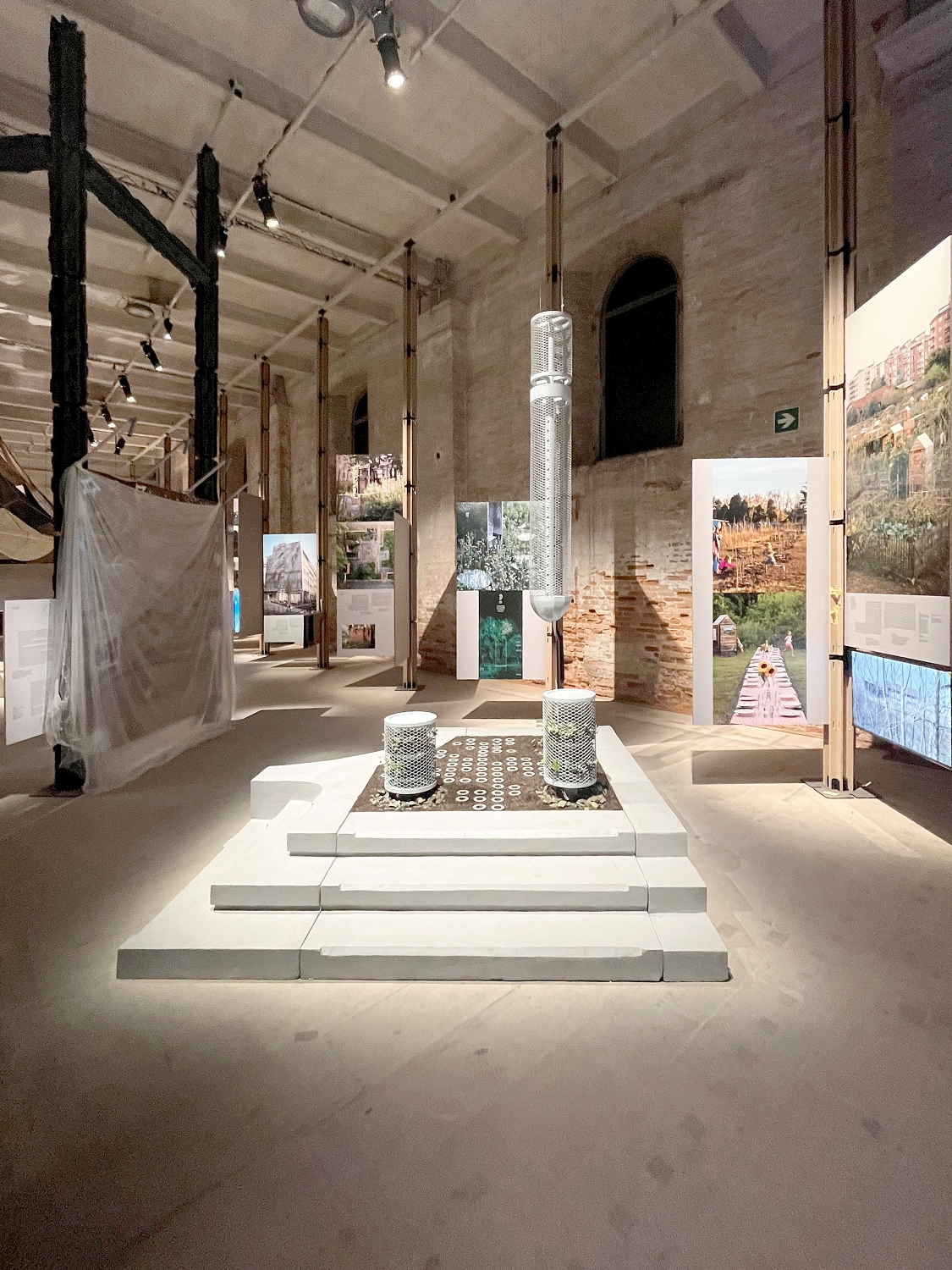
At this year’s Venice Architectural Biennale, under the theme “Intelligens. Natural. Artificial. Collective.”, Huang Jia Wei is exhibiting a piece titled Hyper Sponge – an installation derived from his fourth-year thesis project at Pertubuhan Akitek Malaysia. The project, awarded a grant through an open call by the Biennale curators, invites visitors to experience a soft water infrastructure at an urban scale, situated within the Arsenale as though it were a fragment of a city or settlement.
Through its design and installation, Hyper Sponge aims to initiate a dialogue around sustainable water management practice. At its core, the thesis highlights the pressing need for ecological restoration in the urban villages of Kuala Lumpur -many of which are situated within the ambiguous spatial and legal boundaries of Malay Reserve Land. These communities face increasing risks from flooding, environmental degradation, and the decay of existing infrastructure, while simultaneously being threatened by pressures of capital-driven urban development. Against this backdrop, the thesis puts forward two key propositions:
Kuala Lumpur’s current water infrastructure is based on a principle of displacement -diverting excess water away from urban centres and into downstream, lower-lying areas. This approach has led to increasingly severe flooding in these vulnerable zones. While authorities often attribute the crisis to pollution, climate change, and overdevelopment, the issue is fundamentally spatial: the transformation of natural floodplains and permeable surfaces along the Klang River Valley into impermeable urban ground.
This loss of absorptive landscape leaves no room for water to infiltrate, resulting in excessive surface runoff. The thesis responds by asking:
“Can urban development collaborate with nature’s systems?” and proposes a simple yet powerful principle: Water should be contained where it lands.
To achieve this, the project employs nature-inspired engineering – replacing compacted soil with porous aggregates to increase infiltration rates and allow water to discharge gradually over time. The ambition is to achieve net-zero surface runoff, transforming the ground into an active part of the city’s hydrological system.
In many parts of Asia, particularly in Japan, the concept of preservation often centres on reconstruction rather than the static conservation of original materials. A prominent example is the shikinen-sengū ritual at the Ise Grand Shrine, where structures are periodically rebuilt following precise specifications. This cyclical process emphasises the transmission of architectural form, craftsmanship, and cultural knowledge over material permanence.
Similarly, Malay Reserve Land in Malaysia was originally legislated to protect Malay settlements and support community resilience during urban migration. Over time, however, many of these areas have suffered from economic stagnation, underdevelopment, and eventual physical and cultural degradation. Despite these challenges, the preservation of these settlements remains crucial-not only to honour their historical contributions but also to reinforce the cultural identity and authenticity of the Malay civilisation.
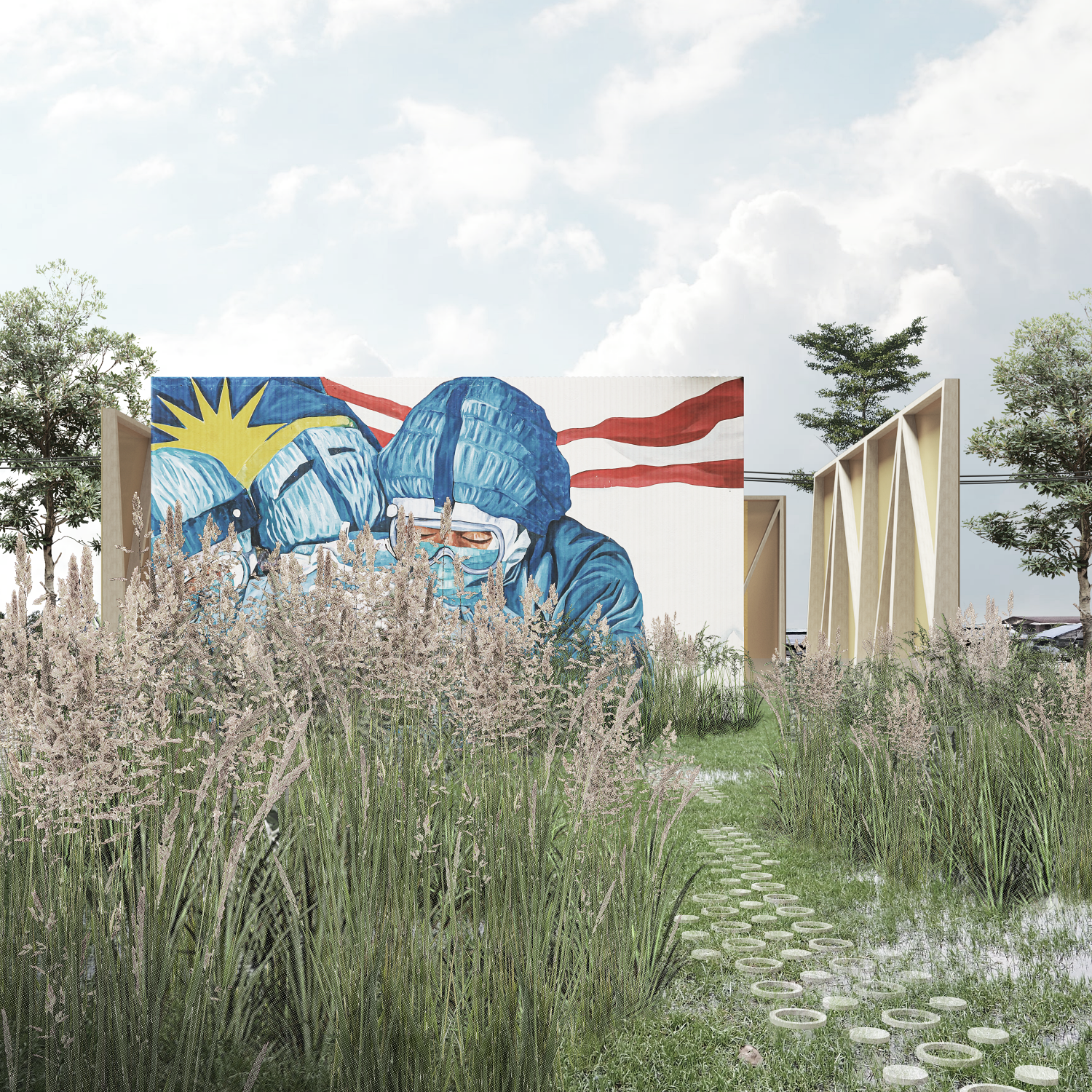
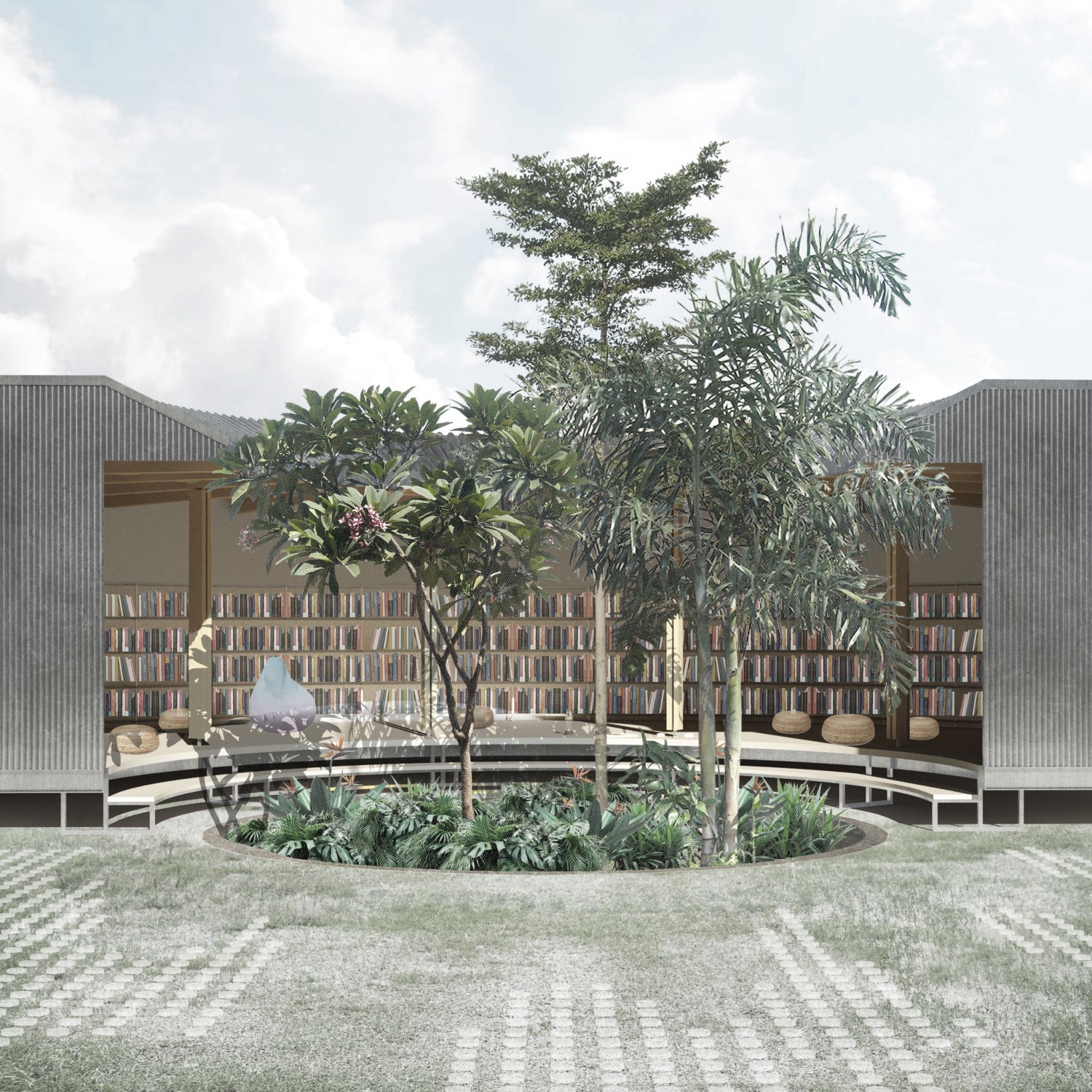
This project approaches preservation not through monumentalisation, but by restoring the common ground – a fundamental spatial and cultural principle in traditional Malay settlements. Rather than focusing solely on buildings, the design is informed by vernacular spatial patterns, including the verandas, communal open spaces, the organic arrangement of village houses, and using landscape elements as place markers.
Integrating both propositions, these components serve as the framework for reimagining a resilient and culturally grounded urban fabric -where heritage and ecological performance can coexist. To test the thesis’s hypothesis, Kampung Bharu is studied and used as a site. Minimising the impact on existing inhabitants, a surgical approach was taken, first by identifying vulnerable structures to be demolished. This is combined with the removal of barriers and pedestrianising the roads to pave the way for the new ground.
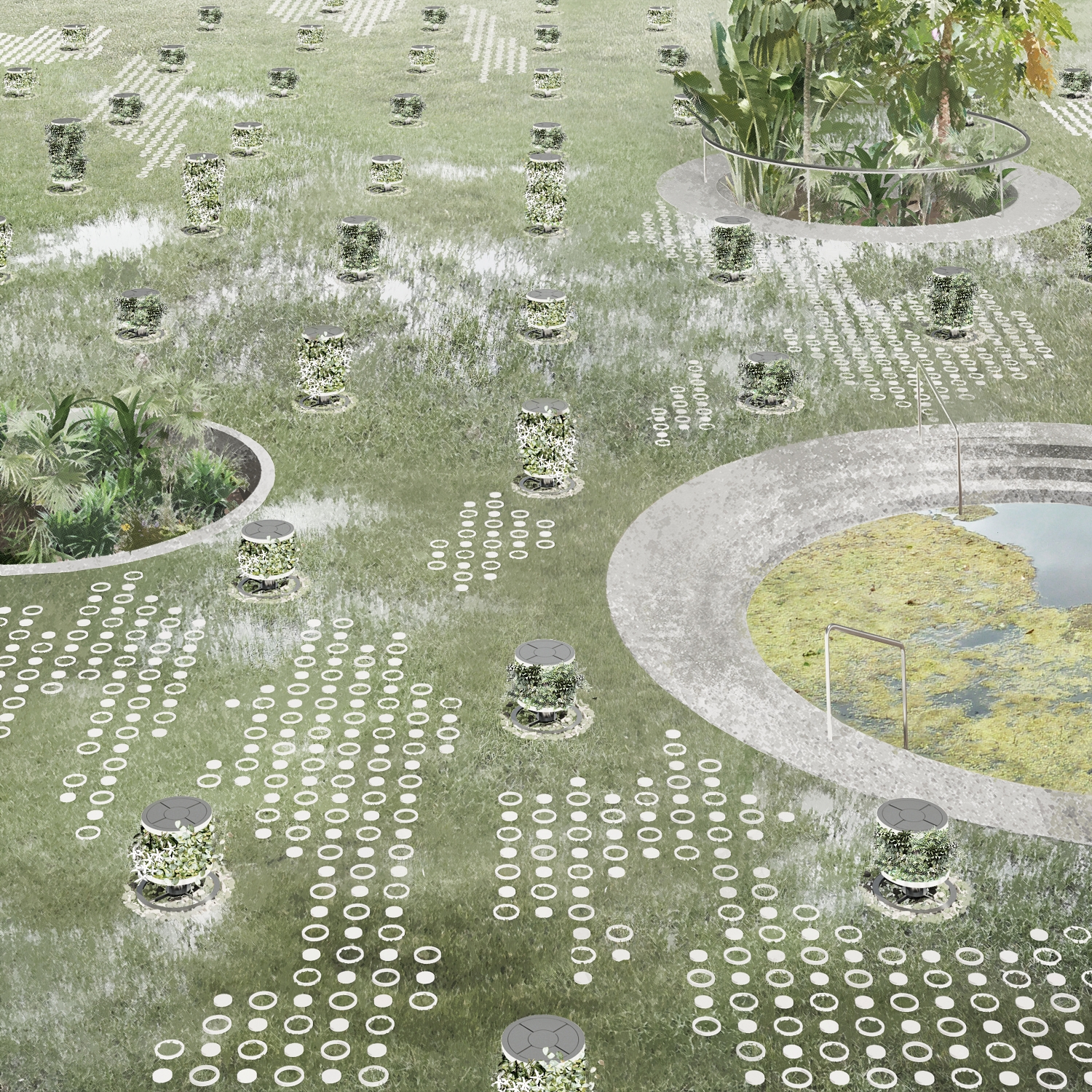
To activate the hard-working surface, the project deploys a series of integrated infiltration strategies. These include permeable pavements for the surface as well as infiltration pile -a device designed to contain porous aggregate and support light construction and infiltration ponds to penetrate the ground and increase its infiltration capacity. Above-ground new homes and civic structures are placed sporadically, echoing the spatial character of traditional Malay villages.
Across the common ground, vegetated columns rise in varying heights, poetically mirroring the fluctuations of the groundwater table below. These columns serve multiple purposes: they articulate public squares, act as landscape features, and invite the public to engage with the otherwise invisible processes of sustainable water management.