

In the case of Eden Handicap, one of their founders Mr Bertie approached us to legalise their “building usage” so that it complies with local authority guidelines and Health and Safety regulations. Knowing that land costs and consultant fees are expensive, they could not afford to purchase a big commercial building back then; instead, they converted their family-inherited house for this charitable cause.
On our first site visit, it touched our hearts when we witnessed so many less-abled persons being patiently trained by a group of dedicated and caring trainers in Eden Handicap. With this training, each less-abled would be more independent and adapt to the community one day instead of burdening their parents or caretakers.
Without a second thought, we wholeheartedly agreed to help them by offering pro-bono service to legalise the building usage and liaise with the Local Authorities. We hope to inspire the community to contribute in any form to Eden Handicap for many years to come.
Eden Handicap Service Centre Bandar is a charitable non-profit, communal-funded organisation with the goal of providing working skills to the less-abled in order for them to better fit into working society today. They have also provisioned free training for the less-abled, services, and been transporting services and workshops since 1993. Members and volunteers of Eden Handicap have always upheld the belief of enabling the less-abled to lead self-sufficient, independent lives, and to be proud members of the working society. Any interested parties who wished to help or contribute to the cause can refer to further details.

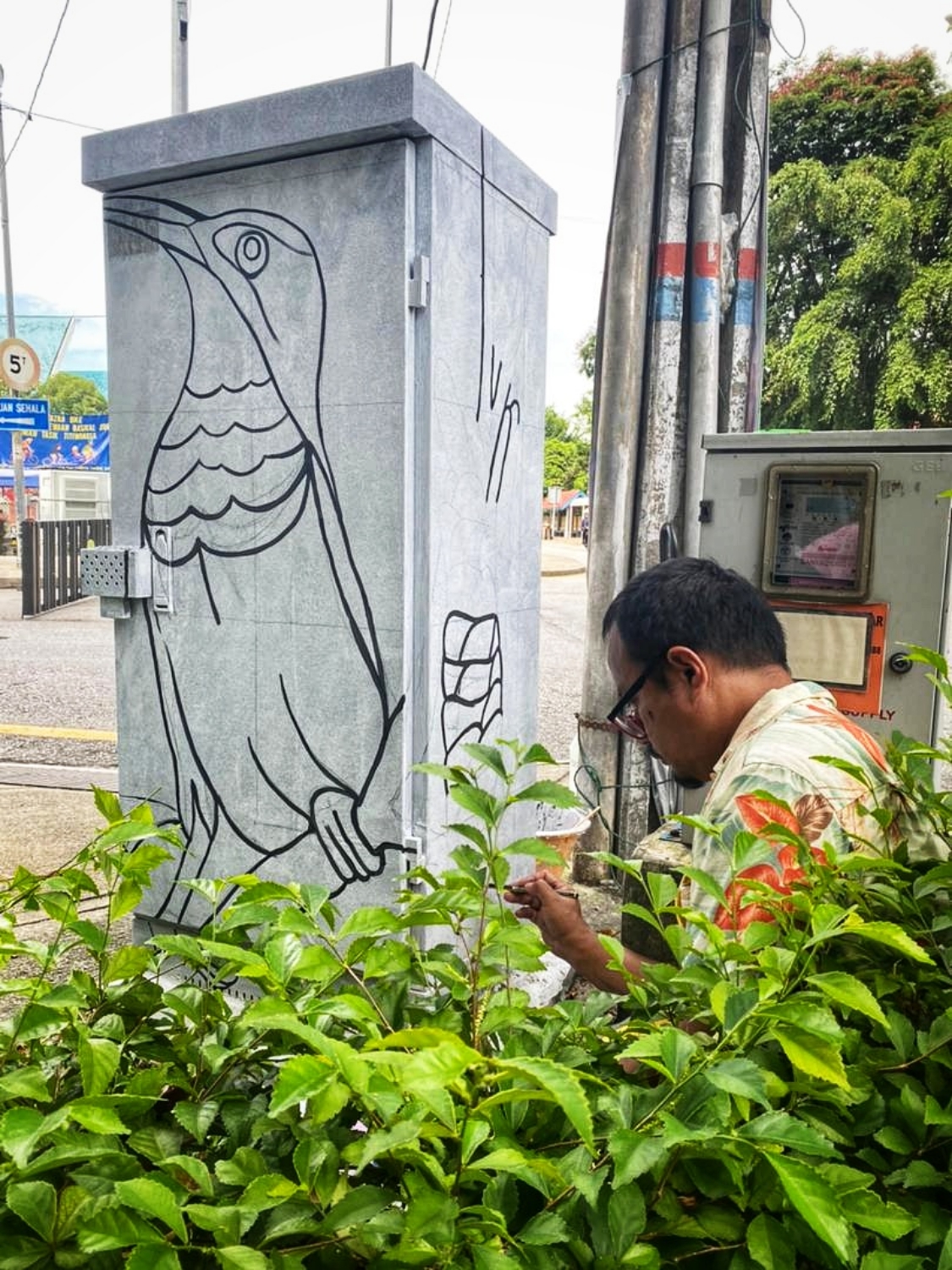
After the artwork is finalised, the process of painting on-site also has a different approach. Rather than just to showcase the artist’s skills and talent, we celebrated the process as a community event. During the painting process, we constantly engaged in conversations with visitors, allowed them to paint or just hold brushes or even wear our painting aprons for them to pose for pictures. We posed in pictures with them, spent time listening to their stories, explained to them about the artwork, and even gifted them a ‘brush’ as a souvenir.
When this approach developed naturally, it become a ‘performance of art’ by itself. One of the visitors Uncle Phua said, “Anak saya nak pusing-pusing. Tapi saya nampak persembahan seni. Jadi saya berhentilah nak tengok persembahan seni. Tak sangka dekat sini ada persembahan seni!!”
When the process becomes a community event and a performance of art in an outdoor space, this will give the artist a platform to educate the public on art appreciation. As a Graduate Architect, this is the opportunity to be part of ‘urban intervention’, adding life to a city.
THE APPEARANCE

With the right mindset, artwork, approach, and appearance set in, the persona of making this mural will become more than just a conventional mural. It becomes a pocket space where people can open their feelings, share their stories, create memorable memories, and be inspired for a brighter future. We can see people take photographs and visit the event during the making of the mural more than the completed mural.
We managed to document many stories on our Facebook page that we were unable to share here. These stories are evident of how human interaction plays an important role in giving life to a masterpiece. As Uncle Yang, one of the visitors said, he loves seeing us paint because it reminds him of his granddaughter who lives in the US and has not seen him since the pandemic started. The mural triggers their longing for their loved ones.
Changing mural work methodology will change the people’s perception that a mural is not just an aesthetic that is concerned only with beauty. The mural is a dialogue that brings people together from different backgrounds and walks of life as a true Keluarga Malaysia.

It started with a phone call from SL. He needed help to build a toilet for a community hall.
He and I have worked on Habitat for Humanity projects for many years. The site was in a swampy area near the river, access was difficult, the plank-walk into the kampong was in bad shape, and we had to concentrate on walking along the beams and not the floorboards, many of which were rotten, broken or both.
Three weekends later, the toilet was completed.
We might have stretched the commitment of our fellow volunteers. If we have gone on for another Saturday, no one would have shown up, including me.
Lesson 1: the easiest to get volunteers to join you is if you were one of the volunteers prepared to put in ‘sweat equity.
Lesson 2: such projects are not entirely about the building, it is about creating an event where social issues such as the lack of public amenities, housing and educational support can be highlighted. It is also about creating a platform for people to come together for a common good – their names, age, and stature in society are not important.
Charity should be anonymous.
SL – Ar. Wong Siew Ling