“We do not see things as they are, we see them as we are.” – Anaïs Nin
As visual journals accumulate over the years, an interesting shift begins to occur. The early pages often focus on places, buildings, landscapes, and objects. We sketch what attracts our attention, what appears visually interesting, or what seems worthy of documentation. Gradually, however, another layer emerges. The drawings become less about the subjects themselves and more about the stories, relationships, and traces hidden within them. A meal is no longer simply a meal. A chair is no longer merely a chair. An electrical meter attached to an old wall becomes more than an arrangement of wires and switches. These seemingly ordinary subjects begin to reveal a deeper narrative about how people occupy, adapt, and leave their mark on the world.
The spaces we inhabit are never as fixed as they appear. Architects design buildings, planners organise cities, and designers organise interiors, yet the real life of a place begins only after people move in. Every place becomes a collaboration between intention and occupation. Over time, individuals alter, repair, extend, modify, and reinterpret the environments around them. These changes may be subtle or improvised, but collectively they form a rich record of human presence. They tell stories that rarely appear in drawings, reports, or photographs. Instead, they exist quietly within the everyday details of a place.
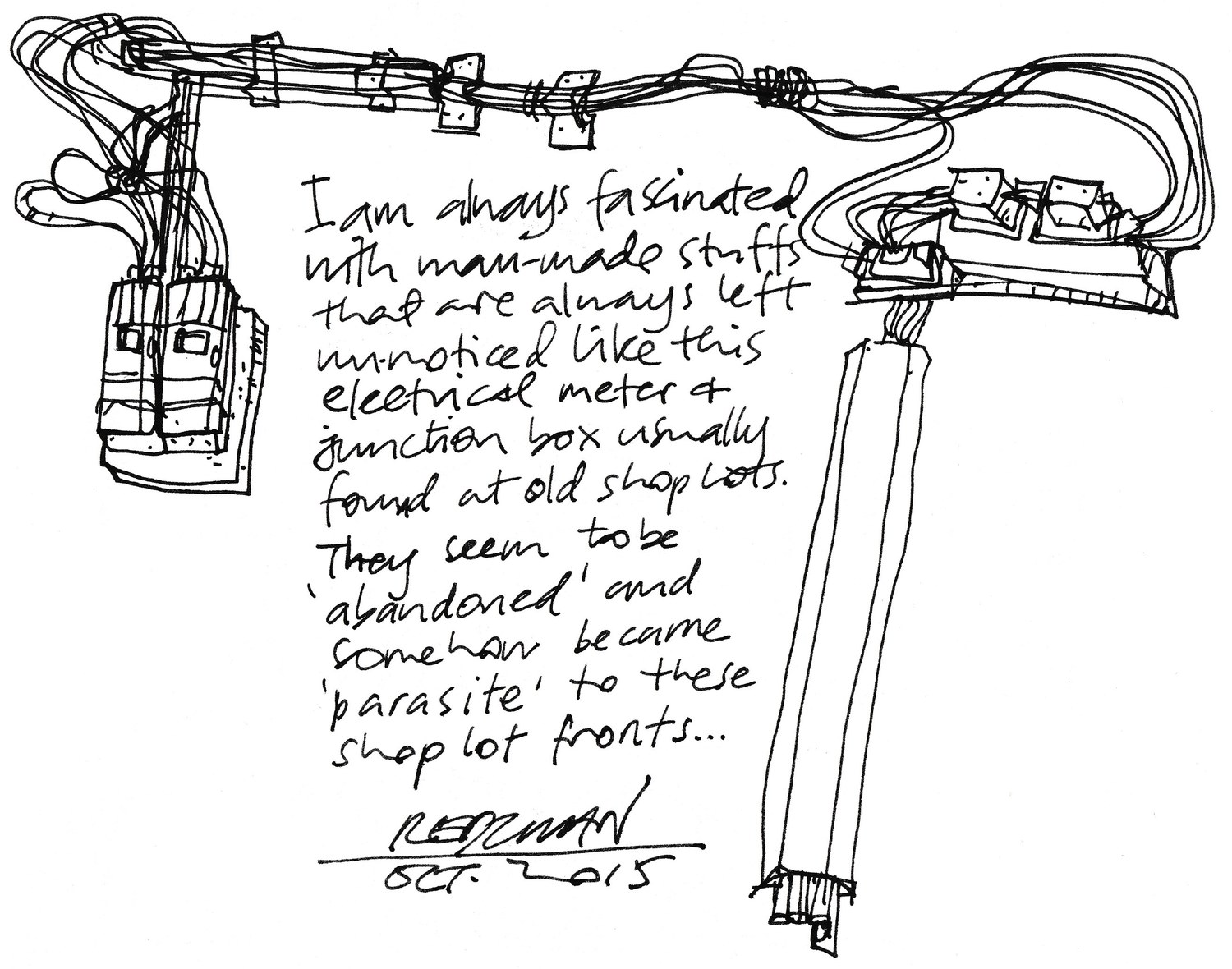
A cluster of electrical cables hanging across an old shopfront may seem insignificant to most passersby. Yet such a scene reveals a fascinating history of adaptation. Each wire suggests a need that arose at a particular moment. Each junction box marks a decision made by someone solving a problem. Layers accumulate over time until the installation becomes a visible record of occupation. What appears chaotic may actually represent decades of adjustments made in response to changing circumstances. The drawing of such a subject becomes an act of recognising that every object carries a history far greater than its physical form.
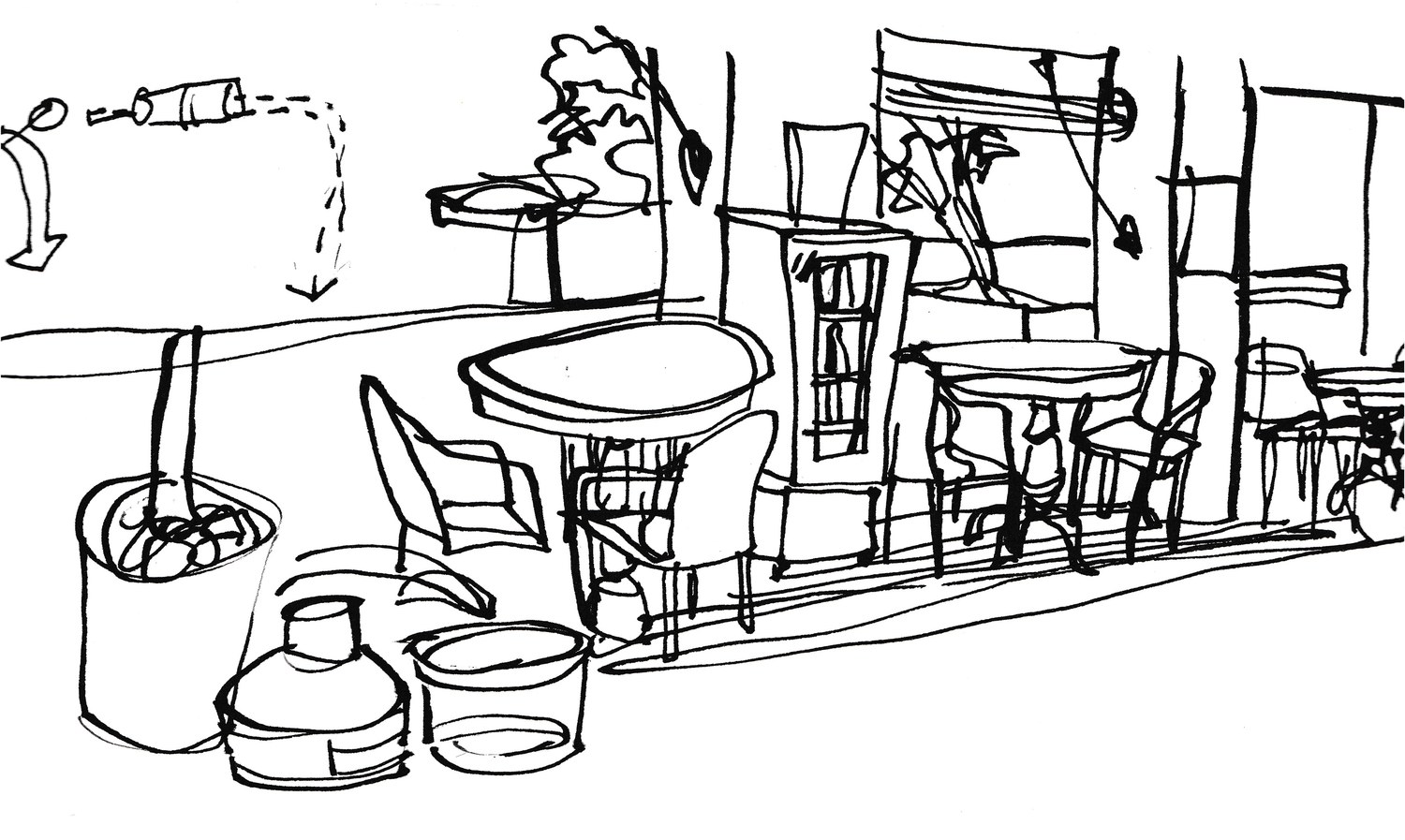
This understanding encourages us to look beyond appearances and consider how places evolve. Cities, neighbourhoods, and buildings are often described through their architecture, yet architecture alone cannot explain why certain places feel alive while others remain forgettable. Life emerges through occupation. It emerges through repeated actions, routines, habits, and rituals. The arrangement of chairs outside a shop. The placement of flower pots along a corridor. The handwritten sign taped to a window. These small interventions reveal the human desire to personalise, adapt, and belong.
John Berger wrote, “The relation between what we see and what we know is never settled.” His observation reminds us that seeing is never neutral. The more knowledge we gain about a place, the more layers become visible. What once appeared as visual clutter begins to reveal patterns. What seemed random begins to acquire meaning. The visual journal allows us to engage with this process of discovery. Through drawing, we spend enough time with a subject to recognise the relationships that hold it together. We begin to understand that every object exists within a larger network of social, cultural, and spatial connections.
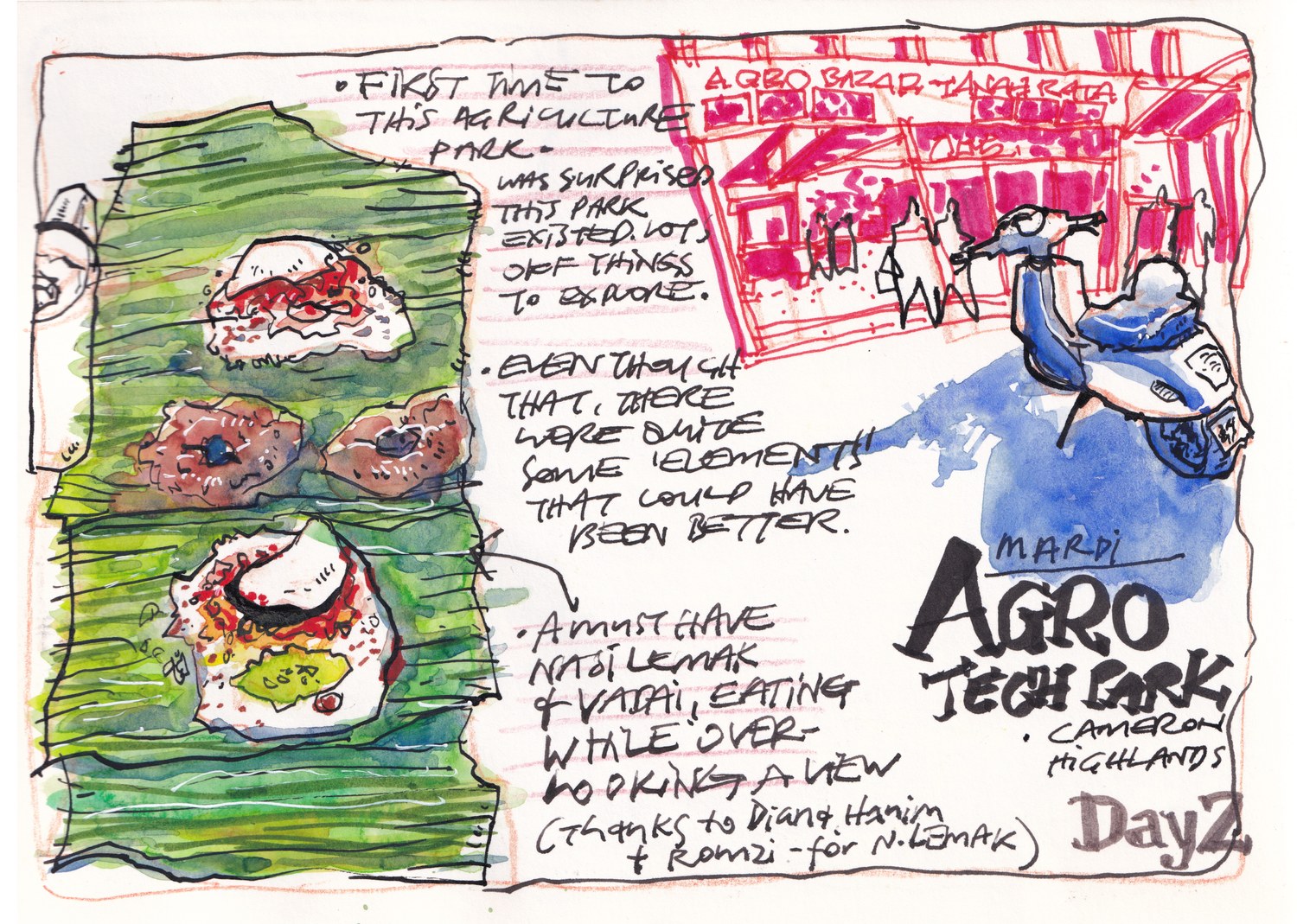
Consider a simple sketch of a meal at a roadside café or market. At first glance, the drawing records food. Yet the significance of the subject extends far beyond the plate itself. The meal represents agriculture, trade, preparation, memory, and culture. It connects farmers, vendors, cooks, and customers through a chain of activities that often remains invisible. A packet of nasi lemak wrapped in banana leaf is not merely breakfast. It is a reflection of local ingredients, regional traditions, and shared cultural experiences. Drawing such a subject becomes a way of recognising the systems that support everyday life.
Leonardo da Vinci understood the importance of studying ordinary things. His notebooks reveal a mind fascinated by details that others ignored. He examined flowing water, mechanical devices, plants, and geological formations, recognising that complex truths could often be discovered through careful observation of seemingly simple subjects. The visual journal follows a similar path. It encourages us to explore the overlooked and the familiar, not because they are spectacular, but because they contain lessons about how the world functions.
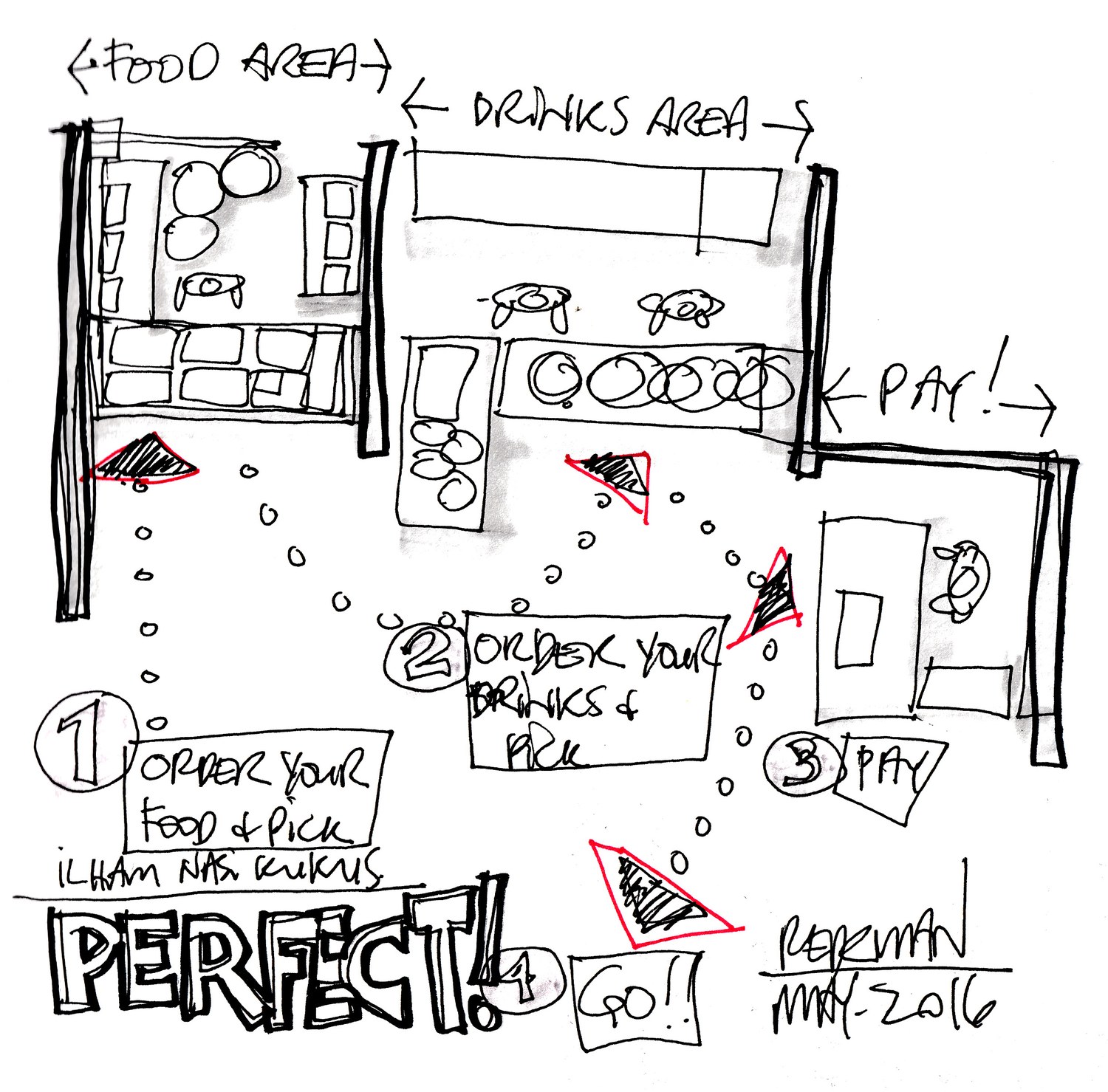
The value of these observations extends beyond aesthetics. They help us understand behaviour. A rough diagram showing how customers move through a restaurant may reveal more about a space’s success than a carefully rendered floor plan. The sequence of ordering food, selecting drinks, finding a seat, and making payment forms a choreography of movement. These actions create patterns that influence how people experience a place. By recording such behaviours, the visual journal becomes a tool for understanding human interaction rather than merely documenting physical form. This perspective is particularly relevant to designers and architects. Much of design education focuses on objects, materials, and spaces, yet the true measure of a place often lies in how people use it. A successful environment accommodates routines, encourages interaction, and adapts to changing needs. Evidence of these activities is often found in unexpected places. Worn floor surfaces reveal preferred routes. Rearranged furniture suggests social habits. Informal additions indicate unmet needs. Every modification tells a story about the relationship between people and place.
Philosopher Gaston Bachelard explored the emotional and imaginative dimensions of space in The Poetics of Space. He argued that places are not merely physical containers but repositories of memory and experience. This idea becomes increasingly apparent when looking through old sketchbooks. Certain drawings evoke memories far more vividly than photographs. A loose sketch of a café may recall an entire afternoon. A drawing of a hotel courtyard may bring back conversations, sounds, and emotions associated with that moment. The sketch becomes more than an image; it becomes a memory trigger.
Perhaps this is because drawing requires participation. A photograph captures an instant, but a sketch records duration. Every line represents time spent observing, interpreting, and responding. The page becomes a record of engagement. Looking back at old drawings, we rarely remember how accurately they were executed. Instead, we remember where we were, what we were thinking, and how the place felt. The drawing serves as evidence of presence.
Over time, these fragments accumulate into something larger. The sketchbook evolves into a collection of traces, not unlike the traces found within the environments we document. Each page records a moment of curiosity, a question, or an encounter. Together they form a personal archive of experiences and observations. More importantly, they reveal recurring interests: unnoticed details, improvised solutions, everyday rituals, and the subtle ways people shape their surroundings.
The space between things, therefore, is not simply a physical condition. It is where relationships are formed, and meanings emerge. It exists between objects and memories, between people and places, between design and occupation. It is where evidence of human life quietly accumulates. While architecture provides the framework, it is these invisible connections that give a place its character and depth.
Anaïs Nin reminds us that we see the world through the lens of our own experiences. The visual journal makes this lens visible. It reveals what captures our attention, what sparks curiosity, and what we consider meaningful enough to record. In doing so, it encourages us to look beyond appearances and toward the hidden narratives embedded within everyday life.
The most compelling stories are rarely found in grand monuments or celebrated landmarks. More often, they reside in the overlooked details that surround us every day: a meal shared between friends, a collection of wires attached to an old wall, the movement of customers through a restaurant, or the arrangement of tables within a quiet café. These fragments may appear ordinary, yet together they reveal something extraordinary about how we inhabit the world. It is within these spaces between things that the deeper narrative of place continues to unfold.
MOHD REDZWAN HISHAM BIDIN is a registered Interior Designer with Lembaga Arkitek Malaysia and has served as a senior lecturer in the Interior Architecture Department, School of Architecture, Building and Design, Taylor’s University, since 2014. He approaches drawing as a daily ritual, an intuitive practice that bridges observation and imagination. Guided by his idea of ‘neverdrawstraight’, he believes in drawing freely without overthinking, allowing ideas to flow naturally from mind to hand. For him, sketching is not just a technique but a way of seeing, thinking, and reflecting, a continuous dialogue between design, creativity, and the everyday moments that inspire them.