The early years of the twenty-first century witnessed a notable paradox: the birth of undemocratic architecture began with the introduction of digital and print media as instruments of representative democracy. The paradigm shifts from physical to virtual as a contemporary platform in determining the idea of democracy, leading the physical forums and debating chambers in parliamentary buildings to take a backseat, and olden civilisation has wistfully remained architecturally stagnant.
A major drawback of the architecture of parliaments is mainly due to the evolution of scale and complexity of our civil society, and the invention of print media at the beginning of the digital age. Thereupon, the discipline of politics has largely ignored the ‘spatial turn’ in recent years, where the public needs to gather, witness, and most importantly, participate physically ceased to exist. The production of physical forums and debating chambers is either forfeited, or the current architecture of parliaments has been privatised in terms of management and policing.
To the degree that the metaphorical term ‘spaces’ is often discussed in political studies to reflect the transparency and publicness embodied in the architecture of parliaments. Parliamentary buildings, by their nature, are intended to draw notice; the larger the structure, the stronger the public and national interest and reaction to it. Parliamentary buildings indeed embody the image of a strong presence and stand for tradition, stability, and power. They often arouse ideals of national identity and pride, as well as what Ivor Indyk (2013) refers to as ‘the discourse of power’.
In the discourse of the role of design and space of parliamentary buildings, there are significant studies that have been conducted argue that an open society with transparency equates a democratically elected parliament with accessibility. Physical and visual access is critical for conveying a sense of accountability, where the general public is given a direct connection to what is taking place rather than allowing views to be camouflaged by intervening objects or level changes that create a ‘stealth space’.
Although most studies emphasise the public’s free access to each parliamentary building, and the openness of proceedings in the chamber is conveyed ‘symbolically’ as a portrayal of the public will’s domination or supremacy in the democratic forum. A paradigmatic model is found in the German Bundestag within the Reichstag Building, which exemplifies the transparency in both production and architecture through the decentralised democratic forum and a commitment to public accessibility. The helical ramp along the outer edges of the cupola opens into the debating chamber below, allowing the public to symbolically ascend above the heads of their representatives in the chamber and giving a visual connection to the legislative process. An architecture of transparency and publicness that is consistent with the vision of Germany as a truly democratic society has replaced the previous architecture of power (Foster, op. cit.,p.9).
Arguments for transparency and publicness of parliamentary buildings are further expanded by Giurgola and Romaldo (vol.76, 1987, p.43-46), who contend that the building configuration must be comprehended visually with the natural landscape and surrounding locations rather than imposing its presence on top of the hill. In fact, the nature of the placement and setting revealed in the Parliament House of Canberra is referred to as the ‘forbidden city’ since the self-contained design of the structure does indeed segregate it from the outside world whose destiny it governs. The remoteness from the homes of the inhabitants makes claims about the ‘people’s house’ and national unity questionable, as pedestrians and major thoroughfares in their respective cities are no longer easily accessible. At the far end of the spectrum, thinkers envision the integration of arts and crafts, landscape, and human dimensions to perform art within nature, and of nature.
On the contrary, the design of the Australian Parliament House of Canberra stipulated a clear separation of classes of people within the building as well, with four distinct entrances serving the executive, Senate, House of Representatives, and the public: internal divisions were equally explicit, with floor-level circulation around and between chambers being inaccessible to the people. Here, power is practised through spatial segregation rather than democratic openness.
The general argument here is that the building is meant to represent a shift in power from the legislature to the executive, heading in the opposite direction to the interests of the media and public. To that extent, the spatial organisation and programming of the ‘people’s house’ are worth discovering in reflecting the idea of transparency and publicness of a deliberative democratic forum.
Closer to home, the Malaysian Parliament House is located on top of West Folly Hill after the independence of Malaysia in 1963, with a new mile-long highway, as part of the extensive road improvement network in Kuala Lumpur. To house the Senate (Dewan Negara) and the House of Representatives (Dewan Raayat), spatial design considers clear segregation between parliament and government establishment. The unintentional result of opening the Malaysian public sphere as a forum for debate and negotiations between the states, activities, and the public was heading in the opposite direction, with neoliberal planning practices. This phenomenon arose primarily from the placement of Parliament Complex in the centre of Kuala Lumpur on a sloping hill, allowing only motorised vehicles easy access, even more crucially, the spaces are segregated according to a specified building program that is further organised in a spatial-clustered manner, taken from the Malaysian parliamentary.
With the birth of undemocratic architecture, Plaza Dataran Merdeka, situated in Kuala Lumpur city centre and connected to the current Malaysian Parliament House through Jalan Parliament, potentially houses an informal public sphere that serves as a counterbalance to the formal public sphere. It is alarming that spaces created during the colonial era are now more democratically friendly than the democratic government’s seat built by the seemingly democratic post-colonial hybrid administration.
This has led to the subversiveness of the designer, which may be seen in securing that the spaces created within the political spaces fit the requirements of healthy city life, in which spatial interactions and physical environments consider power dynamics and shape behaviour. Plaza Dataran Merdeka (Independence Square), along with Jalan Parliament, is therefore proposed to be an ‘informal’ public sphere, as a counterbalance towards the existing ‘formal’ public sphere, the Malaysian Parliament House.
Democracy is a spatial phenomenon, whereas design is a form of politics. The project eventually seeks an exertion to reconnect current democratic and political ideas while exploring the degree of transparency and publicness of the architecture of parliaments in Malaysia to be considered in catering to a public-sphere-oriented account of the deliberate democratic forum. A democratic society ffers both a ‘formal’ public sphere in the focal point of representative institutions and an ‘informal’ public sphere that recognises creative spaces of democratic performance (Habermas, 1964). Taking this as a point of departure, the project argues for the origins of the performance of spectaculars, which are traditionally intended to be in the public sphere for engagement and impression purposes. Adopted a new take on the representation of “people’s house” by exploring the significant role of ‘cueing’ effects on the behaviour of republicanism, participation, and citizenship.
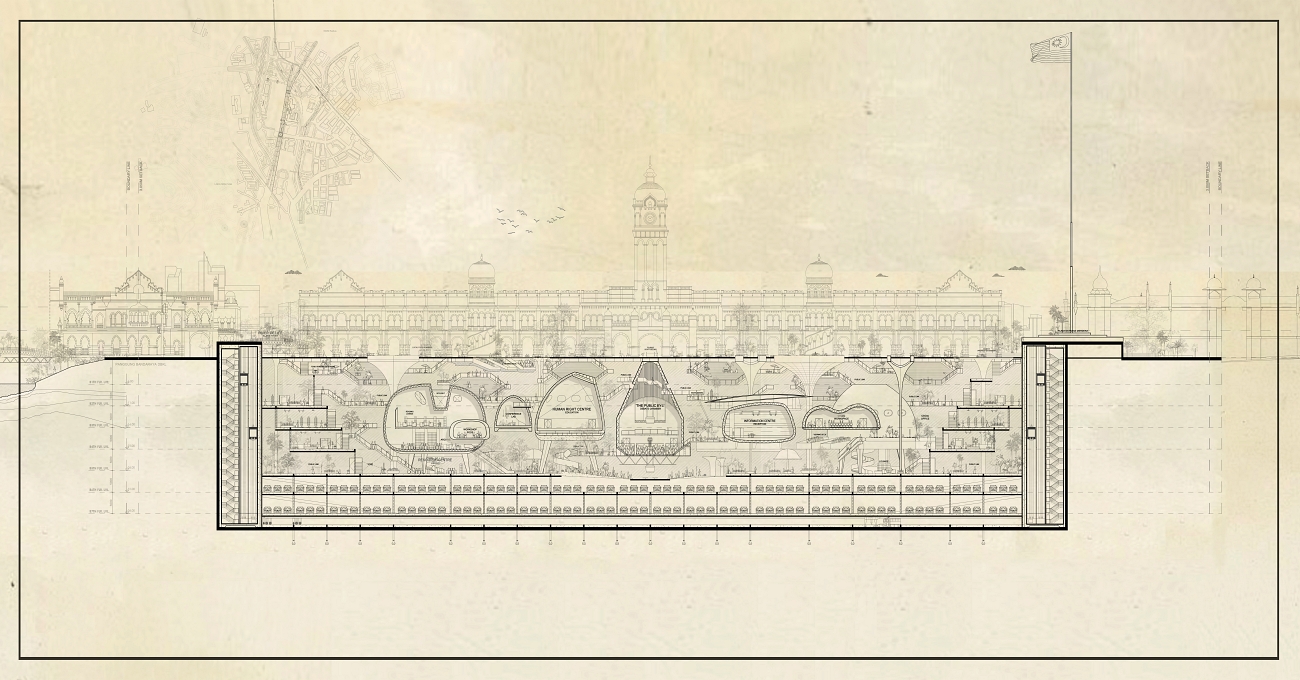
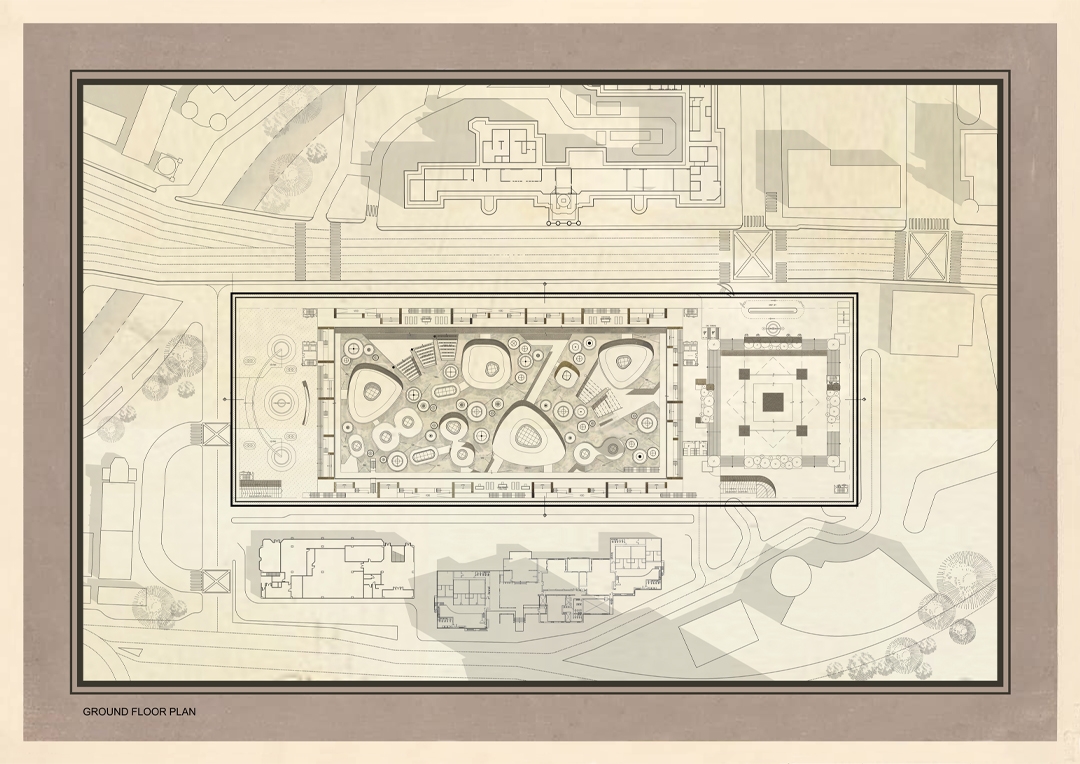
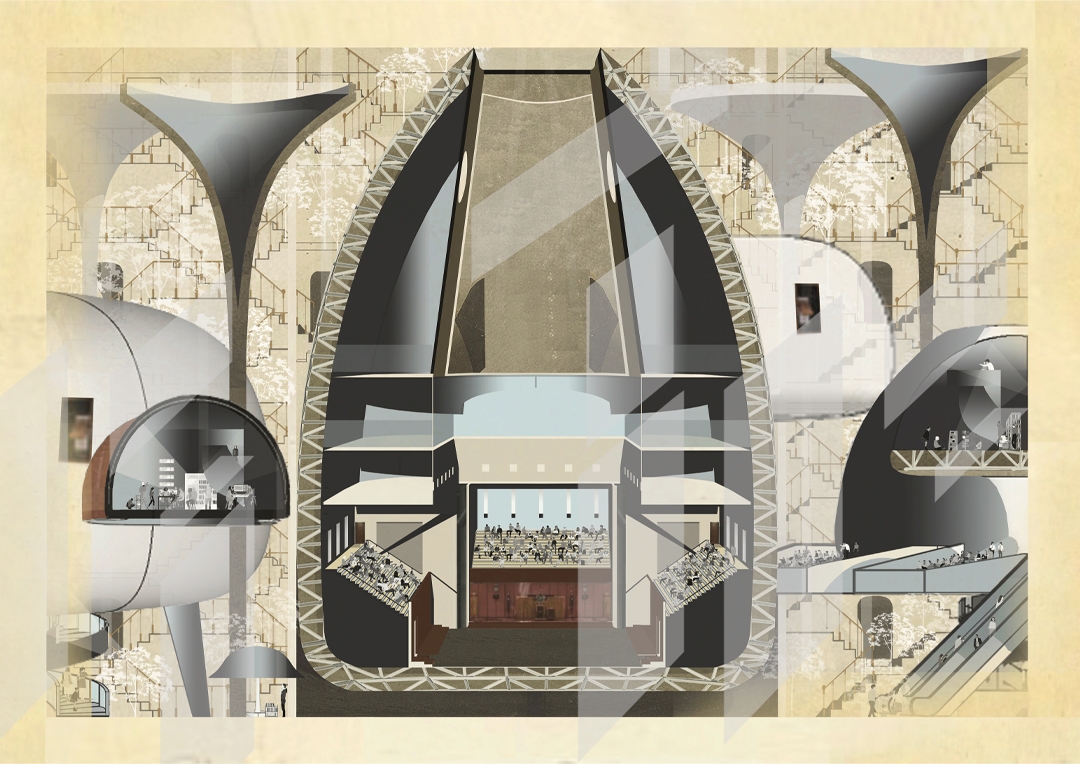
To this extent, the section expresses an informal movement behaviour which is intended to explore geometries, scales, and masses. The spatial programming exemplifies an informal movement behaviour to be considered in catering to a public sphere-oriented. The general argument here is to make a shift in the representation of power, a significant role in “cueing” effects on the behaviours of representation and the public alike, which reframes Plaza Dataran Merdeka not as a monumental backdrop to authority, but as an active terrain for public agency.
Each program occupies a single individualised building with a specific plan and a different rotation. While this building, which includes the individual spaces, is orthogonal, all the collective areas are oriented differently, generating unexpected residual areas. The blocks are all connected by points of contact, always in a different location, with the effect of producing various degrees of tension. The different shapes visible are also highly individualised in sections, creating an overall effect of a citadel and multiple architectural episodes with different geometries, scales, and masses.
The architecture of power has now been replaced with an architecture of transparency, publicness, and civic participation embedded within spatial logic. Through decentralising the democratic forum, the project signals a shift from symbols of power to architectures that empower, inviting an everyday informality that redefines civic life unfolding in the heart of the Kuala Lumpur city centre. This gesture foregrounds transparency and publicness in both architectural production and political engagement, positioning public accessibility as a foundational principle.
Architecture here becomes not merely a backdrop of political rituals, but an active medium that cues behaviour, invites occupation, and sustains public presence over time, holding formal institutions of governance in continual spatial and civic tension. Ultimately, Into The Void: Pusat Demokrasi Rakyat argues that the future of Malaysian democratic architecture lies not in designing new monuments of power, but in spatialising inclusion that allows democracy to unfold – messy, collective, and unresolved within the everyday life of the city.