
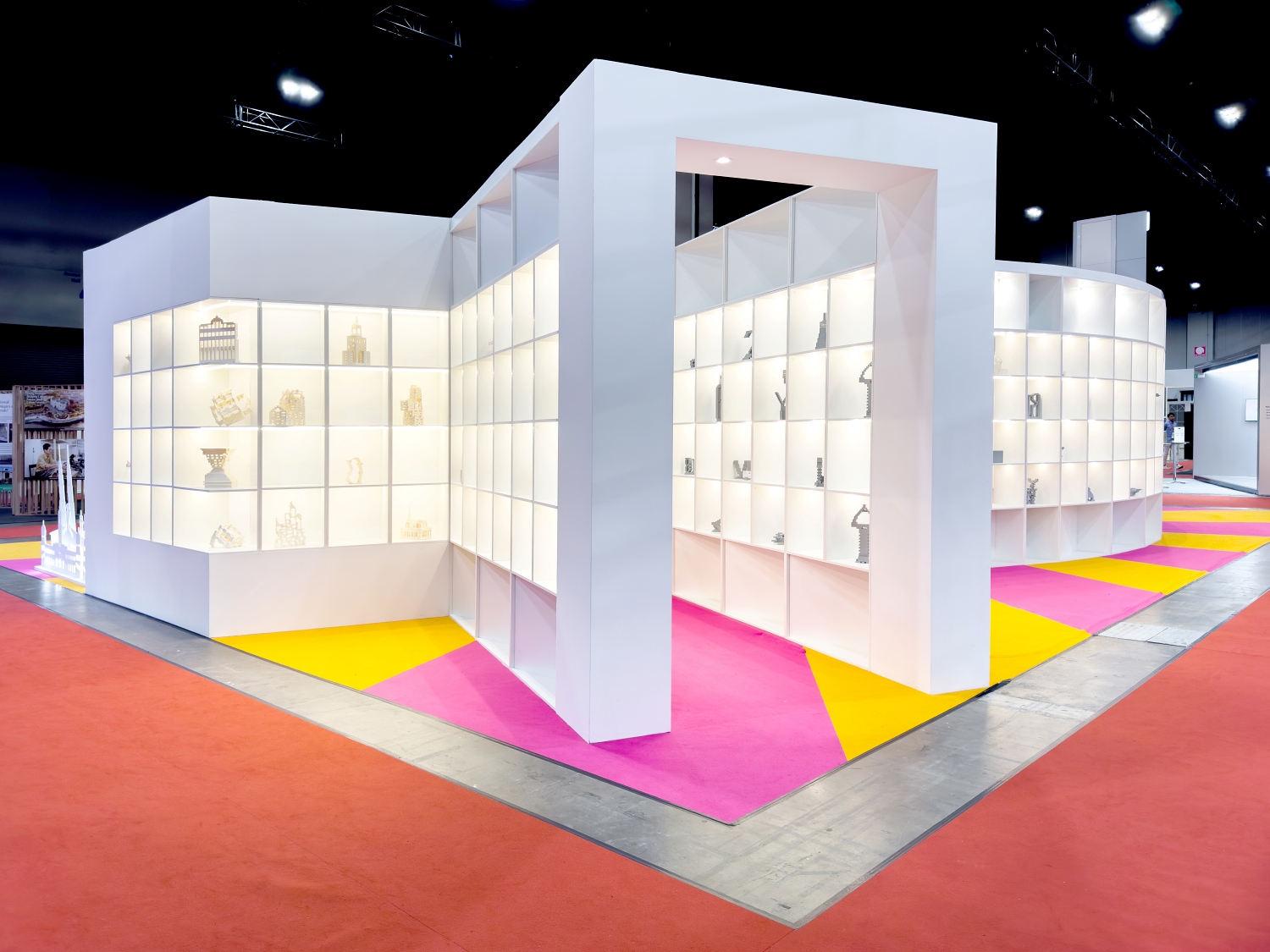
Unveiled at ARCHIDEX 2025 in MITEC Hall 3, the PAM Pavilion@MITEC is designed by Ar. Qhawarizmi Norhisham, Principal of Qhawarizmi Architect, “Colosseum of Co-Creation,” an Architecture Innovation Lab where creativity and community take centre stage.More than a showcase, it is a working experiment in design, participation, and imagination.
Inspired by the theme, “Build Your Imagination, One Brick At A Time,”invites participants of all ages to construct miniature architectural forms using play-bricks.Each creation, whether playful or precise, is then displayed on the pavilion’s striking curved white façade: a lattice of square racks stacked one over another.The facade evolves daily, transforming into a living archive of imagination, authored collectively by its visitors.
The pavilion is designed as a democratic gallery.A framework for collaboration that is complete in structure yet unfinished in content.Its physicality depends on the input of architects, students, and the public.In this way, the pavilion democratically distributes authorship, blurring the distinction between architect and audience.The architecture provides the stage, but it is the collective contribution that completes the work.
At its core, the pavilion functions as a social experiment.Each visitor faces choices: to add onto another’s creation, to shift it, to replace it, or to be inspired by it.These small decisions form a study of behaviour and interaction, reflecting how individuals engage with shared environments.The pavilion becomes a mirror of society’s collaborative instincts, revealing whether we preserve, adapt, or overwrite what others have built before us.
As a participative pavilion, it deliberately fades into the background, allowing the creations it holds to take precedence.What matters most is not the pavilion itself, but the process of co-creation it enables.It resists the idea of a finished, static exhibit; instead, it privileges the evolving narrative of contribution.The work of many hands and minds replaces the authority of a single author.
Spatially, the pavilion adopts a democratic gallery design.Visitors move in an infinite loop around a central seminar and talk area, where discussions and presentations take place.This circulation ensures that learning, debate, and creation exist side by side; knowledge at the core, imagination in orbit.Tucked discreetly within the structure is a coffee bar, offering a pause for conversation and exchange, reinforcing the pavilion’s role as a space of community.
The pavilion also embodies a 60-year tradition of building with play-bricks, tools once seen as toys but long valued as instruments of learning.For generations, these blocks have taught children, and future architects, about gravity, balance, and possibility.In reviving this tradition, the pavilion affirms its continued relevance in an age of digital design and automation: that architecture begins with the hands, with play, and with imagination.
As one of the standout attractions of ARCHIDEX 2025, the Colosseum of Co-Creation redefines what an architectural pavilion can be.It is not only a site of display, but also a site of action.It celebrates architecture as a democratic process, an inclusive experiment.