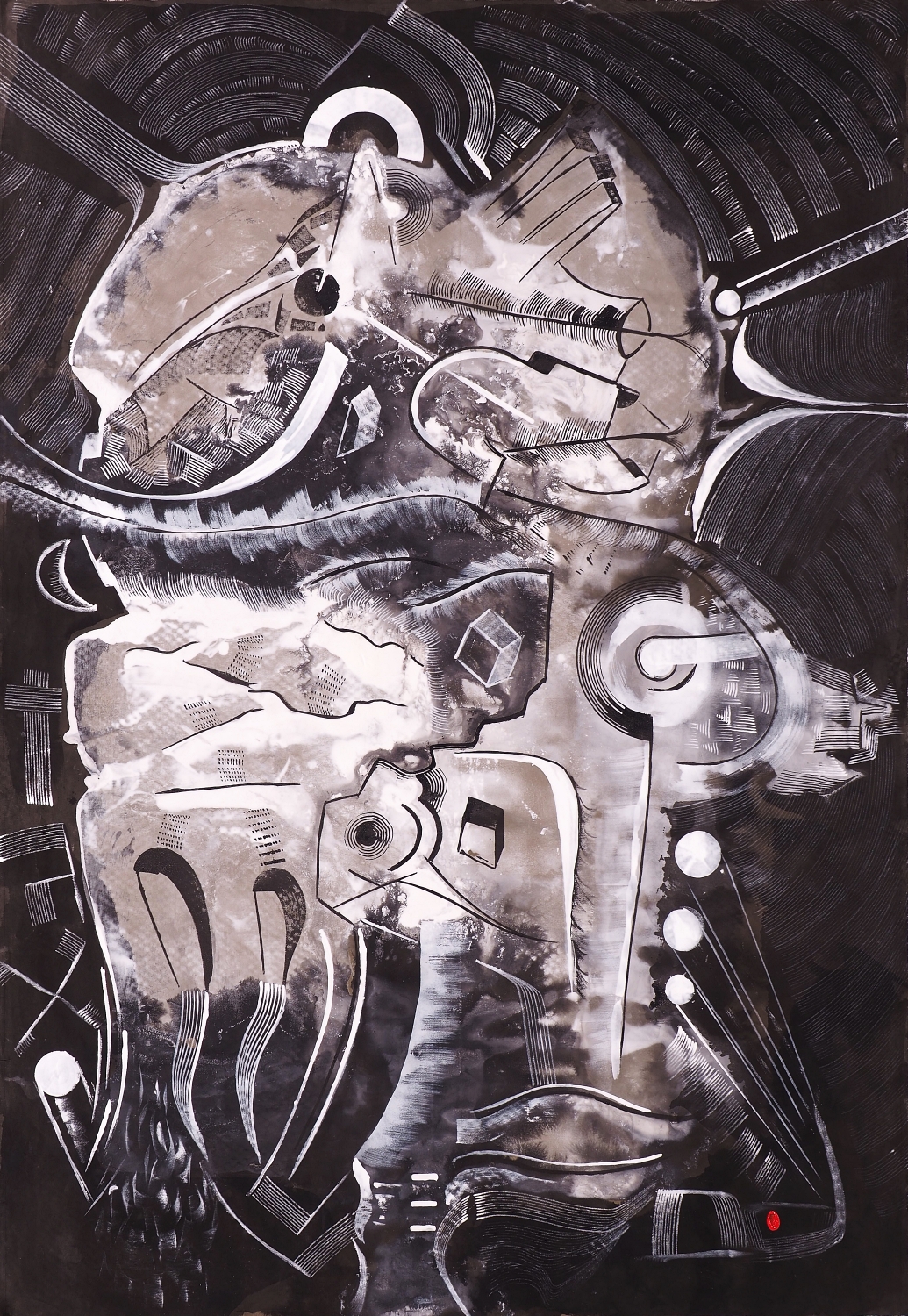
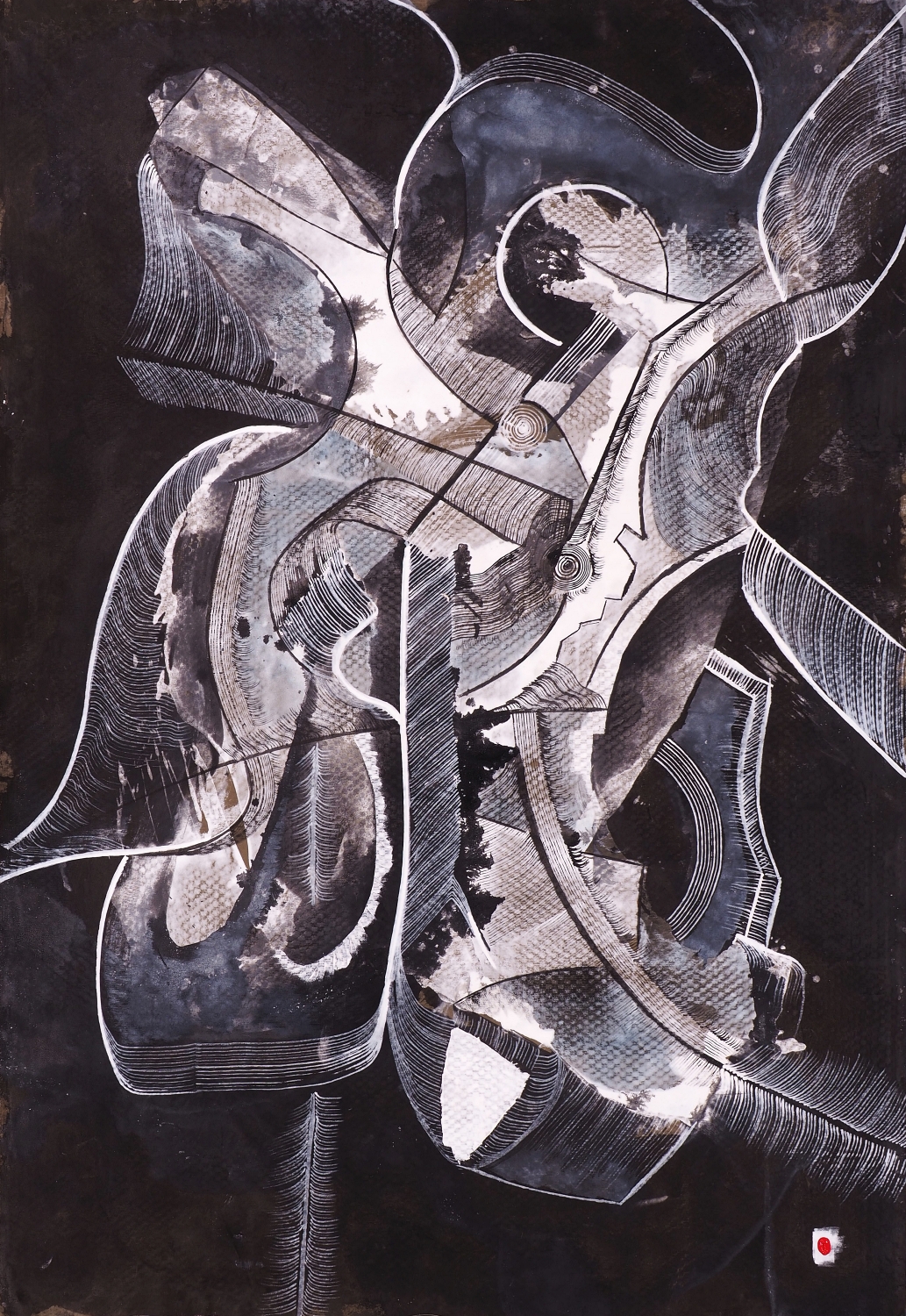
The act of freeing one’s mind is surprisingly challenging yet liberating, offering one to new thought avenues and inspirations. Allowing oneself to free the mind while aimlessly letting the hand draw across the paper, or doodling in the margins while the mind wanders is something we don’t consciously do and are not trained to do so. And yet, many of the world’s greatest ideas came from the wandering of the mind.
That is what Jonathan Vaultman is seeking to explore in his works. At the start of the French artist’s career six years ago, he was fascinated with searching for connections in the world. Through the process of automatism, he explores the existential questions of life, searching for the links between things.
Vaultman’s journey in art is an interesting one. Growing up in a bohemian lifestyle with artist mothers, he was always surrounded by art and inspired by it. He never received a formal art education, but he was moved by art. Even as he studied veterinatry, and later osteopathy and acupuncture, he eventually went back to his roots for art. “I chose to paint because I couldn’t do it any other way.” He was inspired by many different artists such as French artists Jean-Michel Basquiat, Yves Klein, and Egon Schiele, American artist Jacson Pollock, as well as the sci-fi author Philip K. Dick. “I like Basquiat for the brutality and strength of his works; I like Dick for the stories of realities that were confusing and mesmerising; and I like Pollock because we work similarly, with large canvases and fully using our bodies to paint. I don’t follow one artist or genre specifically. Everything around me could inspire me, everything is fascinating.”
When Vaultman first started to paint, he felt a breakthrough in his life. “During my first exhibition,” he explained, “I got a lot of comments from the public that they liked the work, but that I didn’t have my own style. But as I paint, I realised that I was seeking more of a personality in my paintings rather than a style.” He admits that his artworks may be too complex for the public to see many different things at once. “Nowadays, I start with a freer feeling, more automatic, and when I see something more interesting, maybe from an aesthetical or conceptual perspective, then I would step on and try to walk on it to extract the essence of the message.” This process of extraction is rooted in the automatism process.
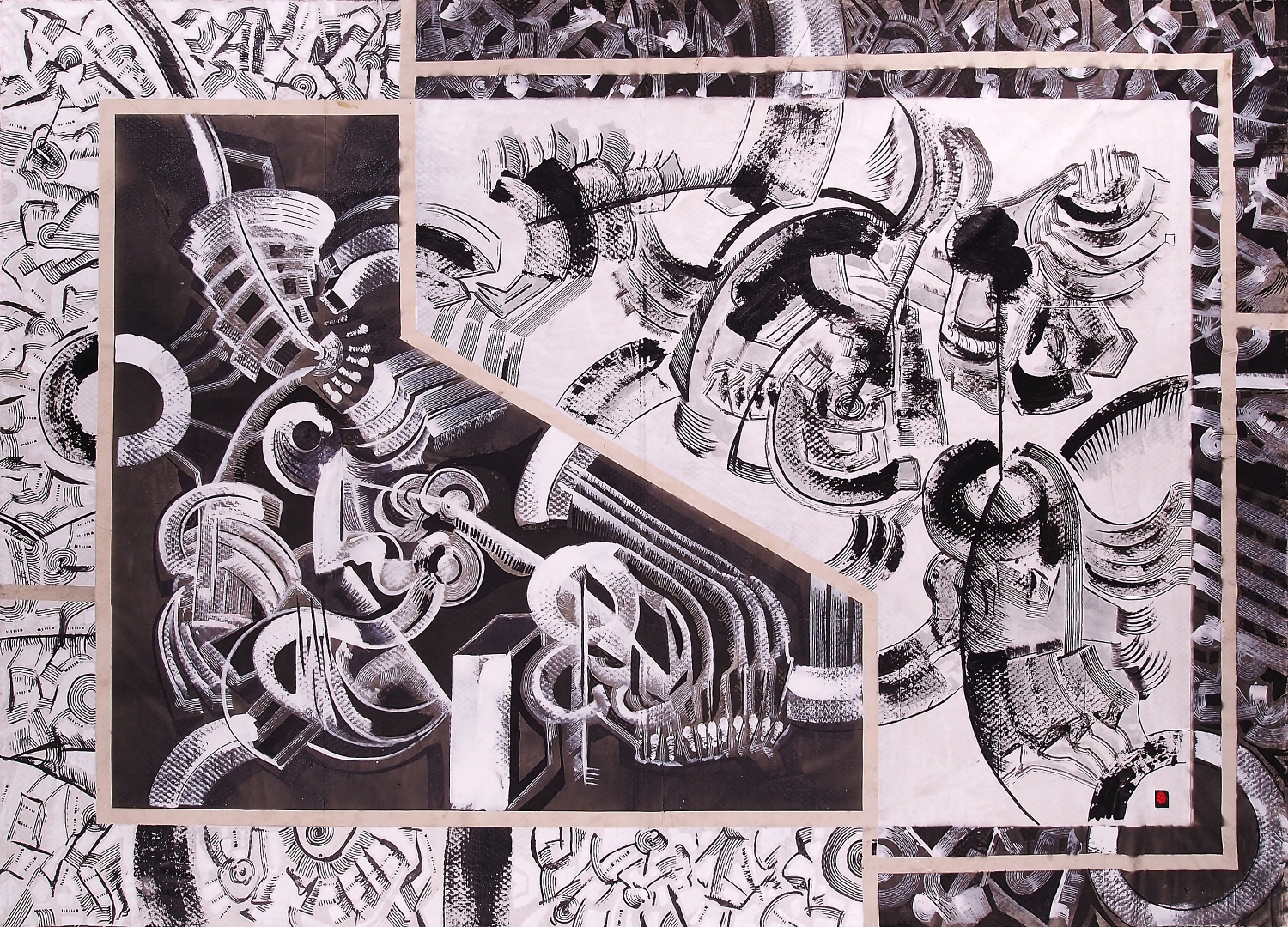
Vaultman’s works are a result of this temporal moment. “I always listen to music when I paint. I listen to different music of different genres, very eclectic, and the music influences the pieces that I create. That is the process, and the painting becomes a graphic memory of the time.” The result is always unexpected, as he goes into the painting freely without any conscious thought. “When I’m in the painting, I’m also somewhere else. It’s a special point in a special state… I can’t really define it. I get a lot of ideas while painting, and I like seeing the personal evolution and growth in the paintings. I think that is serendipity, you can go and bring something from within you into the painting.” Vaultman often paints two paintings at the same time, listening to the same music and using the same tools, switching back and forth between the two canvases, but the resulting art is different from each other. “It’s not a diptych, it’s not meant to be together, but it’s interesting for me to see what comes out while using the same instruments.”
Despite this, Vaultman doesn’t call himself an automatism artist. “Sometimes it’s nice to be fully automatic, to be a tool, but sometimes it’s nice to put some intellectual part in it, to mix both automatism and conceptual parts in the painting. For example, I let the music guide my painting, but I also cannot let myself go, ‘ah, there is no balance there, I need to go [to that corner of the painting].’” He describes his process as bridging the gap between something primal and instinctive, with something more thoughtful and intellectual. “To me, art is about rupture, to find something new and exciting, and to put meaning and integrity into what I do.” The journey, or the process, is more important to Vaultman than the concept itself, as he believes that the process is a concept in and of itself.
Vaultman’s works are all part of a bigger work, an ongoing process of exploration of connections. “My paintings attempt to create a link between things, to bring principles together, to find connections and relationships that might at first seem hidden. I blend abstract concepts, mathematics, inherited from my scientific training, with traces gleaned from a primitive intuition of the body.” He paints in large, expressive strokes, oftentimes on huge canvases. His painting process is similar to that of Pollock, using the force of his entire body as expression and covering the entire canvas. “To me, it’s a question of integrity, of giving something more. The more you sweat, the more attention you give to the painting, the more the painting ‘lives.’”
As Vaultman first started out, he explored several methods with a more conceptual framework, such as the play of colours and layers, or the level of “instinctiveness” in the process. His earlier works are an explosion of colour, with L’Officiel Spain describing the paintings as “pure colour and animal energy.” In the interview, he describes that each of his earlier works reflects a moment of his life, as each was born at a certain time. His first work, Pilot, was a mixture of blacks, blues, and reds with a lot of movement, followed by his first solo exhibition, Magic Tool, with an explosion of bright bold colours of turquoise and red. His collection of works titled Motion Pursuit #001 and #002 capture the rapid and dynamic movements inspired by his work as a veterinarian for competition horses. The aesthetics, speed and resistance of horses are expressed by the rapid, quick strokes across bursts of colour across the canvas as if the lines are dancing and leaping across the canvas.
Vaultman’s background in science (through veterinary and osteopathy) and art (through his upbringing) combine in guiding him through his creations. To him, science and art are two sides of the same coin. “Even though science and art may seem different, to me they are both looking for the truth in our universe. Science takes a more logical and empirical approach in discovering the truths, but art takes a more emotional and subjective approach in expressing the truths.” The paintings that are produced are a result of his constant journey in seeking connections and bridging the duality between science and art, light and dark, the conscious and subconscious.
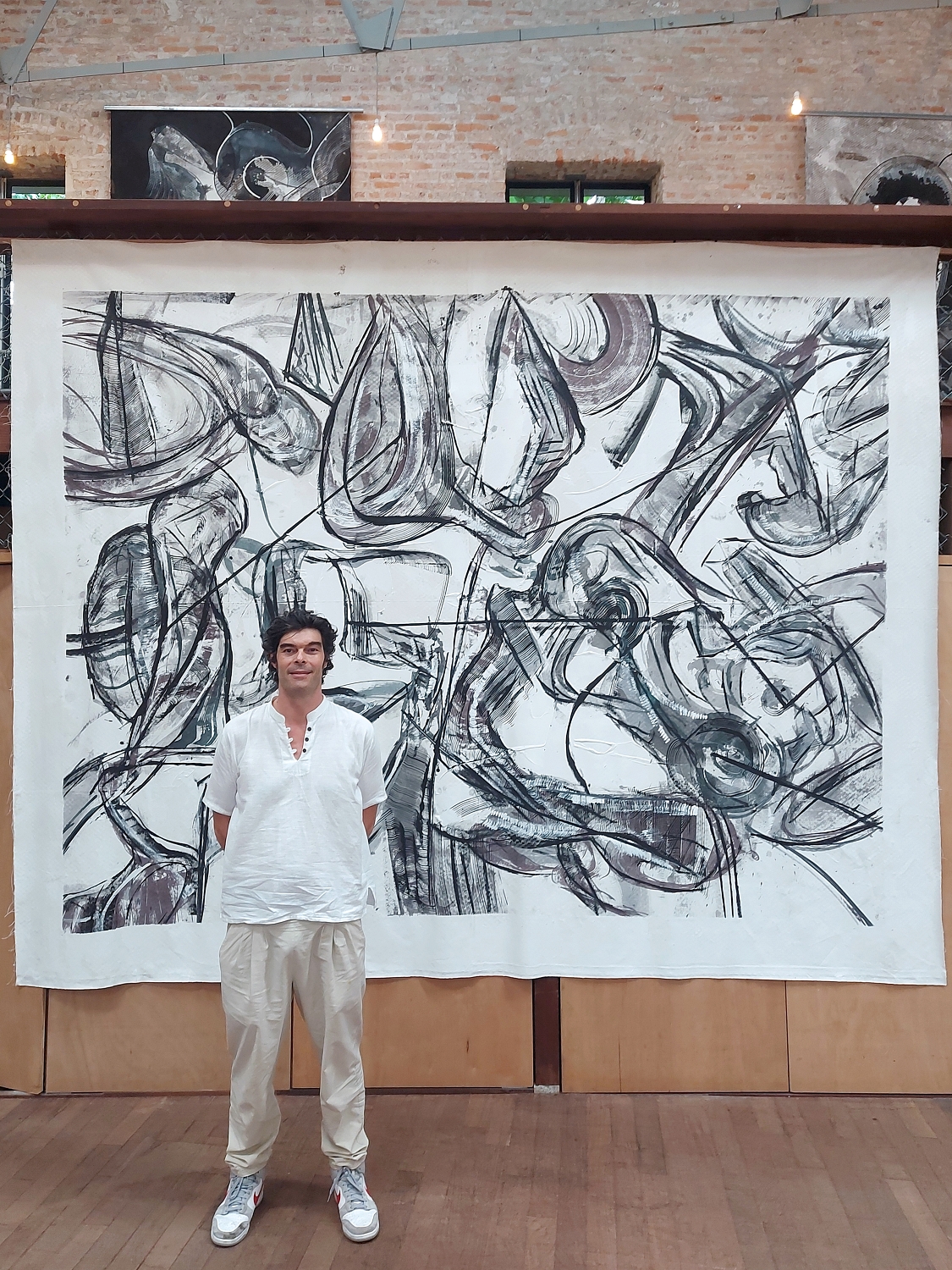
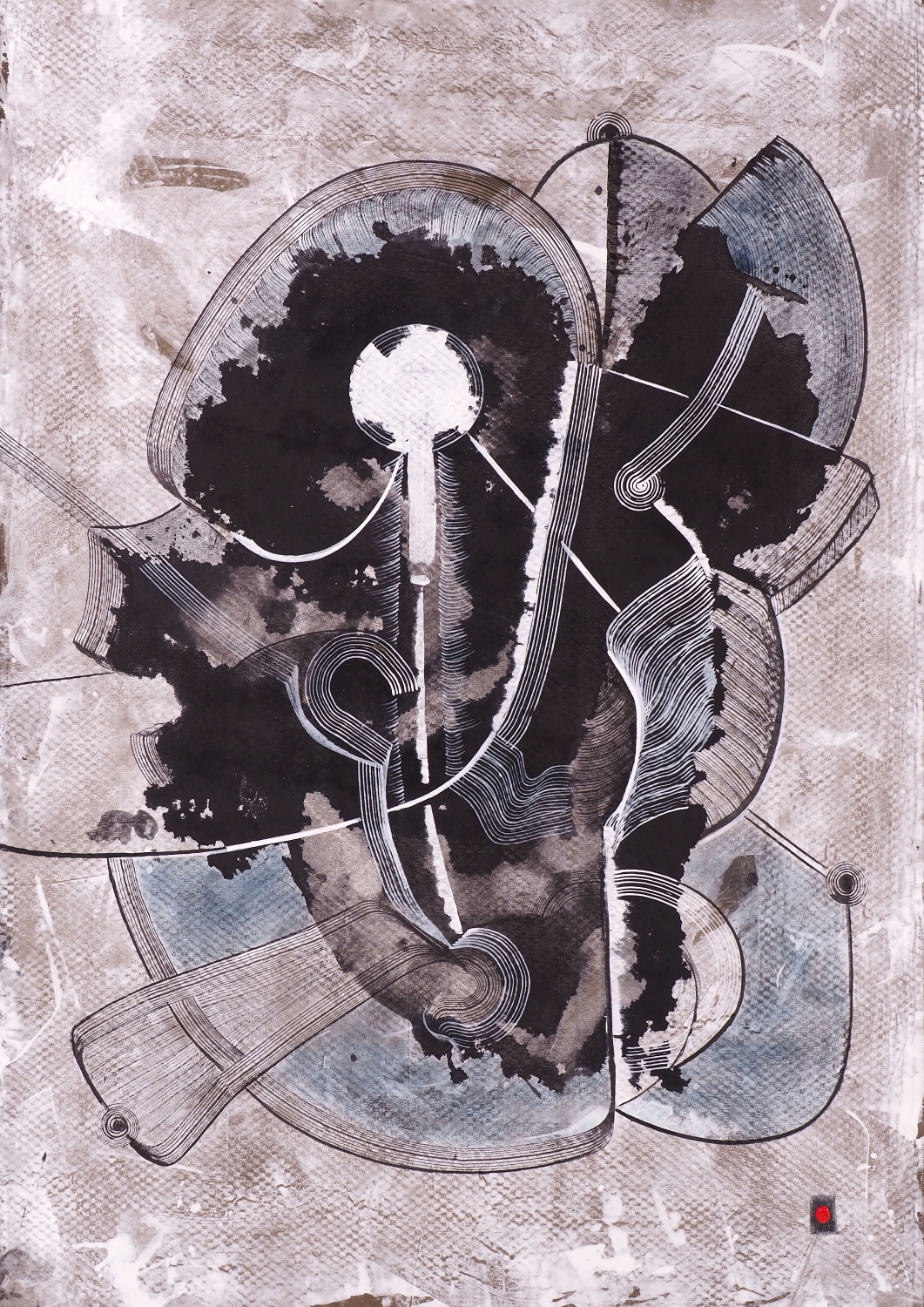
After several years of exploration, Vaultman returned to his roots to retrace and re-examine his journey. For L’oeuvre au Noir, or Black Work, his first solo exhibition in Malaysia, he strips back the colours to only black and white, looking to express the connection and complexity that could be created within the spectrum. “I wanted to explore the idea of alchemy, the contrast between light and shadow, with the process of clarity and enlightenment. I wanted to explore the in-betweenness between black and white, the grey areas between both extremes. “
For these works, I restricted myself to the two basic colours, using simple tools, going back to the fundamentals of my art. From the dialogue between these two tones, there are a ton of emotions and insights if you pay attention to the nuances between them. The connection between the colours is more important than the colour itself.
“As humans, we always try to put things in boxes, we always try to categorise, such as how people like to categorise the genre of art I might belong to, but nature is not like that. Connections in nature are always present, maybe we see it, maybe we don’t. Humans like to simplify things as it gives us the feeling that we manage our destiny and that we are in control because we think we understand. But that is not the truth. The truth for me is addressing the complexity of life. In my art, I try to make the links between concepts and approach, links and connections that might not be visible in the beginning, but through the process slowly revealing itself and allowing us to understand it better.”
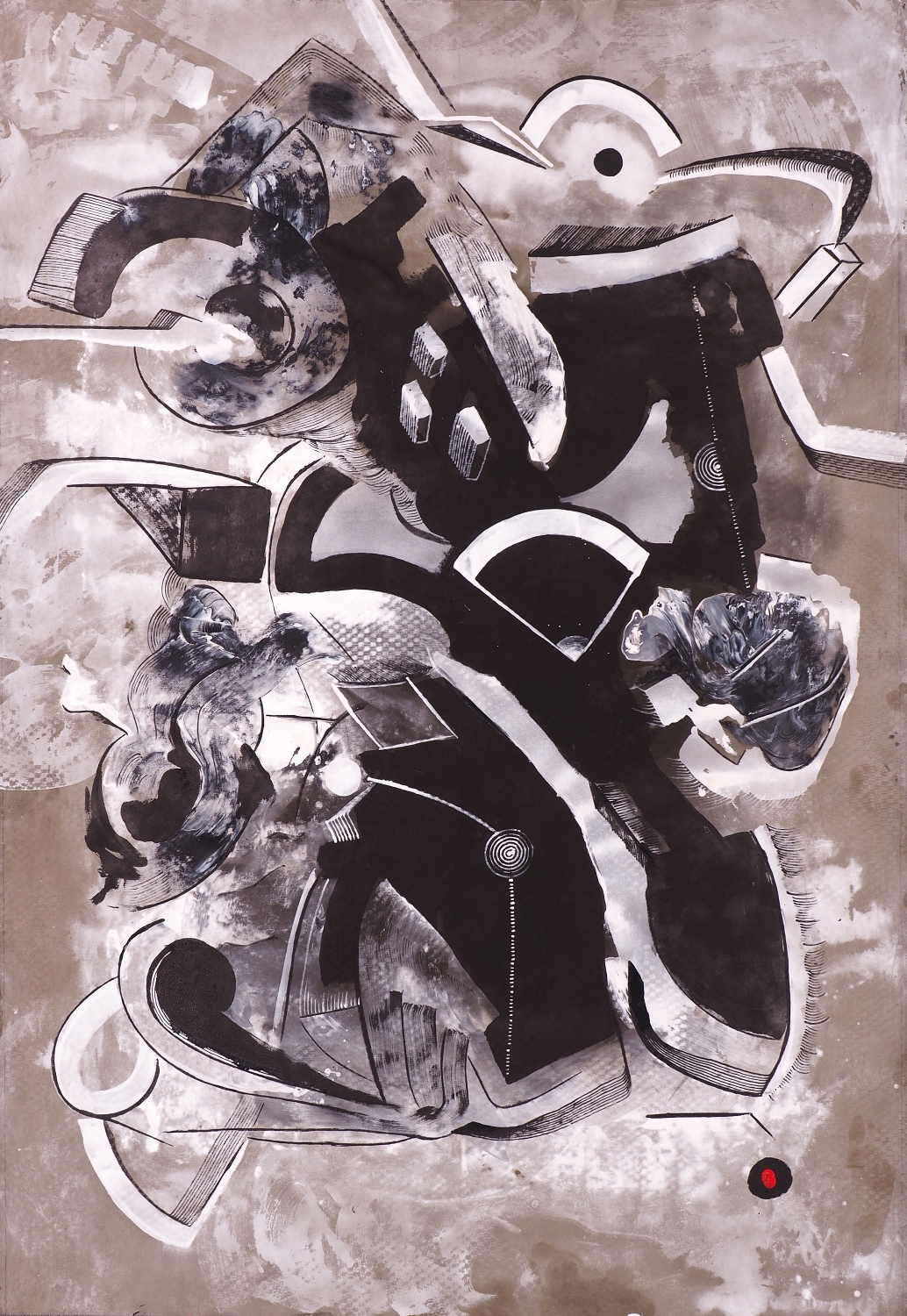
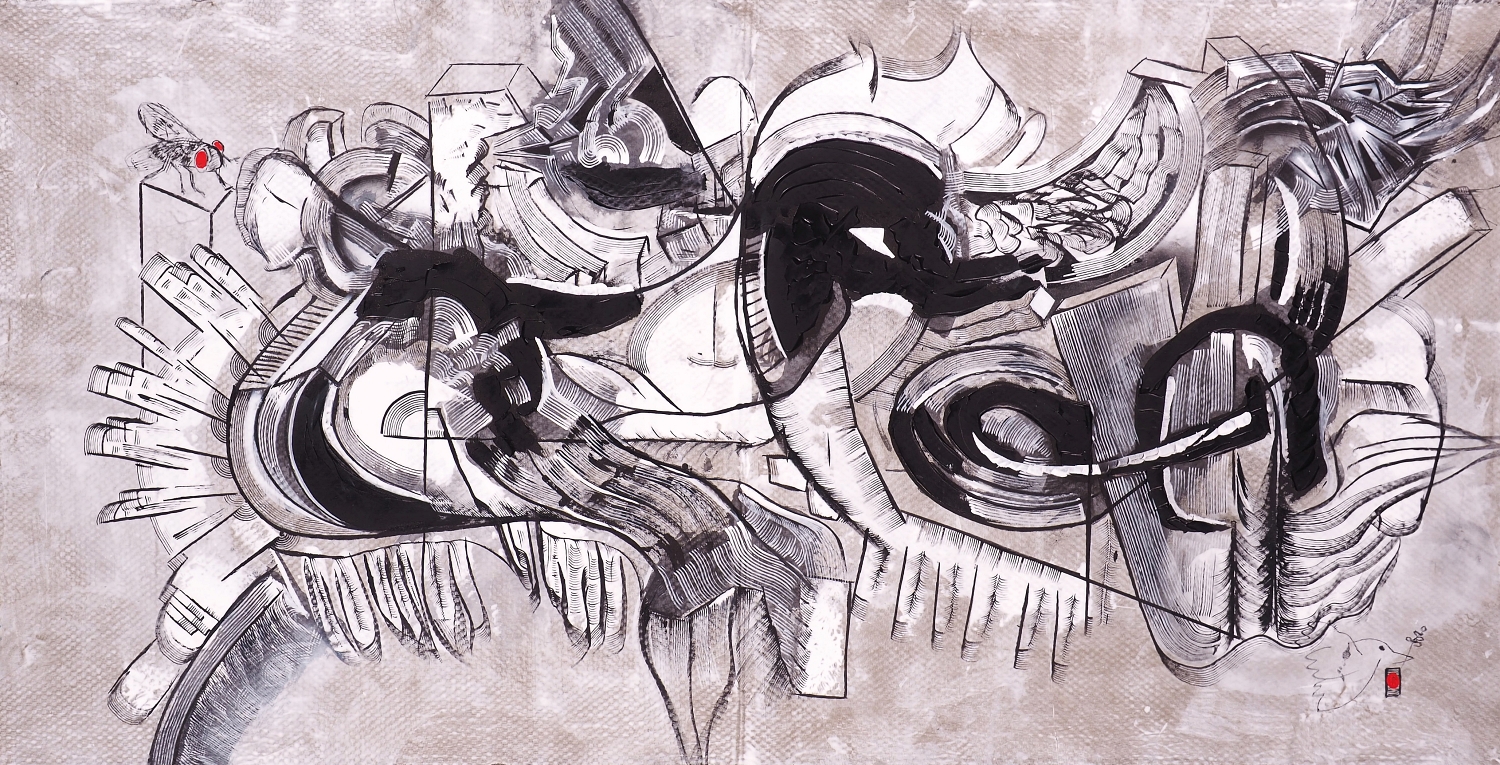
Vaultman explained this revealing of connections through his artwork War (2022). War is usually seen through the narrow lens of a party, he explained. One might see it from one side of war, be it good or bad, or one might take the view that war as a whole is bad. But war has been done since the start of humanity, he said, and there is no answer to the question of war. Vaultman takes a broader view of the concept of war, exploring the duality of destruction and reconstruction. War brings about death, but it also brings the mixing of people. The fly on the top leftcorner of the painting symbolises the warrior, taken from the ancient Egyptian symbol of the perfect warrior, and the la colombe (dove) at the bottom right corner symbolises peace. In between sits the ruins and developments. Vaultman works on the different concepts, different scales, and different points of view of war, and brings them together into one painting. The different levels, one of Vaultman and the viewer become mixed at the end.
Vaultman’s concept of the connection between duality is something that he sees as present all around us. “In Western medicine, they have many specialists, and when we have issues in one area, the stomach, for example, we only look at the stomach. However, we should also look globally to provide better treatment for the patient. Chinese medicine is different, they are always looking globally. Conventionally we are against bringing both Western and Eastern medicine together, that we shouldn’t mix them, but we should.” He stresses that we should look at things globally in order to address global issues, such as global warming. “We have to find not just the one perfect solution, but a collection of good solutions to tackle the global issues.” Just as architecture is not only concerned with singular buildings but also the connections between people and their surroundings.
Throughout his explorations, Vaultman is not only interested in the connections in his own paintings, but he also explores the connection between different art expressions, such as music and dance. In some of his earlier works, he collaborated with contemporary dancers and musicians in an effort to discover the connections between the art forms.
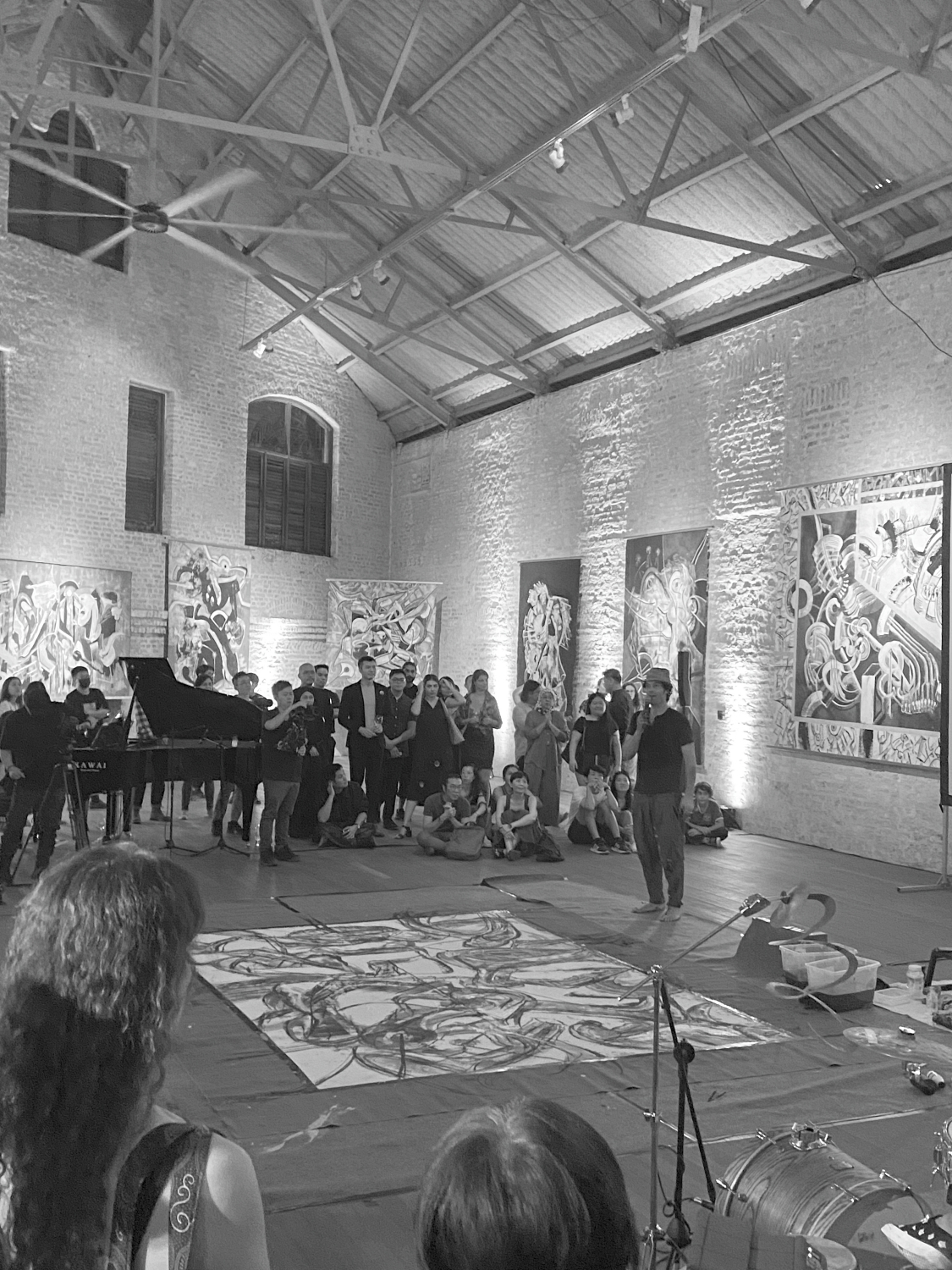
In October 2022, he conducted a performance in collaboration with classical pianist Mei Lin Hii and jazz drummer John Thomas. On the opening night of Black Works, the trio came together once again to stage another performance. The performance is an experiment to find the common point between painting and music, bringing together East and West, classical and jazz, and blending the different aspects of art.
Watching the performance is an interesting experience. As the viewer, one is mesmerised, almost trance-like while watching Vaultman move across the canvas, with the sounds of piano and drums playing in the background. At times, it looks like the music is reacting to the painting, while at other times the painting seems to follow the lead of the music. The push and pull between painting and music flows smoothly, one connected with the other. “If the music goes slow, I would go slow. If the music has a lot of energy, I would go to being high energy. It’s like a children’s game. The intention is not for the painting and music to be separate, but to find a connection between them. Mei Lin and John don’t know about painting, and I don’t know about music, but through the performance, we find the connection between us, like going into a vortex, finding the essence of the common trunk between the two expressions.”He explains that during the performance he lets go of his own personal thinking, not putting too much thought and trying to become a puppet. As he gets into it, he feels the rhythm and the nuances in between, and the trio discover what could be produced from it. He shares that with each performance they do it is completely different as they get deeper in understanding each other. “Each time we do it, each time it’s different. It’s magical.” As the audience, it also feels as if one is guided into the vortex and finding our essence within the swirl. The emotions that swell up are unique to each individual, touching and resonating with the art. “Sometimes people would feel something and even cry, I might not know what is it that touched them, but it also means that they are connected with the art on an emotional level.”
Vaultman spends his time between Paris and Kuala Lumpur, living in Malaysia for almost two years. “There’s something really special about Malaysia, I can’t really explain it fully. It’s very easy to talk to people here, and everyone is really friendly. In Europe, especially the big cities, the people are more closed off. If you go up to someone they would say, ‘What do you want, do you want something from me?’ But in Malaysia, the people are much more open. There is a saying in French, la douceur de vivre – the kindness of living. The way of living of Malaysians is very kind. There is no aggressiveness, and it was very surprising for me, and I really enjoyed my stay here.”
In speaking of the local scene, he speaks of the Malaysian art scene being very different from the French scene. “Much of the art scene here is centred around local or Southeast Asian artists, which is very different from France. In France, if you come from another country and you have a special story, they love that because they love new things. Here, if you are a local and you have connections with local stories it’s much more valued.” He thinks that the local art scene is still in its beginnings, which he celebrates, but he also thinks that the local artists should also open up to more exchanges with global artists and look at the global market as he thinks it’s beneficial for them.
Vaultman continues his journey of exploring the connections of the world, but he admits the journey is a lonely one. He expresses that in the past there were schools of art and groups of artists with a shared belief, but contemporary art sees many different artists going in their own directions. He shares that he thinks humanity in general is losing its meaning. Technology is advancing faster than the human brain could catch up, while the constant influx of colourful and flashing information becomes a mind-numbing drug in the form of social media and content. Vaultman wants to bring back meaning into people’s lives. “The first goal of art for me is to have feeling. It can be an aesthetic feeling or a conceptual feeling. To feel something in front of an art, that is the first step to liking it. It’s not a question about knowing the art history or putting this into a global story, but it’s rather something more intimate. This is the magic of art.”
Vaultman hasn’t forgotten his scientific roots and still treats horses from time to time. He is currently in Brazil and spending some time working there. However, this might not be the last that we would see of him as he plans to come back to Malaysia. The connections keep us together, after all.