
Documenting projects and archiving sketches, drawings and models are the typical practice of architecture firms. But it is rare to see firms build an archive of models of another firm’s work. Yet, for RT+Q, it has become a tradition for new staff and interns who come through the office to spend time building a model of Le Corbusier’s work. Building models is no longer just a tool to express an intended design but also to teach makers about scale, form, space beyond drawings. Ar. Rene Tan led the practice of making Corbusier’s built and conceptual works with the aim to familiarise the interns with the Modern Movement; a iconoclast, Le Corbusier. This tradition becomes an opportunity for a travelling exhibition to showcase Le Corbusier’s body of work to visitors in the Southeast Asia region.
In June this year, the Faculty of Built Environment (FAB) and Faculty of Creative Arts (FKA), Universiti Malaya, together with Pertubuhan Akitek Malaysia (PAM), hosted the Le Corbusier exhibi- tions – LC121 Uncovering The Hand: A Journey Through Le Corbusier’s Forms – curated by Ar. Rene Tan. The show was supported by Fondation Le Corbusier and Alliance Francaise Singapore. Altogeth- er there were 12 models exhibited, from the private collection of RT+Q Architects.
HRH Datin Paduka Setia Tengku Zatashah binti Sultan Sharafuddin Idris Shah, President of Alliance Française Kuala Lumpur, inaugurated the exhibition. The exhibition began at the Alliance Française Singapore in October 2021 as part of Singapore Archifest and has since travelled to the National University Singapore (NUS), Singapore University of Technology and Design (SUTD) and NationalDesign Centre (NDC) Singapore.
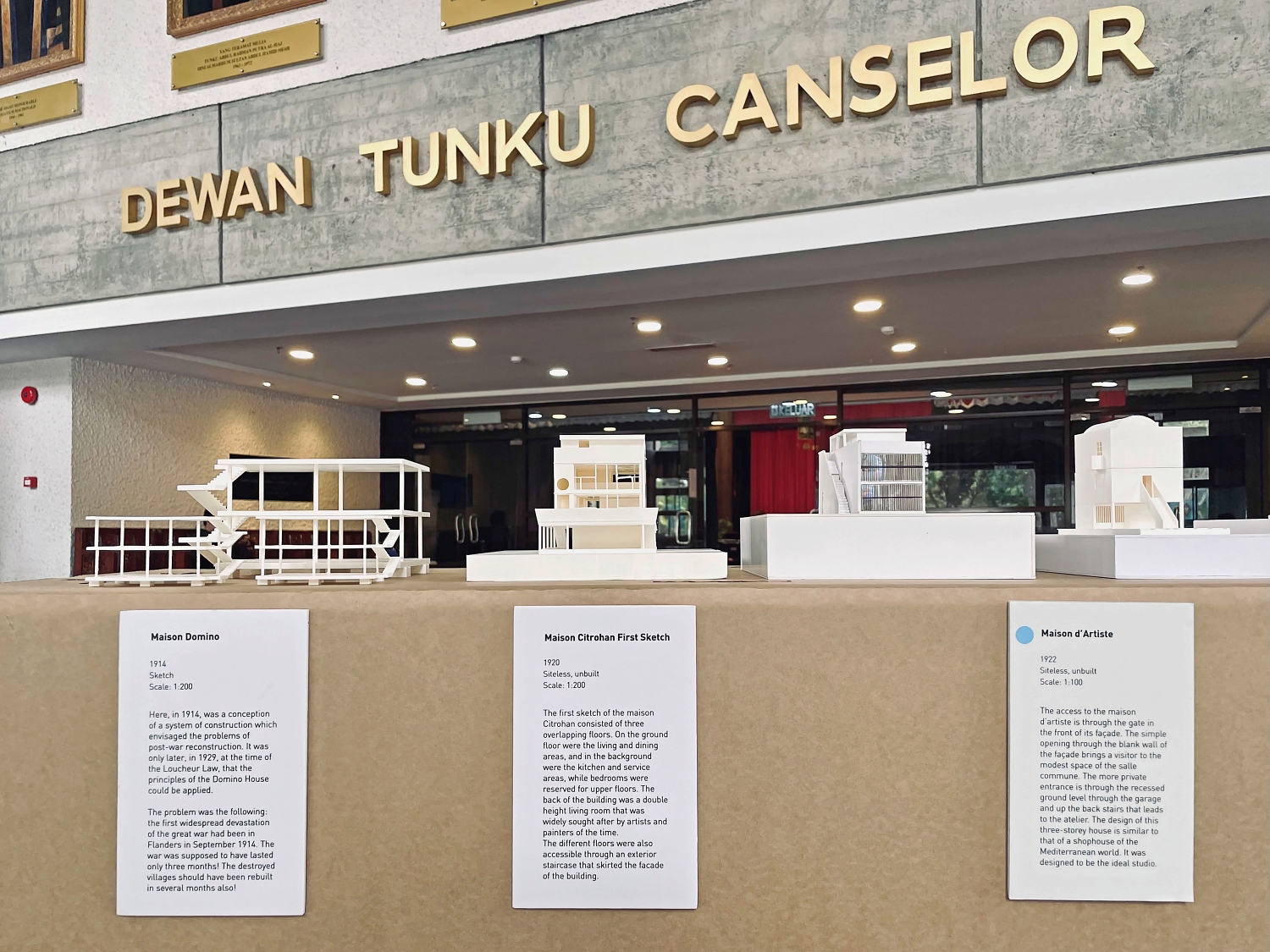
The achievements of Le Corbusier represent a major part of twentieth-century architecture. Held at Dewan Tunku Canselor, the exhibition curated by Ar. Rene Tan allowed visitors to explore the extent of Corbusier’s work.
The Dewan Tunku Canselor at Universiti Malaya is itself an icon. Designed by CHR Bailey of Booty Edwards & Partners (the fore-runner of BEP Akitek), the hall was the country’s first successful application of fair-faced concrete. Brutalist in its style, its foyer is decorated with reinforced concrete louvres angled to exclude sunlight yet providing enough natural lighting to accompany the exhibition. The foyer’s volume also gave visitors a space to reflect on the similar traits inherent between the works displayed and the architecture enveloping them.
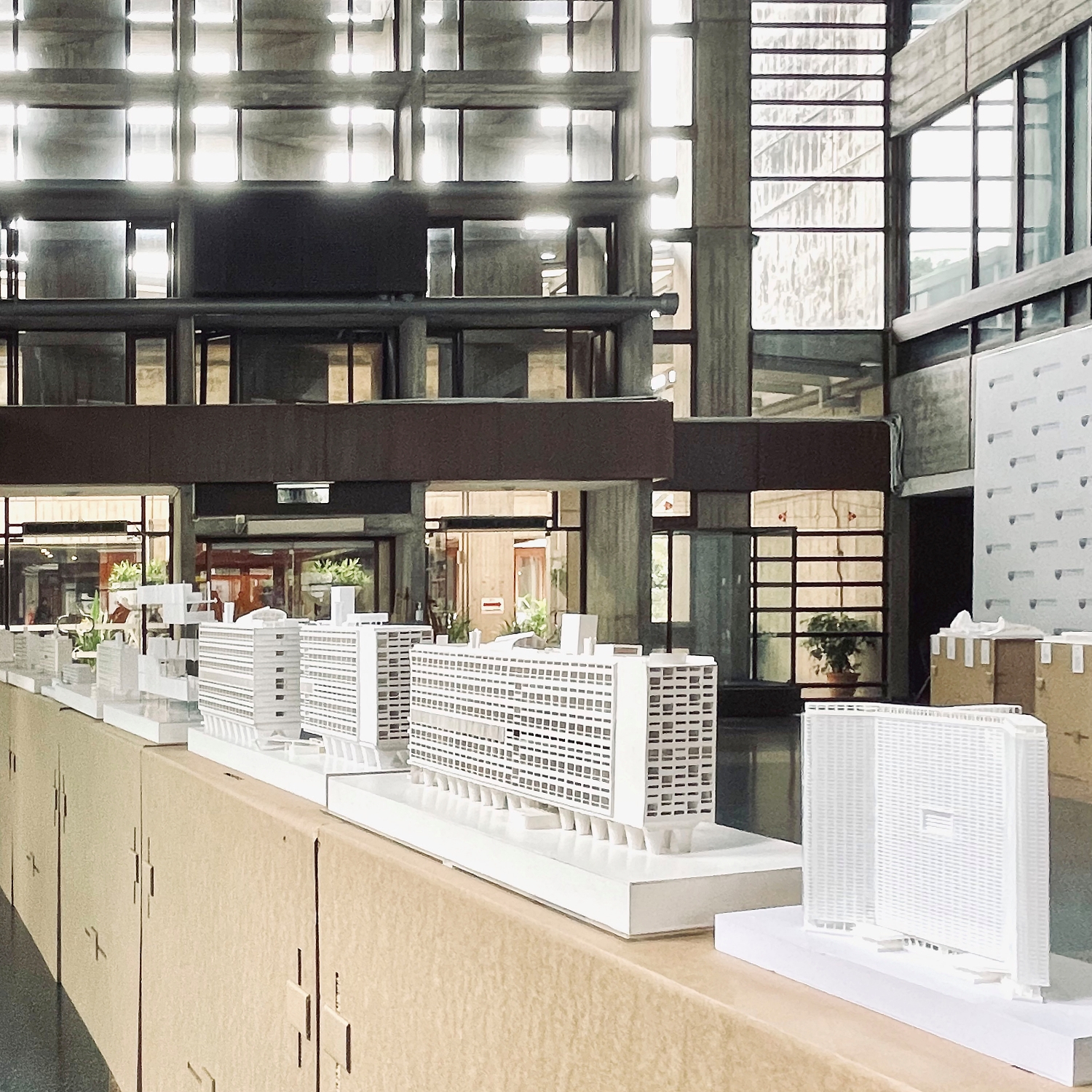
Le Corbusier played a seminal role in the development of 20th Century Modern architecture.The exhibition presented the breadth of Corbusier’s works, from his early dip in the Arts and Crafts-style villas to his more well-known concrete buildings.RT+Q’s models of Le Corbusier’s works were displayed on makeshift board boxes splayed across the foyer.The models were divided into five categories: Institutional & Religion, Single Family Home, Multiple Units Residential, Other Residential and Others.
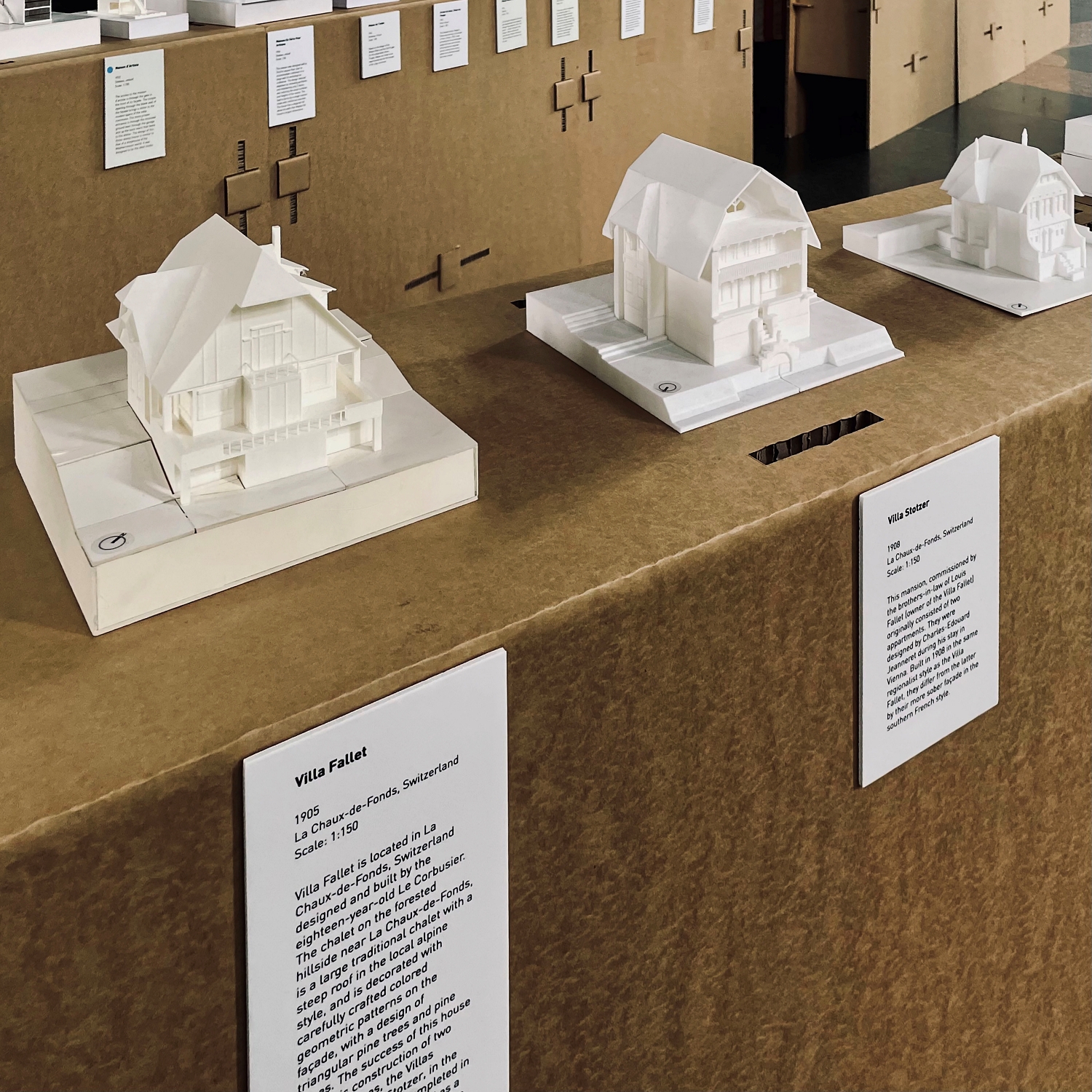
Included in the Single Family Home category were various famous buildings such as the Villa Savoye and the not-so-known Villa Meyer and Villa Terniesien.On display were also his early houses Villa Fallet and Villa Schwob, which were architecturally different from his known modern works.Villa Fallet exposes Corbusier’s dip in the last phases of the Arts and Crafts movement with its apparent Jugendstil manner.The house is a vernacular type, decorated with elements derived from the region’s flora and fauna.His teacher, Charles L’Eplattenier, influenced him at the applied arts school in La Chaux-de-Fonds.
In 1908 Corbusier worked part-time for Auguste Perret, who was already preoccupied with the reinforced concrete structure.Le Corbusier spent fourteen months in Paris, where he ultimately became convinced that beton arme (reinforced concrete) was the material of the future.
The models were divided into five categories: Institutional & Religion, Single Family Home, Multiple Units Residential, Other Residential and OthersRT+Q’s models of Le Corbusier’s works displayed on makeshift board boxesThe Maison Dom-Ino was strategically displayed to represent the ever-present structure underlying many of Le Corbusier’s architecture.Together with his friend Max du Bois, who is also an engineer, they reinterpreted the Hennebique frame as the Maison Dom-Ino.The Dom-Ino prototype was open to different levels of interpretation.On the one hand, it was simply a technical device for production.On the other, it was a play on the word ‘Dom-Ino’ as an industrial patent name, denoting a house as standardised as a domino.According to Kenneth Frampton, Corbusier wished to see the Dom-Ino as a piece of equipment analogous in its form and mode of assembly to a specific part of product design.The Dom-Ino was further developed in the Maison Citrohan, where he would first project his characteristic double-height living space.
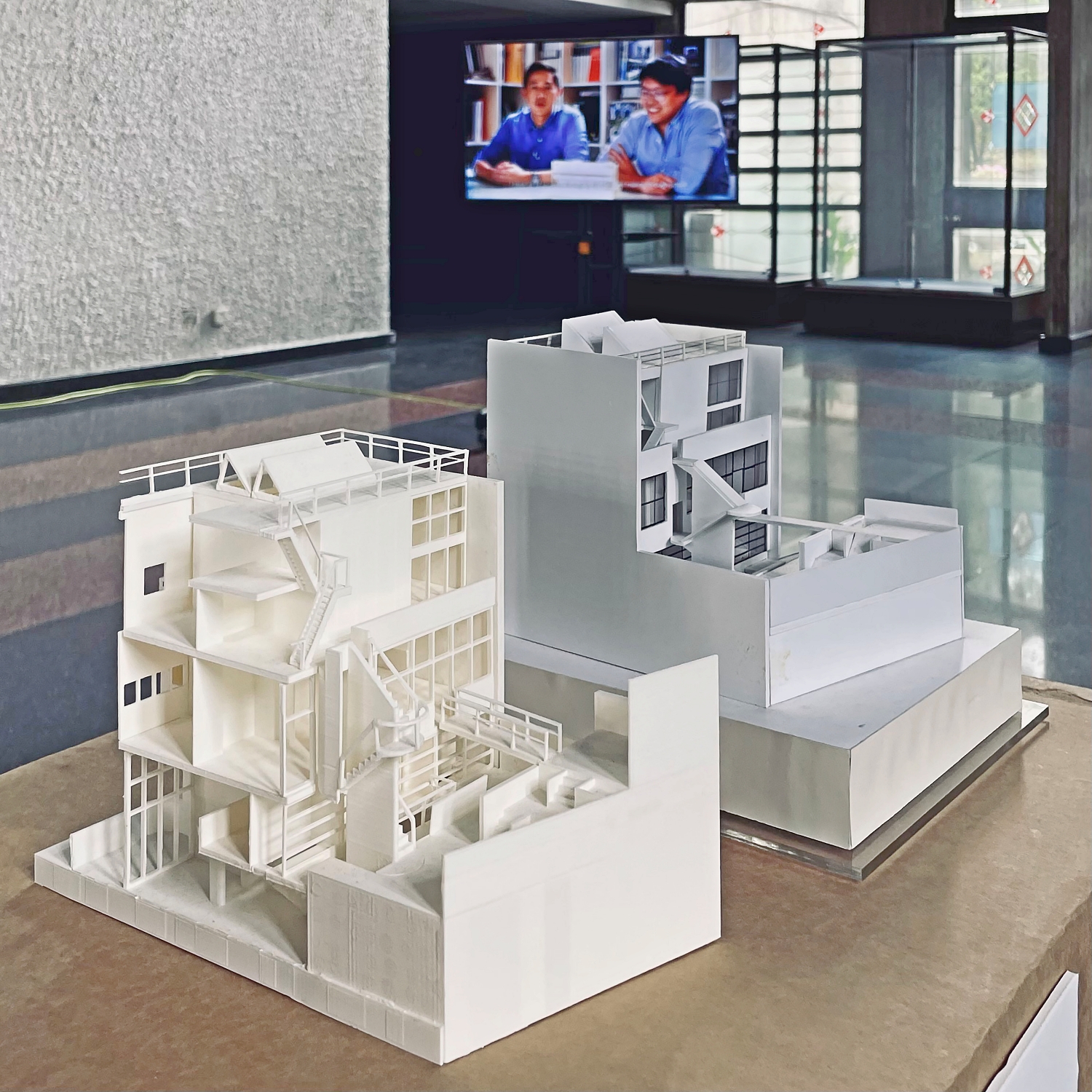
Corbusier travelled to Germany and met major figures of the Deutsche Werkbund, such as Peter Behrens and Heinrich Tessenow.This encounter would influence his designs of Villa Jeanneret in 1912 and Scala Cinema in 1916.The latter was displayed at the exhibition in the Other category with Corbusier’s signature aesthetics – Lesson of Rome – from his book Towards a New Architecture and the Modular Man.
In the Multiple Units Residential category, models displayed included the Ville Radieuse masterplan, his unbuilt Cartesian skyscraper and his Unite d’Habitation typology.The housing series was Corbusier’s attempt to design a communal living with shopping arcades, a roof deck, a running track, a paddling pool, a gymnasium and other amenities.
A variety of Le Corbusier’s known works were displayed under the Institutional & Religion category.His Cartesian approach is apparent in the design of Chandigarh, the new administrative capital of Punjab, India.The flat terrain of Chandigarh allowed him to impose a proportional grid masterplan.Corbusier built three monuments which were derived in direct response to the severity of the climate.Le Corbusier would return to the vernacular in his Ronchamp pilgrimage chapel and the Dominican monastery of La Tourette, built outside Lyons in 1960.
The exhibition managed to cover an extensive view of Le Corbusier’s body of work, giving visitors a glimpse of the Modern Movement which consequently re-shaped the built environment.Even though there is a recent shift in attitudes towards Le Corbusier from a heroic figure to a mere human with nefarious obsession (read: Eileen Gray), the exhibition manages to assert Le Corbusier as an influential figure of the Modern Movement.