In-Person with LEEMAR

LEEMAR - An Artist that Sustains Local Cultures Through Creative Arts
Interview by Ar. Adrianta Aziz & Ar. Dr. Mohd Firrdhaus Mohd Sahabuddin
Insert caption here

LEEMAR – was named one of the top ten best artists in the world by a Chinese international magazine. He is well-known as an acrylic painter who created hundreds of high-quality paintings centred on local cultures. He believes that Malaysian cultures can be preserved and appreciated through the arts from generation to generation. He also carves and is a bonsai artist who has received recognition from both local and international organisations. This article is an in-person interview about his career journey from the beginning to the present. Knowing his principles in the arts and his personal life will inspire readers to recognise that the arts is more than just beauty and aesthetics; they also convey a message of humanity and justice. This is the story of an urban planning graduate who dedicates his life to preserving local cultures through arts.

Could you tell us more about yourself and what motivates you to create art?

L

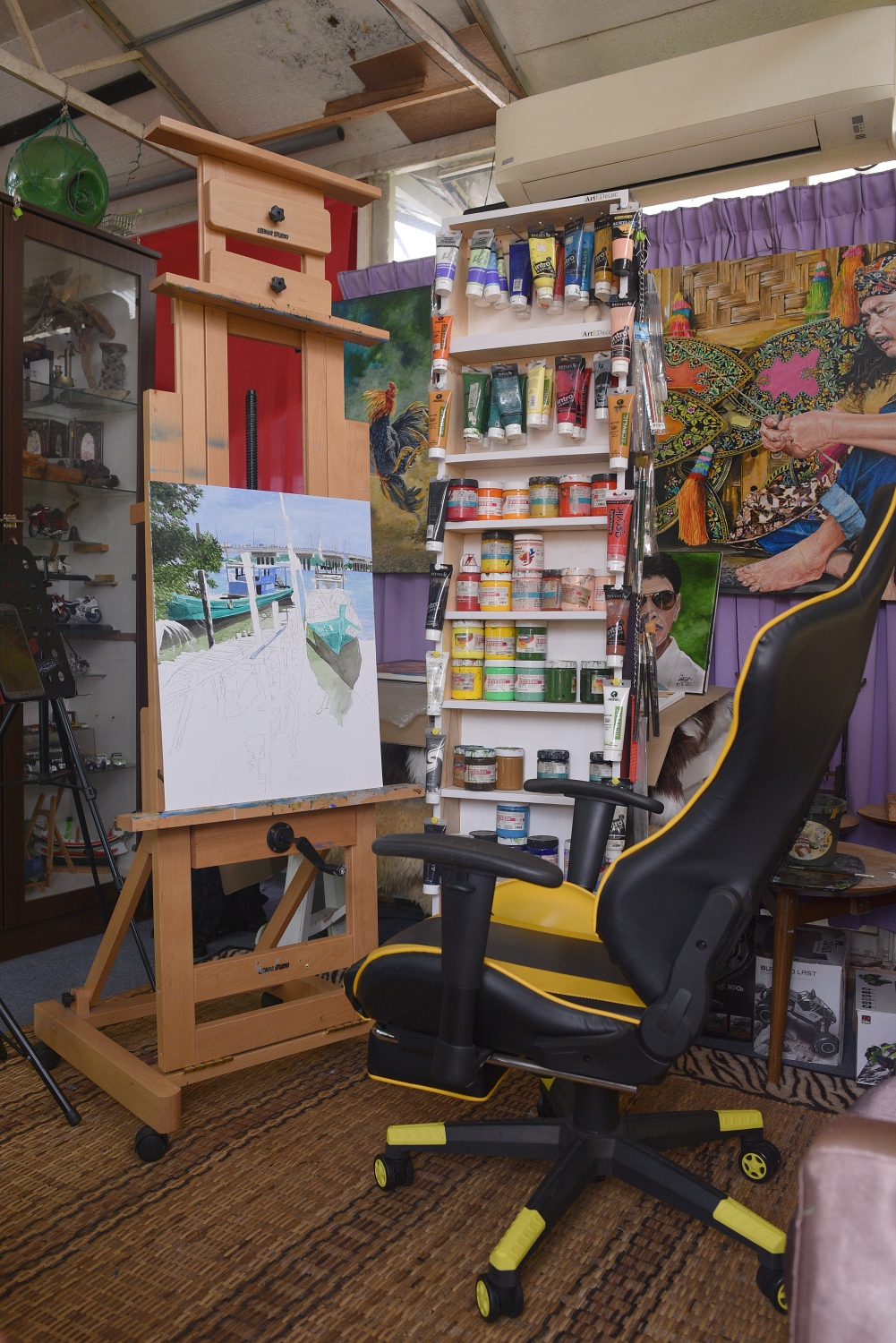
I was born in 1967 in Tumpat, Kelantan. My father was a Keretapi Tanah Melayu officer, stationed in the town before he was transferred to Singapore. He bought a house in Kampung Baru Nelayan; living in that area, I was involved with fishermen and the locals. When I was young, I was exposed to the locals and how they operate the boats, how they trawl, how they go to the sea and many more. I saw these activities on a daily basis, and they inspired me to create several artworks based on them. I built a lot of boat models and drew fishermen boats with carving details. I learned about the proportions and scales of each component of a boat. Everything about the boats is now ingrained in my head, and I can sketch them without relying on photographs.
Tell us about your early education background.

L

I studied Urban Planning in Universiti Teknologi Malaysia (UTM) in Skudai, Johor Bahru. I was exposed to the urban environment earlier when my father worked in Singapore. I examined the surrounding landscape, as well as the shoplot and its operations. I felt that these were unique and interesting. I applied for an architecture course at the beginning but was not accepted. I was really interested in architecture especially traditional and heritage. Then I was accepted into UTM’s Urban Design course. It worked out great – in fact, Urban Design is a wider scope. The concentration of an architect is more on buildings, whereas the scope of Urban Design is far broader. During my study, I did my solo exhibition at the Faculty of Built Environment, UTM. I was a planner student, but I did my solo art exhibition there.
Insert caption here

When did you start to do paintings seriously?

L
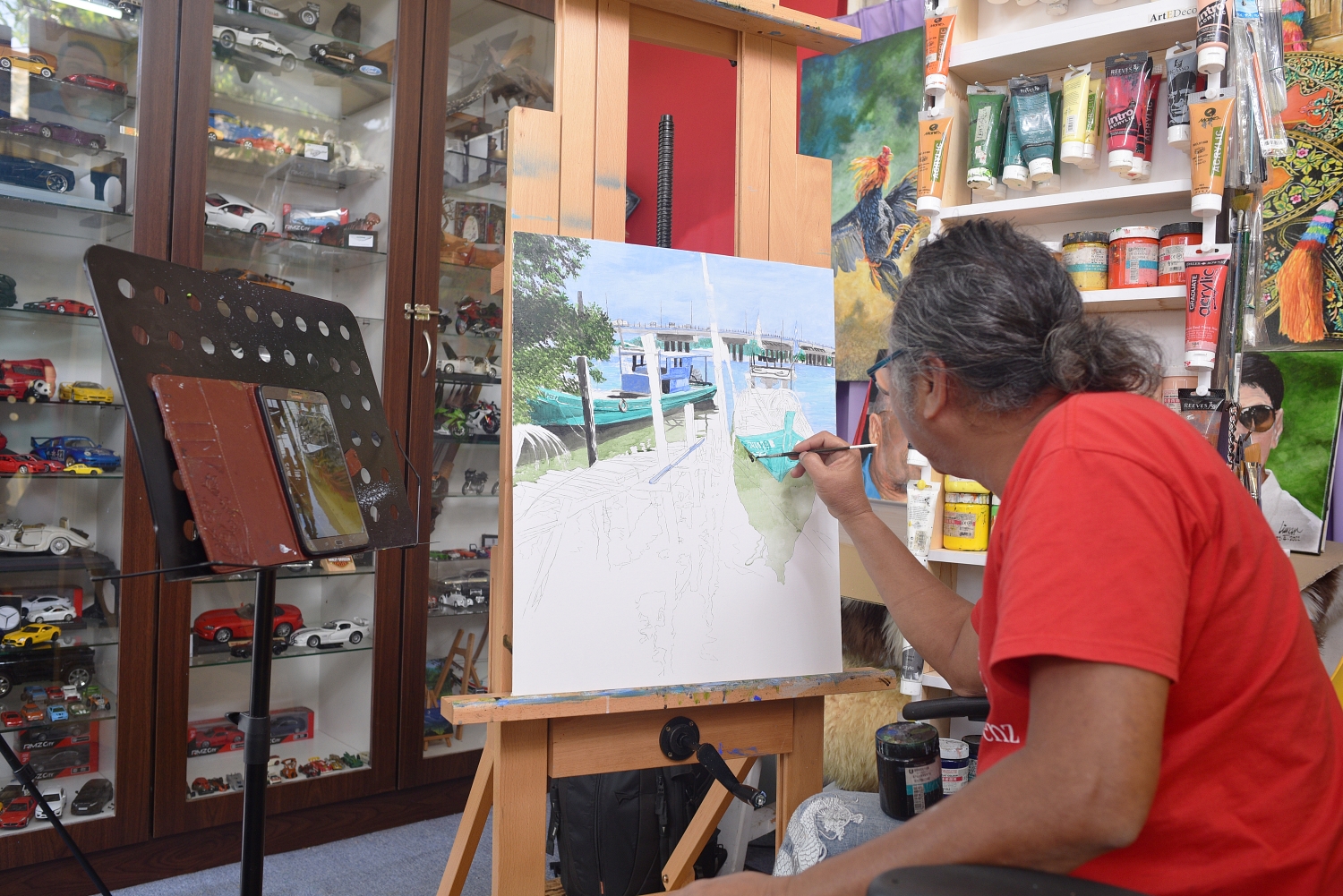
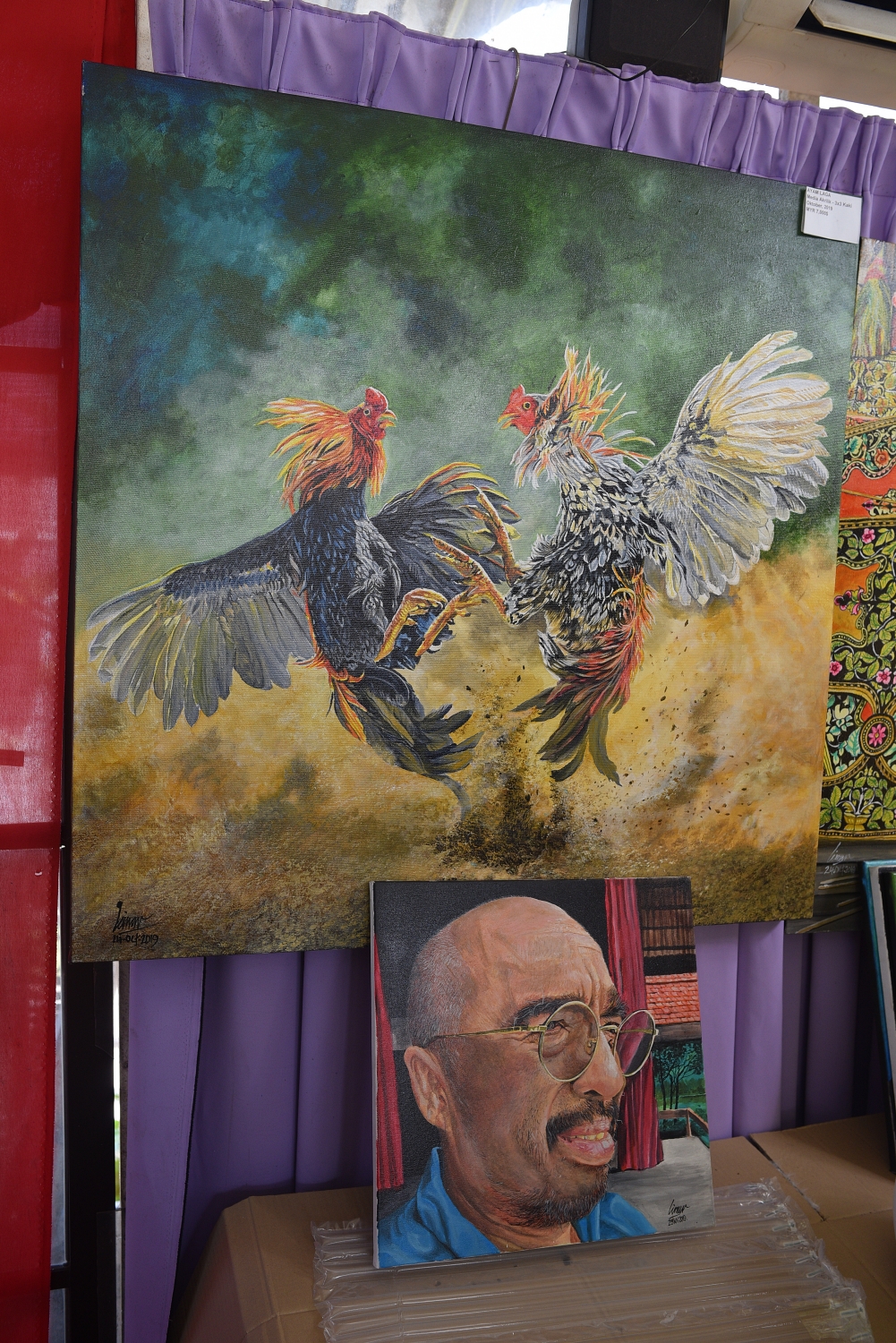
I started to sell paintings when I was 13 years old. When I was 17 years old, my first painting was exhibited at Kota Bharu Art Gallery. Then I produced several other paintings for Royal Pahang as well. I have also painted murals at people’s houses. Just simple sceneries, very simple which are not as detailed as today. This means that I had informal training since I was a kid. During SPM, I started making realistic drawings, meaning that the fishes all already looked very real.
Insert caption here
What type of paint media do you like to use?

L

Paintings in oil and acrylic are my favourites. I do both, therefore I am well-versed in all methods. Everything is in, including the pens, pencils, colourings, shadows, wash, and so on, from a technical perspective. As a result, when I use acrylic as a medium, it is in between a wash and a solid colour. That is why I can complete a painting in a short period. Some individuals are still having trouble with proportion and scaling, but I am not one of them because that is my profession, and I am quick to merge the two.
What inspired you to become an artist? Who was your inspirational figure?

L

When I was a kid, there was a Punjabi man who was good at drawing. I looked at his drawings and they were amazing. One of his paintings was an underwater world scenery in A3 size, just a small painting. I asked to buy it from him, but he refused. Since then, I told myself, “I can do better than you” and started to focus on sharpening my skills in painting. Up till now, I am still in contact with that man. I do many other artworks too, not only painting. I do bonsai art, stone art and carving as well.

What do you feel as an artist and the recognition you receive?

L

“Oh Allah, Oh Lord”, some of my prayers, “Grant me your highest success at the hereafter and the highest success in the world”. Meaning that I only want the highest. So, to get to the highest, it is very difficult. For the hereafter, we need to donate more. We should donate every day even though it is just small, just donate. In terms of the world, we should develop our skills. We cannot just do paintings only. We should be good at everything. If you become an architect, you are good at it, but can you build your design on your own? No, you cannot. That is my motivation. I try my best to fully equip my skills in my field. I can design, I can do 3D, I can do animation, I can do SketchUp and all including 3D rendering. So, we need to be good at many skills, that is what I hold on to. My art is my motivation with discipline and passion, Insha Allah we will achieve the best.
Insert caption here
How do you cope with COVID-19 pandemic challenges?

L

Just be thankful for what you have, because whatever that we have is not permanent. So, we must be thankful for whatever we have, so give to those who are in need. The main concept is Alhamdulillah, always remember that. By doing so, we won’t feel proud of ourselves. We won’t feel arrogant. We know we will not live forever. If we have more money, we better donate it to those who are in need. I sold a lot of my paintings, I will make sure that some percentage I have received is for these people. Maybe because of ‘being thankful’, during the COVID-19 pandemic I sold 58 paintings while others can’t even sell one painting. This fortune is not for me but everyone else. The more we give, the more we will get. The most important thing is we are happy, mentally, and physically.
What is your daily routine?

L

wake up before Subuh prayer every day to worship Allah. I give it all out. That is the best time to worship. Once the Azan is announced, I pray. After Subuh, I will read supplication (wirid) and then go to the fish tank and feed the fishes, these are all living creatures. After that, I go to the farm straight away and see what I can do. At 8:00am I go out with my wife to buy some breakfast for the family. When we get back home, I perform my dhuha prayer. Then, I continue painting around 11:00am and 12:00 noon and if I need to fulfil orders, I will start early. I will paint until 6:00pm but not beyond that. During Maghrib prayer, sometimes I go to musolla. If not, I will just stay at home with my family, look at the fishes. Night time is just to rest my mind.
What is your hope in doing these artworks?

L

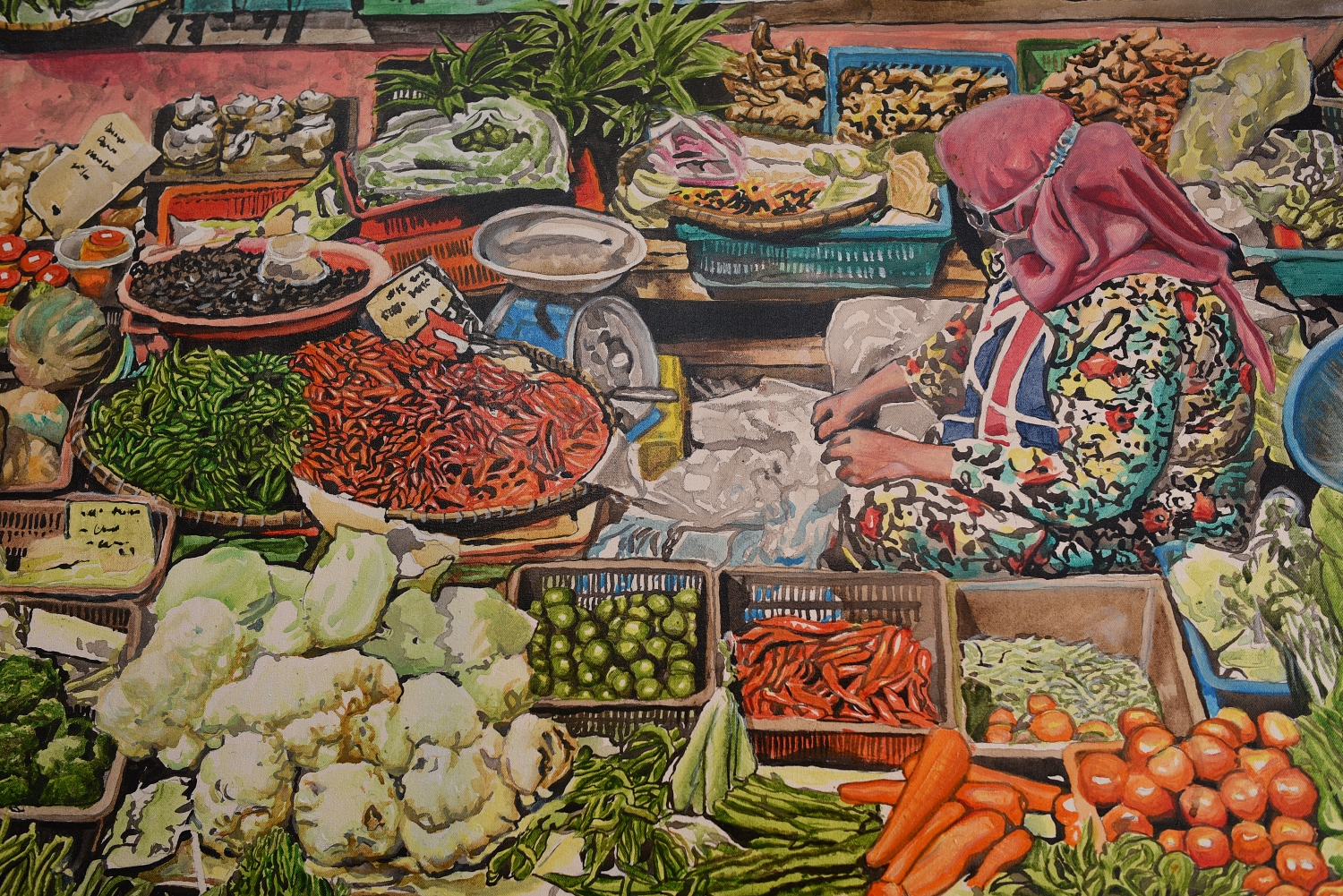
I like to paint things that are related to our cultures and sceneries. If I die tomorrow, these arts will be our heritage. Future generations can see it as their ancestral heritage. For example, they will know what their ancestor’s boats looked like from my paintings. These arts can preserve our civilisation. We do our part in preserving our cultures through our skills in arts. Someone will buy these artworks because they appreciate them. Later when the culture is gone, bit by bit it will be remembered again. How? From these paintings.
How do you relate your paintings with architecture?

L

As in our field, we try to tackle our heritage. For instance, the Malay house. We know of Malay houses, but what type of Malay house? Is it a limas house, is it Perak cut or is it Dutch cut? Like shop houses, many artists paint shop houses but what type of architecture is that? Maybe they don’t know. At least, I paint something authentic to our culture. Something of our architecture which is 100 years or maybe more than 200 years old. These paintings will show the house’s authenticity. So, we know that an authentic Malay house has these types of detail on it. I do sketch images to highlight things that I want to preserve. I have skills, so I use them to highlight that specific thing, not everything.
What do you want to tell our young generation about our culture?

L

We were once civilised, right? We had bigger ships, about ten times than that of the Dutch and Portuguese. Who we were? People and colonisers took our culture, they copied it and brought it back to their homeland. We were moving backwards; they were moving forward. What happened to our civilisation? We were civilised, right? A long time ago in South-East Asia, people did not build cannons yet, but we had them already. It shows how advanced our technology was. Our civilisation started to expand, but with our own mistakes, the civilisation fell just like many other empires before. Including Islam, once became so great, but it also fell, right? That is why Islam encourages us to be moderate. We can be rich but do not forget to be kind.
What do you want to show more to the world about the identity of Malaysia?

L

I am pleased to call myself a Malaysian. That is what I am clinging onto. I am proud to be a Malaysian. I held an exhibition in Paris and transported everything there. If I hold an exhibition in Australia, I will bring Malaysia’s identity to the country. I am unconcerned about others, but I will contribute to everything that our culture entails. As a result, I carry the Malaysian identity with me everywhere I go. Like this lovely boat painting, it was created and adorned entirely with wood on the island of Pulau Gajah. Fibreglass is now used in other boats. I sketch about our culture and take it with me everywhere I go. Yes, I am pleased to call myself a Malaysian.

In the coming future, what more do you feel you want to promote, what kind of identity?

L

Yes, I would like to promote batik, keris, wau (traditional kites), and other traditional Malaysian textiles. Each of them has its own set of values. Before we promote them, we need to get to know them. Yes, you must study first, so that when people ask what sampir, seruling, or pendongkok is, we would be able to explain it. I have a collection of keris. The most special is ‘Keris Nusantara’, a combination of arts of Keris from Malaysia, Indonesia and Thailand. The only one in South-East Asia.
Nowadays, sustainability is the current trend of any development. What do you understand about sustainability?

L

For example, a house, right? You have trees, so oxygen helps to cool down the house. When there is a tree, birds will come, and many types of birds come and fly. So, the squirrels move away. So, the word sustain is not to be said at the global scale only, but we must experience it in our house first, only then do we go wider. If you do not sustain it at home, do you expect to sustain it outside? You can’t, right? It is not balanced. So, it should start with yourself first. So, do not throw things that can still be used, take them back and collect them. Yes, recycle it back. Meaning that these things will not become rubbish. Meaning that when we think about the word sustain, it does not mean that we have to look outside to sustain it. We should start with ourselves first. For example, a fish tank needs a complete ecosystem. Sustainability is a complete system, I depend on you, you depend on them, and they depend on us back. Sustainability is a cycle, like a symbiosis. That is why I like the aquarium. I do not need to change the water in my aquariums for many years because the ecosystem in the tanks sustains it. They have no water filter. Amazing, right? Like ourselves, we also have values that we need to sustain. Like our culture, of course.
What do see as your role in our society?

L

Painting is no longer a passion for me; instead, it is my profession. This job entails a significant amount of responsibility on my part, as I wish to promote Malaysia to the rest of the globe. Yes, it is my obligation to preserve our civilisation, to preserve our local traditions through the arts.

FEATURES

RELATED ARTICLES